Diversity settings for apartment blocks and ADMD standard norms

I'm looking at calculating a total diversified load for a small apartment block. Using Table A2 in the OSG i am able to get the majority of the diversity settings however does anyone know of any standard norms when it comes to diversity considering the amount of apartments. Say for example the total diversified load per apartment is 50A and there is 8 apartments. Technically you would need a 400A capable supply to feed these apartments however this doesn't take into account that not all apartments will be drawing their maximum load at any one time.

I have come across a french standard  NFC14-100 which gives correction factors depending on the amount of apartments you have. Estimation of actual maximum kVA demand - Electrical Installation Guide

Does anyone know of anything similar in British standards or standard norms used by the DNO for this?

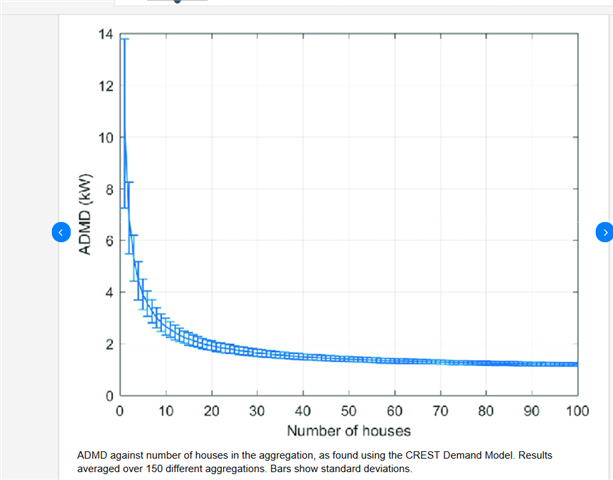
  • DNOs don't use the on-site guide (!)  As you note, results for a shared supply to many properties is quite distinct from the supply to any one property, as it becomes increasingly safe to assume that they are never all on at once long enough to heat anything to a dangerous level.

    Network planning assumptions do vary a bit across the regions but for example SPEN puts theirs on-line as an excel spreadsheet.  

    https://www.spenergynetworks.co.uk/pages/admd_calculator.aspx

    A study by the University of Loughborough produced the CREST demand model, which is another approach. 

    https://repository.lboro.ac.uk/articles/dataset/CREST_Demand_Model_v2_0/2001129 , and there are some nice graphs from it when modified by home solar and battery storage in this paper by some chaps at Leeds. https://www.researchgate.net/publication/324141791_The_potential_for_peak_shaving_on_low_voltage_distribution_networks_using_electricity_storage


    It is an interesting area, and not simple. 
    Mike

  • Most of the DNOs have documents that show how they calculate demand/diversity - e.g. https://www.northernpowergrid.com/sites/default/files/assets/IMP001911_0.pdf - table 5 and surrounding text might be of interest for example.

    DNO figures tend to look rather low to BS 7671 eyes - but should give you an idea at least.

       - Andy.

  • The traditional 2KW per dwelling (see the graph in the post by mapj1) assumes gas central heating.

    If these new apartments all have heat pumps and car chargers, then you need to allow for that. 

  • For information, I was involved in the installation (NOT design!) of 4 blocks of 70 new build flats. A mixed of 1 & 2 bed, 3kW of heaters in the 1 bed, 5kW in the 2 bed, all had a 3kW immersion, a 2kW oven and 3kW hob. So potentially around 9kW load for each flat when everything is on, obviously for a shortish period until the stats kicked in.

    The trouble was, the incoming fuses were 3x 100amp to each block. And the immersions were on a timer. As is typical, the immersion timers were commissioned, and left exactly as they left the factory, so at 6am each morning, all 280 immersions would come on, giving a 300amp surge on each phase in each block. We'd arrive at 7.30, to find no power to each of the blocks. After the third time this happened, (it took out a transformer fuse one time) it dawned on the site Management that 3x 100 amps fuses were not going to be enough. So they were changed to 200 amps (the cable from the cutouts to the panel board in each block was, luckily, big enough). We had 3 weeks of non-tripping, however, I brought up that we hadn't turned on the heating, or ran the cookers simultaneously yet, so should we do that?  They said no, as "It'll be fine now".

    I was off site the following week, so didn't find out how it fared when people were living there.

    I'd be going for 25amps per flat if electric water/heating, 16-20A for gas heating. 

  • And the immersions were on a timer.

    What poor design! So somebody who gets up at 05:50 might have had a cool shower. Had the immersions been on constantly, I feel sure that diversity would have worked.

    Even if you had fan heaters, the 'stats would have opened and closed independently. And yes, the cookers might all go on at around 18:30, but not every hotplate all at once.

    Say for example the total diversified load per apartment is 50A and there is 8 apartments.
    I'd be going for 25amps per flat if electric water/heating, 16-20A for gas heating. 

    70 flats at 3 x 100 A is a little over 4 A per flat, and (obviously) 8 A on 200 A fuses.

    3kW of heaters in the 1 bed, 5kW in the 2 bed

    An extra 2 kW is a lot for a bedroom - just put more blankets on the bed. Seriously, the heat loss from a modern small apartment should be well under 3 - 5 kW.

    If you know the heat loss at an indoor temperature of 20°C, does that not give a reasonable estimate of after diversity heating load? Granted some people may leave the heating off during the working day, but they do not turn it back on at exactly the same time.

  • An extra 2 kW is a lot for a bedroom - just put more blankets on the bed. Seriously, the heat loss from a modern small apartment should be well under 3 - 5 kW.

     The 3 or 5kW was for the whole flat. The 2 bed ones were bigger overall, plus had the extra bedroom.

    What poor design! So somebody who gets up at 05:50 might have had a cool shower. Had the immersions been on constantly, I feel sure that diversity would have worked.

    Well yes, but no instructions were given to whoever commissioned them, so they were all set for the same time, then left for the (eventual) Renter to adjust the timing.

    70 flats at 3 x 100 A is a little over 4 A per flat, and (obviously) 8 A on 200 A fuses.

    Yes, that's why the fuses popped! I don't think it is enough, that's why I said 16A+ per flat. This was before anyone moved in, when they did move in, the heaters and appliances would be on, 8A per flat is looking a little small to me.

  • DNO figures tend to look rather low to BS 7671 eyes - but should give you an idea at least.

    The reason for this, is that in general for the electrical installation, we need to design for safe surface temperatures of cables (not applicable most of the time to DNO cables as they are buried or placed out of reach), and conductor temperatures of 70 deg C to match the thermal conditions for equipment terminals.

  • The 15 minute or 30 minute values for MD used by the DNO are not always suitable to size fuses, switchgear/controlgear assemblies and cables for an electrical installation to BS 7671.

  • values for MD used by the DNO are not always suitable to size fuses, switchgear/controlgear assemblies and cables for an electrical installation to BS 7671

    Indeed, and the corollary is also true, that BS7671 methodology is not really suitable or applicable to the design of large distribution networks supplying unsynchronised loads and at power levels where items like transformers and switchgear have thermal time constants of several hours; and a far more nuanced understanding is needed.

    It's not clear if the OPs query falls into that situation or not.

    The example above of the immersion heaters is amusing - the cheaper fix would have been to randomise the timer settings but it also highlights the problem of a coherent load step versus a random noise-like one (to borrow some terms from the signal processing folk) - and things that accidentally drive group behaviour, like a large group all getting home off the same train, or all staying up late to watch the same football match, tend to break the assumption of randomness , and can cause a very large peak-to-mean variation in demand. Its the difference between kids splashing about incoherently in the pool and synchronising their kicking to produce one big wave.

    The saving grace is that the peaks for cooking and so on are normally short compared to the thermal response time of the larger circuit elements like substations.

    Mike

  • It should also be noted that the supply industry is pushing consumers to synchronise changes in demand through various forms of dynamic pricing.

    To take the immersion heater example, if the flats were such that Economy 7 was the best tariff then there would almost certainly be a similar surge at whatever the E7 switch on time was.  Meters with switching elements try to ameliorate the effect on the transmission network by incorporating different delays  between notional E7 tariff start time and switching element operation across the meter population but this doesn't help in the distribution network as once switched on an immersion heater is probably going to be running for several hours.

    Similarly, most electric car chargers incorporate a random delay in switching if they have been set up in a timed operation mode.