Automatic Transfer Switching - Dual Supplies - Neutral Earthing

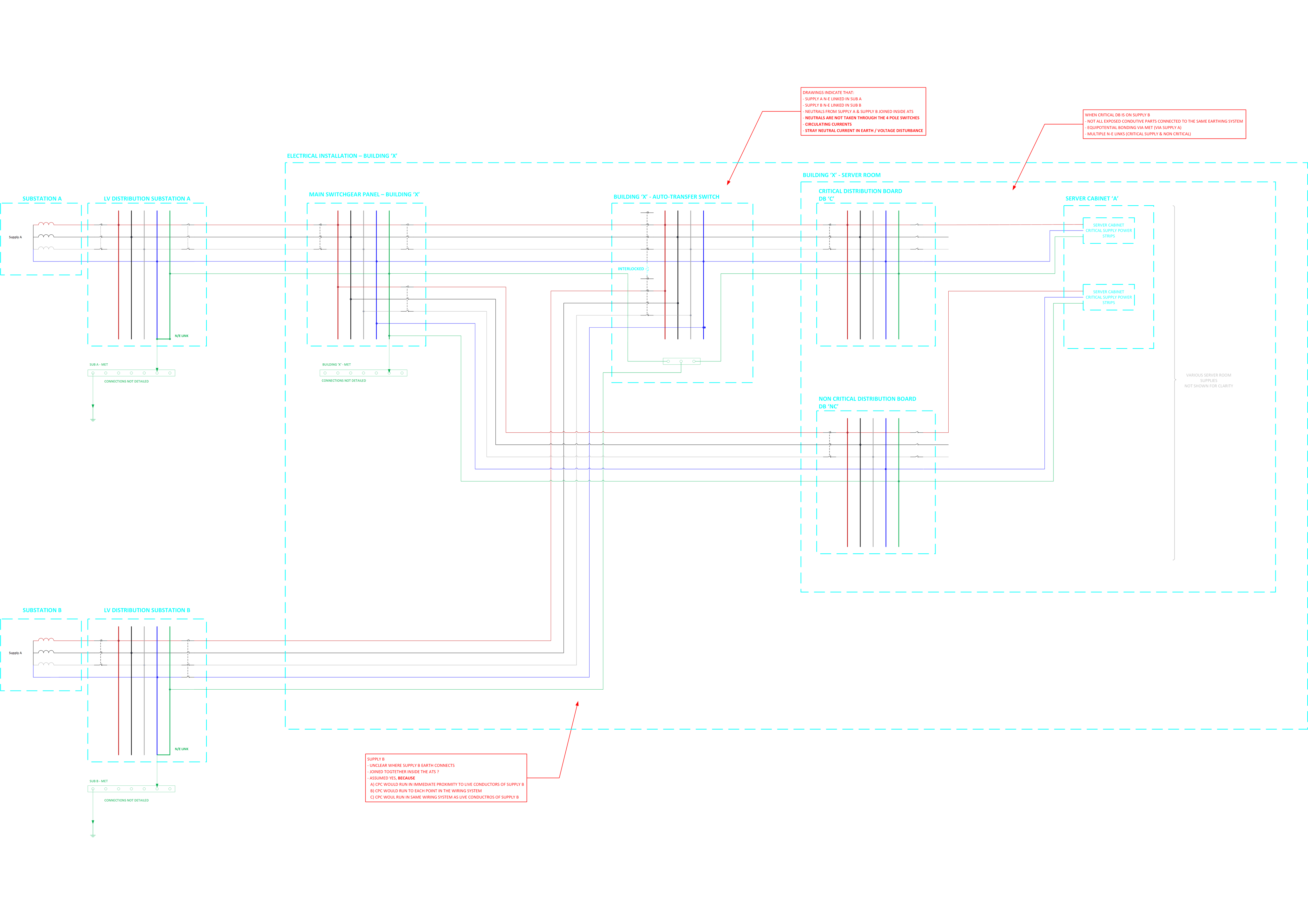
I am inheriting an existing design to review (the installation has been completed for a number of years).

The installation is fed from a main supply "Supply A (from Sub A) and supply A N-E link is in the upstream LV substation.

The installation has a server room with a critical distribution board, the critical DB is fed from an automatic transfer switch

  • The ATS is fed by two supplies
  • One supply to the ATS is derived from Supply A
  • The other supply to the ATS is derived from another supply "Supply B (from Sub B)"
  • Supply B N-E link is in the upstream LV substation.
  • The neutrals of supply A and supply B are connected together in the ATS
  • The ATS changeover switch uses 3 pole breakers (neutrals are not switched)
  • Inside the server room there is a mix of 1) Equipment supplied by supply A non critical and 2) Equipment supplied by supply B critical
  • The ATS appears to have 4 pole changeover switches but only 3 of the poles are used (neutral not switched) 

Please see attached sketch for the five wire diagrams

To my mind there is a lot to be desired about this but I want to double check my thinking by running it past the community:

  1. Two N-E links present
  2. Neutrals linked inside the installation
  3. Not all exposed conductive parts connected to the same earthing system (supply A and supply B)?
  4. Circulating currents and voltage disturbance
  5. Stray neutral currents flowing to earth
  6. Issues with protection
  7. Etc.

What are your thoughts?

Thanks

Richard

/resized-image/__size/14034x14034/__key/communityserver-discussions-components-files/4/WIring-Regulations-_2D00_-Protective-Measures-ADS-and-Earthing-Conductors.png

Parents
  • I can sort of understand a reluctance to switch Ns on 3-phase systems - especially those with a number of single-phase loads - as any imperfection in timing that results in N open when two or more lines are connected, even momentarily, can lead to severe overvoltages (e.g. 400V being presented to 230V equipment) - which tends not to end well. Probably even more of a worry with switch-mode power supplies, as N currents are even less likely to cancel nicely.

    The belt and braces approach is to open the lines, verify they have all opened correctly, then open N, the close the N of the secondary supply, verify that that's happened OK and only then connect the lines of the secondary supply. Maybe your ATS does that, maybe it doesn't. Even if it does, that might result is a much longer transfer time ... so critical loads probably want a UPS downstream of the ATS as well. There might be an argument for an UPS anyway - relying on a 2nd feed alone for critical loads is a bit "old hat" these days - I'm fairly certain it's no longer a recognised approach for safety-critical systems. All the data centres I've been to in recent years have their own backup generators (and UPSs to cover the generator startup).

    Not all exposed conductive parts connected to the same earthing system (supply A and supply B)?

    The two supply PEs look to be solidly connected together - so we've sort of got one earthing system common to both supplies (perhaps not unlike the situation where bonded metallic water or gas mains cross between substation boundaries - which doesn't seem to cause problems in practice).  Conductors between the supplies and thee common point would have to be appropriately sized of course (something akin to main bonding perhaps).

    Etc.

    If I was feeling particularly argumentative, I might observe the N on one supply would carry some of the earth fault currents associated with the other .. which might be interpreted as combining neutral and earthing (protective) functions in a single conductor within a consumer's installation ... which is prohibited (by law) in the UK by the Electricity Safety, Quality & Continuity Regulations (https://www.legislation.gov.uk/uksi/2002/2665/pdfs/uksi_20022665_en.pdf) reg 8(4).

      - Andy.

Reply
  • I can sort of understand a reluctance to switch Ns on 3-phase systems - especially those with a number of single-phase loads - as any imperfection in timing that results in N open when two or more lines are connected, even momentarily, can lead to severe overvoltages (e.g. 400V being presented to 230V equipment) - which tends not to end well. Probably even more of a worry with switch-mode power supplies, as N currents are even less likely to cancel nicely.

    The belt and braces approach is to open the lines, verify they have all opened correctly, then open N, the close the N of the secondary supply, verify that that's happened OK and only then connect the lines of the secondary supply. Maybe your ATS does that, maybe it doesn't. Even if it does, that might result is a much longer transfer time ... so critical loads probably want a UPS downstream of the ATS as well. There might be an argument for an UPS anyway - relying on a 2nd feed alone for critical loads is a bit "old hat" these days - I'm fairly certain it's no longer a recognised approach for safety-critical systems. All the data centres I've been to in recent years have their own backup generators (and UPSs to cover the generator startup).

    Not all exposed conductive parts connected to the same earthing system (supply A and supply B)?

    The two supply PEs look to be solidly connected together - so we've sort of got one earthing system common to both supplies (perhaps not unlike the situation where bonded metallic water or gas mains cross between substation boundaries - which doesn't seem to cause problems in practice).  Conductors between the supplies and thee common point would have to be appropriately sized of course (something akin to main bonding perhaps).

    Etc.

    If I was feeling particularly argumentative, I might observe the N on one supply would carry some of the earth fault currents associated with the other .. which might be interpreted as combining neutral and earthing (protective) functions in a single conductor within a consumer's installation ... which is prohibited (by law) in the UK by the Electricity Safety, Quality & Continuity Regulations (https://www.legislation.gov.uk/uksi/2002/2665/pdfs/uksi_20022665_en.pdf) reg 8(4).

      - Andy.

Children
No Data