Earth Loop Test

Our ground floor extension has 7x 12v Halogen with the necessary 240v to 12v transformers on a circuit from the wall switch. I would like to upgrade to integrated LED lamps. I understand that if I am competent, I can exchange the fittings and still be within the Building Regs rules. The new LED lamps (Collingwood H2 Lite CSP) need an earth connection.

The existing round 5A junction boxes have an in and out for the circuit (1mm twin and earth) and a feed to the transformer for each light (the transformer doesn't require an earth connection).

To verify the earth connection, I have removed the junction box and transformer for the lamp at the end of the circuit, and temporarily connected a 13A 3 pin socket and I have plugged in a KewTech Loopcheck 07. The KewTech reports all the connections are present, (so earth is connected for the circuit), but it is saying "Check loop test" because it has detected a safety earth path between 1.80 ohms and 92 ohms. 

If I plug the Kewtech into a proper 13A power circuit, it reports everything is OK.

My questions

a) Could the 240v / 12v transformers that are before the Kewtech cause an impedance issue?

b) Could one of the junction boxes have a non perfect connection and therefore cause an impedance issue?

c) Is the use of the Kewtech on a lighting circuit a valid test?

I could move the temporary 13A socket to the start of the circuit, not connect the outgoing circuit and use the Kewtech at that point. If it said everything was OK, I could work around each lamp until the Kewtech complains. 

Alternatively, I could look at a solution that doesn't need an earth connection but since the Kewtech has found an issue, it would sit in the back of my mind. 

Thank you


  • like seatbelts. You may never need one, but... 

    Well to be fair, one might place fuses and MCBs into the same category

    A few years ago now there was a post on here where someone had a CU that had been mis-assembled so that the MCBs did nothing at all, so it was all in effect directly across the incoming main, and it had apparently worked like that for years. No nuisance trips mind you ! 
    Mike

  • Which sort of begs the question of who is it intended for - I could make you a DIY grade one with 2 neons and an RCD test  push button with a BOM cost of about £5-£10 and this is far too pricy for that market segment, yet rules itself out of the professional league.

    M.

  • The story goes that the first socket tester was made by a plumber who lived in Cheltenham, whose hobby was electronics, using a plug, some neons and resistors, and that where he went wrong was selling the design outright to a test equipment manufacturer instead of taking a royalty off each one sold.

  • PS these are a fun thing for those who enjoy the warmth of a real fire in the living room, given that a 13A plug gets pretty warm above 10A already.

    Yes ... BS 1363-2 doesn't cover ratings above 13 A; having said that, if the fuse were to otherwise align with the standard, the dissipation at the rated current of the fuse is limited to 1 W. so the fuse itself ought not to contribute as much to the heat; however, pulling more current through of course will cause products to overheat.

  • What that Megger socket tester does, that installation testers do not do, is measure harmonics to the 49th.

  • has replaced the fuse with some studding or threads of a bolt of a similar diameter

    A chum of mine turned up a very neat little brass bar to the exact dimensions of a BS 1362 fuse when he got fed up with his compressor blowing them on start-up. One might argue that it is little different from fitting a BS 60309 plug and socket.

  • Got one of them; hand made, probably 45 years old.Still detects the occasional loose earth (double socket, end of a long spur; now a proper ring with electricians cert!)

    Plus a baby light in soothing orange neon in a plastic shield protruding from cable grip.

    Grimacing

  • One might argue that it is little different from fitting a BS 60309 plug and socket.

    I don't see too much problem on a 16 A or 20 A radial, as with standard socket-outlet circuits in many EU countries ...  but on a 32 A ring final, of course things can go wrong.

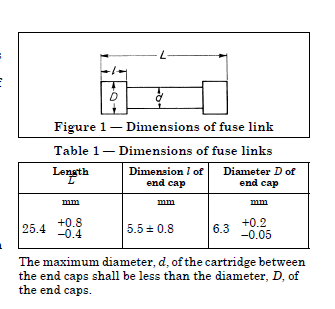
    A chum of mine turned up a very neat little brass bar to the exact dimensions of a BS 1362 fuse

    Cutting an inch of 6.3 mm nominal diameter brass bar often measures up very well when you get the calipers out, as I've done myself for some lab tests on samples of products intended for BS 1362 fuses. From Clause 5.8 of BS 1362:

  • One of my lady customers had a Karcher commercial pressure washer that was blowing the 13-amp fuses, the motor needed a capacitor replacing, once it had a new motor capacitors she didn’t have anymore issues with it.