Who is responsible for non compliantbev install

EICR on 3 year old house thats a rental property. C2 because ev charger is sharing an rcd with other circuits in a split load board.Complied with how many organisations interpreted the regulations at the time of design.

No.high integrity ways available, only practical solution is replace the board or additional board for the ev charge point. Could consider rebuilding the internals of the existing cu, but still time consuming and fairly expensive.

Just generally interested in how the as long as it complied at the time approach works.

Who is responsible for the costs?

Parents
  • Complied with how many organisations interpreted the regulations at the time of design.

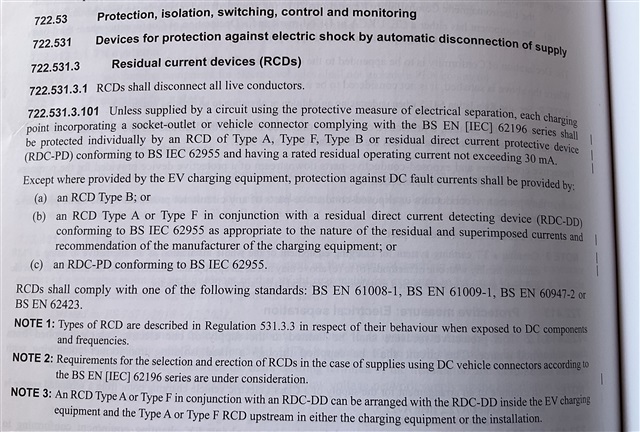
    A leading and well respected member of this forum commented on LinkedIn that although electricians can choose to use either the brown third amendment book or the orange fourth amendment book up until the 15th October 2026 for new installations and alterations to existing installations, all EICRs should be prepared using the orange amendment four book, because they have to be prepared to the latest available edition and amendment of The Wiring Regulations BS 7671:2018:Amendment 4:2026.

    There are several minor amendments in the orange book to 722.531.3.101 as identified by the lines in the right hand margin.

  • But as I read it,nothing in there prohibits and additional RCD upstream shared with other circuits (if that's what we have here). Not exactly ideal design perhaps to have two 30mA devices but lack of selectivity is hardly a C2.

       - Andy.

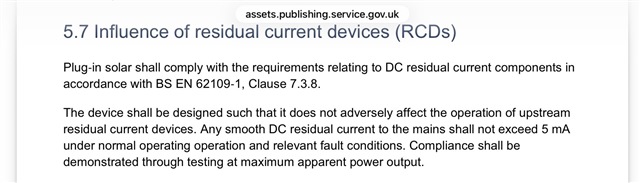
  • What about the effect of the cumulative DC leakage from several circuits jamming the upfront RCD?

    If the EVSE has 5 mA DC leakage it will not trip the RCD-DD, add another 5mA from other circuits and there will be a total of 10 mA of DC leakage, will the upfront Type A RCD in the split load consumer unit still work?

  • What about the effect of the cumulative DC leakage from several circuits jamming the upfront RCD?

    As far as I'm aware, d.c. leakage from "ordinary" circuits isn't a significant concern - otherwise we'd have worried about a single 30mA A-type supplying multiple ordinary circuits or even multiple electronic appliances. I suspect the main worry about d.c. residual currents comes from faults rather than normal usage - and the chances of multiple faults existing at the same time must be small (mostly we ignore multiple faults anyway). EVs are a bit of an oddity - not least because of their habit of sending currents through the N-PE loop to check earthing and together with a few other items (e.g. battery storage and inverters) the availability of a large source of d.c. current.

      - Andy.

Reply
  • What about the effect of the cumulative DC leakage from several circuits jamming the upfront RCD?

    As far as I'm aware, d.c. leakage from "ordinary" circuits isn't a significant concern - otherwise we'd have worried about a single 30mA A-type supplying multiple ordinary circuits or even multiple electronic appliances. I suspect the main worry about d.c. residual currents comes from faults rather than normal usage - and the chances of multiple faults existing at the same time must be small (mostly we ignore multiple faults anyway). EVs are a bit of an oddity - not least because of their habit of sending currents through the N-PE loop to check earthing and together with a few other items (e.g. battery storage and inverters) the availability of a large source of d.c. current.

      - Andy.

Children
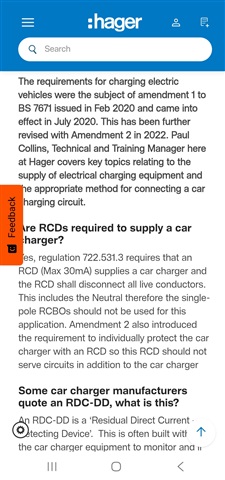
  • Throw in typical manufacturers guidance from the time of installation such as this from Hager.

    "Amendment 2 also introduced the requirement to individually protect the car charger with an RCD so this RCD should not serve circuits in addition to the car charger".

    hager.com/.../ev-charging-and-rcds

  • Throw in typical manufacturers guidance from the time of installation such as this from Hager.

    "Amendment 2 also introduced the requirement to individually protect the car charger with an RCD so this RCD should not serve circuits in addition to the car charger". "This RCD may be also supplying other circuits within the house which could then be affected or in some cases blinded by any DC that may be coming from the car. These other circuits then may not have any residual current protection, the consequences of which could be severe.".

    hager.com/.../ev-charging-and-rcds

  • This RCD may be also supplying other circuits within the house which could then be affected or in some cases blinded by any DC that may be coming from the car. These other circuits then may not have any residual current protection,

    Hence my questions about whether the EVSE contained its own RCD (most do these days I gather), whether CU RCD was an AC or A types and whether the EVSE provided 6mA d.c. protection.

    I'm all for simple robust solutions (e.g. don't use shared RCDs for EVSE, or even don't use split load CUs) but that's not the same as saying doing so a C2.

       - Andy. 

  • As far as I'm aware, d.c. leakage from "ordinary" circuits isn't a significant concern - otherwise we'd have worried about a single 30mA A-type supplying multiple ordinary circuits or even multiple electronic appliances.

  • Fair point. I guess out idea of "ordinary circuits" will have to change come Sept... in the meantime though.

       - Andy.