Have your say on the Electrician’s Guide to Domestic Electric Vehicle Charging Equipment Installation

The Draft for Public Consultation (DPC) is available for the IET’s Electrician’s Guide to Domestic Electric Vehicle Charging Equipment Installation. This is your opportunity to review the draft and provide feedback to help ensure the publication meets the needs of electricians, designers, installers and other professionals working with electric vehicle (EV) charging equipment. 

As EVs become increasingly common across the UK, the demand for safe, and compliant charging installations continues to grow. This guide has been developed to provide practical guidance on the selection, design, installation and certification of domestic EV charging equipment, helping practitioners navigate the technical and regulatory requirements associated with this rapidly evolving sector. 

What the guide covers 

The draft publication provides a comprehensive overview of domestic EV charging installations, including: 

  • The various EV charging modes and types of charging equipment 
  • Relevant regulations, standards and key sources of information 
  • Assessment considerations before system design and installation 
  • Methods of electrical protection and earthing 
  • Domestic and small commercial installation design, including control devices, circuit design and cabling 
  • Certification and documentation requirements 

Bringing together essential technical guidance and industry best practice, the guide is intended to support both experienced electricians and those new to EV charging installations. 

Why your input matters 

The DPC provides an opportunity for industry professionals to help shape a practical and authoritative resource for the electrical sector. Whether you are involved in EV charger installation, inspection and testing, electrical design, training or compliance, your feedback can help ensure the guidance remains relevant, accurate and aligned with current industry practice. 

Your comments will help strengthen the final publication, supporting safer installations and promoting consistency across the growing EV charging market. 

Visit the website to find out more and submit your comments by 21 August 2026: https://spkl.io/600073To0

Parents
  • It makes a lot of training courses, qualifications and manufactures installation instructions look unfit for purpose.

  • Anyone remember being told this on a training course?

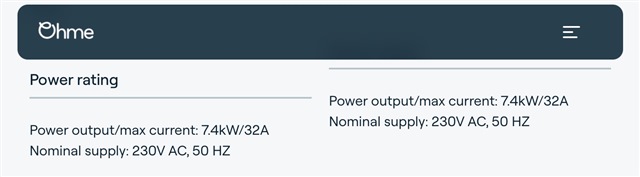
    One set of manufacturers instructions says use a B32 circuit protective device for 7.0 kW EVSE, whilst the same manufacturer says in another set of instructions for another of their 7.0 kW EVSE units that the CPD has to be rated at 120% of the design current which I presume is 7000/207=33.816 amps, so the a B32 will be overloaded and really the circuit should be protected by a B45 MCB or RCBO as 33.816x120%= 40.6 amps, as a minimum it seems that it requires a B40 device.

  • Anyone remember being told this on a training course?

    EVs were not common when I trained.

    However, I take the point.

    Table 4D5 tells us that 4 mm2 T&E can manage 37 A clipped direct (on a garage wall?), but if you go for a 40 A MCB (or RCBO) you now need 6 mm2.

    Similarly, singles in conduit are on the borderline at 4 mm2

    So is the takehome message that you need to wire your EVCP in 6 mm2 cable?

  • Who installs 7.4 kW EVSEs? I though the maximum standard rating was 7.2 kW.

  • Hi,

    As per my comment in the "Electricians in the real world" thread my understanding is that AC EV charging is a constant current load, not constant power.

    I suspect that since the EV load is 32A then the argument will be that with the added load of the EVSE itself (a whole 25mA?) plus the fact that it is suboptimal to run domestic MCBs continuously at their rating, a 40A MCB / RCBO is the better choice.

  • Hi

    EVSE is switchgear, not a load.  Providing you are operating it within its voltage rating then usually the interesting parameter for switchgear is its current rating.  We don't rate CUs in kW so I'm not sure why we do that for EVSE.

  • As per my comment in the "Electricians in the real world" thread my understanding is that AC EV charging is a constant current load, not constant power.

    Yes, that is also my understanding. If correct, it needs someone to respond on the DPC form. 

  • Interesting point. However a lot of the regs try to take a 'simplified view' [rather than a let's over complicate this view], which leaves many making assumptions about how loads are to be assessed.

    Plus, as you say, the EVSE isn't a load, but the EV behind it is a load, and the confusion is over the way the wiring to the EVSE should be selected and spec'd, especially when others keep following the 'loads are in kW' primary expectation...

Reply
  • Interesting point. However a lot of the regs try to take a 'simplified view' [rather than a let's over complicate this view], which leaves many making assumptions about how loads are to be assessed.

    Plus, as you say, the EVSE isn't a load, but the EV behind it is a load, and the confusion is over the way the wiring to the EVSE should be selected and spec'd, especially when others keep following the 'loads are in kW' primary expectation...

Children
No Data