Have your say on the Electrician’s Guide to Domestic Electric Vehicle Charging Equipment Installation

The Draft for Public Consultation (DPC) is available for the IET’s Electrician’s Guide to Domestic Electric Vehicle Charging Equipment Installation. This is your opportunity to review the draft and provide feedback to help ensure the publication meets the needs of electricians, designers, installers and other professionals working with electric vehicle (EV) charging equipment. 

As EVs become increasingly common across the UK, the demand for safe, and compliant charging installations continues to grow. This guide has been developed to provide practical guidance on the selection, design, installation and certification of domestic EV charging equipment, helping practitioners navigate the technical and regulatory requirements associated with this rapidly evolving sector. 

What the guide covers 

The draft publication provides a comprehensive overview of domestic EV charging installations, including: 

  • The various EV charging modes and types of charging equipment 
  • Relevant regulations, standards and key sources of information 
  • Assessment considerations before system design and installation 
  • Methods of electrical protection and earthing 
  • Domestic and small commercial installation design, including control devices, circuit design and cabling 
  • Certification and documentation requirements 

Bringing together essential technical guidance and industry best practice, the guide is intended to support both experienced electricians and those new to EV charging installations. 

Why your input matters 

The DPC provides an opportunity for industry professionals to help shape a practical and authoritative resource for the electrical sector. Whether you are involved in EV charger installation, inspection and testing, electrical design, training or compliance, your feedback can help ensure the guidance remains relevant, accurate and aligned with current industry practice. 

Your comments will help strengthen the final publication, supporting safer installations and promoting consistency across the growing EV charging market. 

Visit the website to find out more and submit your comments by 21 August 2026: https://spkl.io/600073To0

  • Hi

    EVSE is switchgear, not a load.  Providing you are operating it within its voltage rating then usually the interesting parameter for switchgear is its current rating.  We don't rate CUs in kW so I'm not sure why we do that for EVSE.

  • As per my comment in the "Electricians in the real world" thread my understanding is that AC EV charging is a constant current load, not constant power.

    Yes, that is also my understanding. If correct, it needs someone to respond on the DPC form. 

  • Interesting point. However a lot of the regs try to take a 'simplified view' [rather than a let's over complicate this view], which leaves many making assumptions about how loads are to be assessed.

    Plus, as you say, the EVSE isn't a load, but the EV behind it is a load, and the confusion is over the way the wiring to the EVSE should be selected and spec'd, especially when others keep following the 'loads are in kW' primary expectation...

  • It would be much clearer if it just said that using either a rewirable or cartridge fuse does not meet the requirements of BS7671:2018:Amd.4 Regulation 722.533.101, so doing so is a non-compliance.

    That wouldn't be entirely true though - cartridge fuses, which used to be BS 1361 and are now BS 88-3 do comply with BS EN 60269 series ... BS 88 and 60269 are identical - "dual numbered" as they say. https://www.lawsonfuses.com/bs-88-vs-iec-60269-are-they-the-same-standard/

    I'm not sure what the objection to BS 3036s is though ... I doubt the charge point itself will rely on the upstream device for overload protection as it already has loads of systems to limit what the EV can draw.

      - Andy. 

  • but if you go for a 40 A MCB (or RCBO) you now need 6 mm2.

    Not necessarily - it's still permitted to handle overload and faults separately - if the EVSE provides overload protection, the cable still need only be sized for 32A provided it's c.s.a. has enough withstand for the B40 fault clearance (54000 A²s for a 6kA device - or just over 2mm² Cu for k=115). (double check the c.p.c. though if T&E)

       - Andy.

  • If correct, it needs someone to respond on the DPC form. 

    Good call. I've already sent my response last night (and hadn't noticed that) ... any volunteers?

       - Andy.

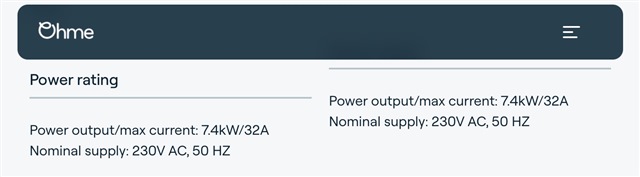
  • We don't rate CUs in kW so I'm not sure why we do that for EVSE.

    Probably a consumer/marketing thing. EV owners will know their EV batttery capacity in kWh, so it's simpler for them if the charge rate is in kW - e.g. 72kWh EV and 7.2kW charger = 10 hours for a full charge.

    Who installs 7.4 kW EVSEs? I though the maximum standard rating was 7.2 kW.

    I guess it's a bit like showers - it all depends on the voltage you assume  ... 32A is 7.68kW at 240V, 7.4kW at 230V and 7.2kW 225V (presuming PF=1) - allowing 5V v.d. within the installation probably isn't unrealistic.

       - Andy.

  • I have only had a cursory skim, but I am not sure about the assessment of Ipf for 3-phase, page 110/111 and appendix F. Seems to use line to line calculation rather than the simultaneous fault all three phases. 
    Also has commercial and industrial checklist, which seems odd for a book aimed at domestic installers. I noted at least one grammar error, can’t recall where.

    From my experience, there will be few coalface contractors who will be waiting with bated breath for this unwieldy tome and even less who will be able to follow the design process set out therein. As I have often said, contractors are not mathematicians. I do not mean to be disparaging in any way, but it is painfully obvious that during my 2391 classes even a simple revision of Ohm’s law initiates glazed looks. 

    It might be nice to think that electricians could confidently and accurately design long hand as set out in the book, but if cable design is as critical in domestic premises as suggested, I think I would prefer to see it run through a proprietary program. 

  • BS 88 and 60269 are identical

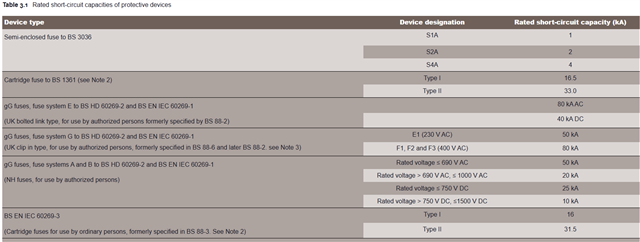
    That's only true to a point. BS 88 as it used to be  is not directly equivalent to the same part in IEC 60269 series today., and BS 88 as it was at the last dual numbered edition (for parts that have not fully transitioned to BS EN IEC 60269-x yet. So, for example

    BS 88-6 'clip-in' fuses for use by authorised persons became incorporated into BS 88-2, and currently the UK clip-in type are now gG fuses, fuse system G, to BS HD 60269-2 and BS EN IEC 60269-1.

    It also doesn't mean that fuses to earlier versions of BS 88 will have the same characteristic as an equivalent device today, as improvements have been made to the standard.

    Following clips are from Table 3.1 of the  IET Guidance Note 6 :