Guidance for plug in solar for Electricians

We are now a few days from plug in solar being legal. The likes of Martin Lewis is recommending people should ask an electrician to check their installation before plugging a solar system in.

I have seen various comments referring back to changes in the law and changes to the specification for a 13A plug.

But I haven't seen any guidance from IET, NAPIT or NICEIC for electricians stating under what conditions it's acceptable to plug one of these systems in.

Personally as it stands today based on what I have seen I would not be willing to say iny installation is acceptable unless it was a single socket on it's own circuit protected by a bidirectional type A RCBO. Which I am sure isn't what the government wants.

Have I missed something, is something in the pipline?

I know lots of people will just do it, but in those situations I am not responsible.

Parents
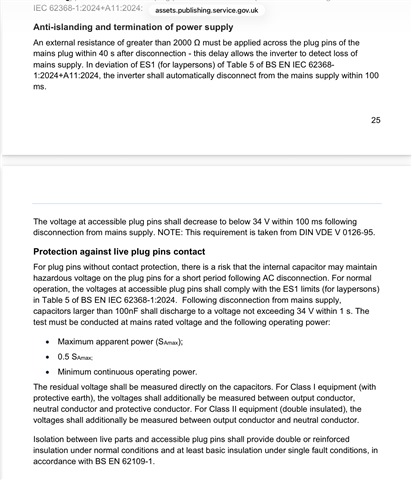
  • The Department for Energy Security and Net Zero (2026) have produced a product specification (Plug-in Solar Device Interim Product Specification Version 2.0, July 2026) which outlines the requirements for the PV panels and the respective electrical installation. It's probably a good starting place to have a review of that document.

  • That does not make sense. Why a resistor? Surely with a loss of supply the anti islanding should kick in and turn off the inverter? 

    JP

  • When I was at college doing the C&G2360 Part Two we had a workshop lecturer who did his apprenticeship in a carpet factory and then worked for the MEB and the companies that took over as the local DNO until he retired and was persuaded to come and teach us practical skills in the college workshop.

    He advised us that having carried out the safe isolation procedures to prove an installation or circuit “dead” that we should then put our insulated long nose pliers or something similar across the terminals as a final test, as to quote him “it's better to sacrifice your long nose pliers than your fingers”.

    The resistor in the plug in PV to prove dead is a test as simple and as unsophisticated as shoving your long nose pliers across the pins of the plug in PV 13-amp plug when you pull it out of the socket, it should not be necessary, but it’s a very good idea as it may stop you or someone else getting injured.

  • Forty seconds.

    assets.publishing.service.gov.uk/.../plug-in-solar-final-_interim-product-specification.pdf

  • Yes, that's the document I quoted from. Where did 40 seconds come from? It seems an awfully long time when we typically think of disconnection within 5 seconds.

    But , reading it again, it requires the resistor to be in place 40 s AFTER disconnection. So it will disconnect, then within 40 s a resistor will bridge the terminals so there is no chance of any charged components backfeeding the plug.

  • But, presumably the resistor will still be in place when the mains supply is restored and the system is reenergised?

  • “it's better to sacrifice your long nose pliers than your fingers”.

    Yes, I was advised similar, turn  it off, verify it then allow it to bleed downs and then short it out.

    (The teaching acronym was SIDE = Switch off load, Isolate supply, slow Discharge, connect to Earth)

    If you are mistaken or even just in a hurry,  but ideally if they are not your pliers, you can combine isolation,  making dead and then proving into one easy manoeuvre ! I keep some cutters with a bit missing out of the jaws that I keep to remind me not to be an idiot. 

    In a large system with lots of circuits and similar cable sizes, mistakes do occasionally occur.
     
    The London Underground have a similarly scary dead-certain process that require dropping a metal bar between the rails, before certain types of work can take place, where the instructions insist the user turns away before the bar makes contact, presumably as basting the backside of a pair of company-issue poly-cotton or flannel trousers in a shower of hot metal bits is greatly preferable to the hospital treatment for injuries to face and arms, and it is a cheap procedural habit to teach.
    Mike.

  • I fear that is partly a German to English translation issue.


    In VDE 0126 -95: 2025 as part of the testing, after removal from the supply, a  resistor of any value at least 2000 ohms is connected  back across the exposed pins of the plug, and this is listed as one of a set of actions to test that the inverter does not try to restart when there is no grid, but there may or may not be connected low current resistive loads or  worse a person in parallel.

    It does seems a bit odd to cherry pick parts of a test in this way without the rest of the explanation and other tests.

    The VDE standard stipulates that, following a grid disconnection 
    (e.g., due to a power outage or voltage faults), a photovoltaic inverter
    must continuously monitor the public grid for a period of at least
    20 to 60 seconds (with the standard setting being 40 seconds).
    The inverter is permitted to automatically reconnect
    only once the grid has remained
    (imagine this says within tolerance and - MAPJ1)
    absolutely stable throughout this period.

    Mike

  • I fear that is partly a German to English translation issue.

    The whole document appears to have been translated by AI.

    The resistor in the plug in PV to prove dead is a test as simple and as unsophisticated as shoving your long nose pliers across the pins of the plug in PV 13-amp plug when you pull it out of the socket, it should not be necessary, but it’s a very good idea as it may stop you or someone else getting injured.

    I feel sure that the resistor is part of type-testing and that there is no intention that purchasers should short out the pins every time that they remove the plug from the socket.

    What might be wise is to switch the socket off and wait a short while before removing the plug.

  • That is all very nice but what I would like to know what time it takes for the inverter output voltage to fall to zero on not seeing the grid?

    Then I can add that time to the operating time of the RCD in the  event of a circuit fault to earth to verify that is an acceptable time for protection against shock?

    JP

  • appears to have been translated by AI.

    I was being charitable - I think they could have done with a German speaker (ideally native) on the team . 

Reply Children
No Data