


Kindly share your comments and experience on the application of AFDD on electrical distribution system.
Is it proven on enhancing electrical safety and is it worthwhile on the additional cost involved ?
Kindly share your comments and experience on the application of AFDD on electrical distribution system.
Is it proven on enhancing electrical safety and is it worthwhile on the additional cost involved ?
Is it proven on enhancing electrical safety and is it worthwhile on the additional cost involved ?
To the best of my knowledge, the UK does not record fire safety statistics for electrical installations to an appropriately granular level to assess this properly.

Hi Gkenyon!
Thank you so much for your kind response.
In Hong Kong, we are preparing to use AFDD on a wider scale but we find it difficult to justify the very high cost involved.
I would suggest that some universities in the UK or other countries will carry out research on the justification of application of AFDD in collaboration with the major manufacturers of AFDD.

I would suggest that some universities in the UK or other countries will carry out research on the justification of application of AFDD in collaboration with the major manufacturers of AFDD.
If there is a driver to do so? I have not come across any, but I guess an internet search would reveal any prior or in progress research if you are looking for that?
USA was first to implement, so if there is any data, it would be there.
Its not what you want to read I suspect but a few years ago now a chap from CIBSE did some independent experiments and analysis It seems that his paper has now escaped onto the internet, so I link to it here Arc Fault Devices Are they worth it?
His conclusion was as above that there is not really a lot of evidence. Actually the conclusions are more than equivocal about the claimed 'advantages', and sort of suggests that at best they only detect a very limited range of dangerous situations, (".. verification tests are quite artificial, and there appears a disconnect between BS EN 62606’s verification procedure and real faults..") and comments that in terms of fire safety we'd probably do better replacing PVC with XPLE cable... Apart from that it is a pretty ringing endorsement. Ha !
Mike.

Ideally, a randomised controlled trial is required. So take a new development and randomly assign 50% of dwellings to get AFDD and 50% not.
Then observe. Given the rarity of electrical fires, even with a whole new town, it might take a long time.
If anything less than a randomised controlled trial is performed, it is going to be difficult to exclude obviously biassing factors. So, installations with AFDDs will be newer than those without, the owners/occupants may be more risk averse and use other means to reduce the risk, and so on.
Its not what you want to read I suspect but a few years ago now a chap from CIBSE did some independent experiments and analysis It seems that his paper has now escaped onto the internet, so I link to it here Arc Fault Devices Are they worth it?
Given the current thread debating the merits of the ring final circuit, makes an interesting point about the ring removing the voltage difference across a conductor break, so preventing series arcing faults.
Its not what you want to read I suspect but a few years ago now a chap from CIBSE did some independent experiments and analysis
I've definitely read this? (Although mapj1 I understand if this wasn't aimed at me, just the post said 'in reply to gkenyon ')
I'm also not sure it's correctly attributed to CIBSE affiliation ?
Happy to let everyone draw their own conclusions ... but at the end of the day, I'm firmly of the opinion that any comments about the performance, operation, relevance or need for the device ought to be aimed at BS EN 62606 and IEC 62606 ... BS 7671 is not, after all, a product standard (and nor is IEC 60364 series).
Happy to let everyone draw their own conclusions ... but at the end of the day, I'm firmly of the opinion that any comments about the performance, operation, relevance or need for the device ought to be aimed at BS EN 62606 and IEC 62606 ... BS 7671 is not, after all, a product standard (and nor is IEC 60364 series).
BS 7671 is stipulating that AFDDs "shall" be used in some situations and generally "recommended" in other situations (421.1.7).
This is a moderately serious regulatory intervention, directly changing wiring practices with direct financial costs being imposed on the end-consumer.
To state the obvious, there must be some evidence base, a safety incident analysis, a cost-benefit calculation to justify the imposition of this requirement.
Presumably the committee responsible for deciding to add that requirement into the BS 7671 must have that evidence and analysis, does anyone know where that is recorded?
Apologies for any confusion Graham, that was supposed to be a reply to Albert's main request for supporting evidence, not to you in particular - that is just a mixture of my fumble fingers and a counterintuitive software feature. My slightly odd turn of phrase is because I had already seen a copy of that article some time ago, as a private communication, but only now realised it was now on the web, and so I felt I could therefore mention it.
But there is a second serious point.
I am reminded that back when RCDs first came into common use and long before they first got snuck into the regs and then only for sockets that might be used to supply equipment outdoors, there were a whole rash of newspaper and tragic That's Life style reports to encourage us to use them of the form ' boy saved from cut lawnmower lead by new safety device'; 'disaster averted', 'life could have been saved' ' tragedy in the sun' Sun says 'whew what a scorcher' etc.
Far more recently, prior to the changes about cables remaining supported in fires driving the installation of metal clips and so on, there were several reported cases of folk becoming entangled in fallen wiring during fires and rescue attempts, and nasty injuries or deaths occurring that could have been fewer or maybe even avoided altogether as supporting evidence that the changes were proportionate.
Comparatively any equivalent reporting has been very quiet on the AFDD front, even in North America where the things originated, and the UK regulatory requirements rather appear to have preceded the body of evidence.
Mike.
Apologies for any confusion Graham, that was supposed to be a reply to Albert's main request for supporting evidence, not to you in particular - that is just a mixture of my fumble fingers and a counterintuitive software feature. My slightly odd turn of phrase is because I had already seen a copy of that article some time ago, as a private communication, but only now realised it was now on the web, and so I felt I could therefore mention it.
But there is a second serious point.
I am reminded that back when RCDs first came into common use and long before they first got snuck into the regs and then only for sockets that might be used to supply equipment outdoors, there were a whole rash of newspaper and tragic That's Life style reports to encourage us to use them of the form ' boy saved from cut lawnmower lead by new safety device'; 'disaster averted', 'life could have been saved' ' tragedy in the sun' Sun says 'whew what a scorcher' etc.
Far more recently, prior to the changes about cables remaining supported in fires driving the installation of metal clips and so on, there were several reported cases of folk becoming entangled in fallen wiring during fires and rescue attempts, and nasty injuries or deaths occurring that could have been fewer or maybe even avoided altogether as supporting evidence that the changes were proportionate.
Comparatively any equivalent reporting has been very quiet on the AFDD front, even in North America where the things originated, and the UK regulatory requirements rather appear to have preceded the body of evidence.
Mike.
It seems to me that an engineer can demonstrate in the lab that an AFDD does what it is intended to do during product development, but that is very different from demonstrating that they can save lives or property.
Along similar lines, a statin can be shown to reduce harmful lipids in the blood, but evidence of added quality adjusted life years could only emerge after they had been in extensive use for a number of years.
I am reminded that back when RCDs first came into common use and long before they first got snuck into the regs and then only for sockets that might be used to supply equipment outdoors, there were a whole rash of newspaper and tragic That's Life style reports to encourage us to use them of the form ' boy saved from cut lawnmower lead by new safety device'; 'disaster averted', 'life could have been saved' ' tragedy in the sun' Sun says 'whew what a scorcher' etc.
Don't forget that there has also been expert evidence given in court on a few occasions, that in certain cases, presence of an RCD (for additional protection) might have saved a lives.
To state the obvious, there must be some evidence base, a safety incident analysis, a cost-benefit calculation to justify the imposition of this requirement.
It's definitely the case that the expert evidence given in the Grenfell Enquiry pointed to the most likely cause of the fire (on the balance of probabilities) being an arc fault in a fridge-freezer.
It's definitely the case that the expert evidence given in the Grenfell Enquiry pointed to the most likely cause of the fire (on the balance of probabilities) being an arc fault in a fridge-freezer.
Did the Enquiry come to the conclusion that an AFDD would (on the balance of probabilities) have prevented the fire please?

The report you need to read is that relating to the expert witness Dr John Glover.
In summary he opined that wiring he has inspected showed that the FF175BP fridge-freezer in Flat 16 has what appeared to be a "poor crimp connection" - suggesting a weakly compressed wire in the connecter barrel.
https://humanfactors101.com/wp-content/uploads/2023/10/Grenfell-Tower-Inquiry-Phase-1-Report-Volume-4.pdf pages 505 (the first page of actual text, page 4 of the PDF) to about 520.
The MCB and RCD did both trip, and the occupant turned off the power at the CU before they left the flat. Sadly by then the spread of fire was already irreversible.
Mike.
Did the Enquiry come to the conclusion that an AFDD would (on the balance of probabilities) have prevented the fire please?
Dr GLover's complete report is here: webarchive.nationalarchives.gov.uk/.../dr-j-duncan-glovers-expert-report
Did the Enquiry come to the conclusion that an AFDD would (on the balance of probabilities) have prevented the fire please?
Another thought on this ... if the statistics are not there at present to support such a conclusion, would Dr Glover have been confident making that judgement?
I tend to disagree with the "MUST" aspect.
We shouldn't need to kill people first, so as to gather evidence to allow our selves to be safer. We do have to match that tendency to being scared of our own shadow, to decide about ALARP (as low as reasonably possible), or other 'value of a life' etc. financial measures of safety.
The difference between making a decision about a provision of a standard, vs coming to a conclusion without sufficient supporting evidence as an expert witness.
Dr GLover's complete report is here
Mike, Graham, thank you for the links.
I am struggling a bit with the addendum to Dr Glover's report.
Figure 7 shown a L-N fault.
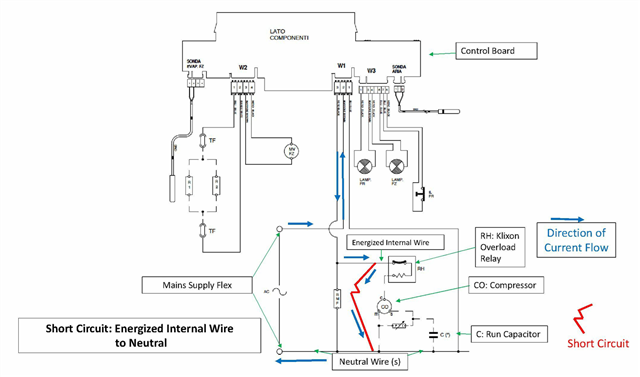
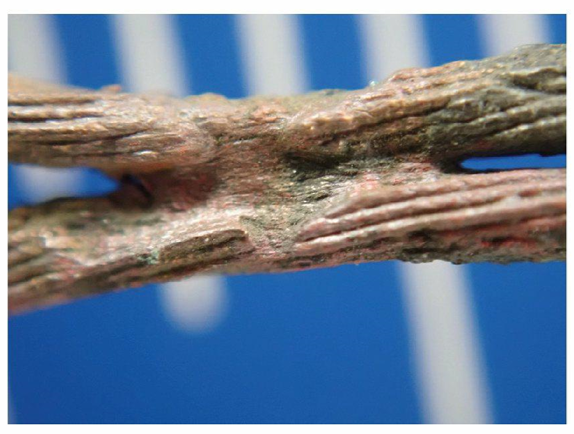
Figure 5 shows what appear to be two multi-strand conductors which have fused together due to an arc. They could have been at line and neutral potential respectively.
I agree that such an event could have tripped the MCB of circuit 7. However, I am troubled by the explanation for the RCD tripping.
Smoke and smoke particles (soot) are electrically conductive. When smoke and smoke particles attack an electrical socket, the socket receivers can be affected by deposition of soot. After the 32-A MCB for Circuit No.7 tripped and prior to Mr. Kebede turning off the Main Switch at the Consumer Unit, Circuit No.8-Flat Sockets (not including those in the kitchen) as well as the RCCB remained energized. It is probable that smoke and smoke particles, having exited the kitchen before Ms. Kinfu vacated Flat 16 and before Mr. Kebede turned off the Main Switch, attacked an energized socket resulting in a current flow to the grounding socket receiver in excess of thirty milliamperes (30mA), which tripped the RCCB.
How did so much soot enter a socket? How did it get behind the shutters?
Then we have:
Mr. Kebede states, however, that when he left his flat, the smoke had not spread beyond his kitchen [Paragraph 76, IWS00000490].
But he had opened the main switch. So there is an important inconsistency here.
Then we have in (paper) page 516 of the report which Mike linked, In my view it is better to accept that it is not possible within the scope of this Inquiry to identify with confidence the precise nature of the defect in the large fridge-freezer which caused the fire.
The real issue was to do with the cladding.
I have to say, with the assistance of Occam's razor, that there had to be a L-E fault in the fridge-freezer, and it tripped both the MCB and the RCD.
It follows that an AFDD would have added nothing.
I am struggling a bit with the addendum to Dr Glover's report.
I can see that. Unfortunately, without being able to fully examine the evidence, I'm unable to help further ... because it would simply be a set of hypotheses.
Agreed.
Suppose that the kitchen circuit had been on an AFDD. Assuming that it would have tripped before an arc had set fire to the fridge-freezer, the occupant might have tried resetting it. It would have tripped again. The appliance would have been replaced. Nobody would have been any the wiser. The success of the AFDD would have been unrecorded.
So, I think that it may be impossible to prove that AFDDs are beneficial.
Of course, if a second disaster happens with AFDDs fitted, we really are in trouble.
So, I think that it may be impossible to prove that AFDDs are beneficial.
To be honest, I think the same goes for RCDs ... and in fact most other protective measures in BS 7671.
Of course, if a second disaster happens with AFDDs fitted, we really are in trouble.
Why? I'm sure AFDDs don't come with a 100 % guarantee.
With respect to both points, it has been said elsewhere that the only way we could show benefit, would be a suitable set of statistics of fires possibly caused by arc faults (or for RCDs fatalities and life changing injuries in cases that might be classified as being covered by what we now call 'additional protection') from before the devices were in use, compared with a similar set of statistics from today ... and hopefully we see a reduction.
Pinning that reduction on the presence of the device, however, is purely circumstantial, as changes occur in other standards (such as product standards), to which the reduction could also be attributed.
So, overall, I think I'm siding with the 'it may be impossible to prove' even if we actually had some statistics to hang an argument on.
We're about to take you to the IET registration website. Don't worry though, you'll be sent straight back to the community after completing the registration.
Continue to the IET registration site