Hi there,
I have a general technical query regarding installation methods and Appendix 4 tables for Twin & Earth cables.
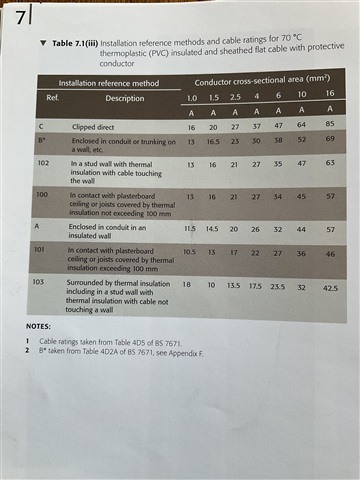
Table 4D5 is applicable to PVC/thermoplastic Twin & Earth. In this instance, with the cable installed in accordance with Reference Method 103 – within a stud wall with thermal insulation, with the insulation not touching the inner wall surface – a 2.5 mm² cable has a tabulated current-carrying capacity of approximately 13.5 A.
This can also be verified within ElectricalOM, where selecting Flat Twin 70°C PVC with CPC gives 13.5 A for 2.5 mm² under the relevant installation conditions.
However, when selecting an XLPE Flat Twin & Earth cable (90°C thermosetting), ElectricalOM identifies the cable against Table 4E2. The software also provides an option to “Run to 70°C”. When this is selected, and Reference Method A No. 3 is selected, it gives a current-carrying capacity of 21 A for 2.5 mm².
My question is therefore whether this is an appropriate application of Reference Method A No. 3 for XLPE Twin & Earth installed within a thermally insulated stud wall.
In particular, where the installation is not relying on the 90°C operating temperature of the XLPE cable, is it permissible to use the 4E2 installation/reference-method arrangement but limit the conductor operating temperature to 70°C, resulting in the 21 A rating?
Or, when XLPE Twin & Earth is installed in this type of thermally insulated construction, should the 70°C PVC/thermoplastic values from Table 4D5 be used instead, despite the cable itself being a 90°C thermosetting/XLPE cable?
The particular installation I am considering is 2.5 mm² 6242B XLPE Twin & Earth, installed within a 90 mm stud wall with approximately 50–70 mm of thermal insulation surrounding the cable. The circuit has a design current of 11.26 A and is protected by a 20 A protective device.
I would appreciate clarification on which Appendix 4 table and reference method should correctly be applied in this situation, and whether the 21 A value obtained from ElectricalOM is an appropriate basis for the cable selection.