


For High resistance earthed, LV systems, Can the neutral be used like this? Will there be any safety issues like increase voltage in the neutral?
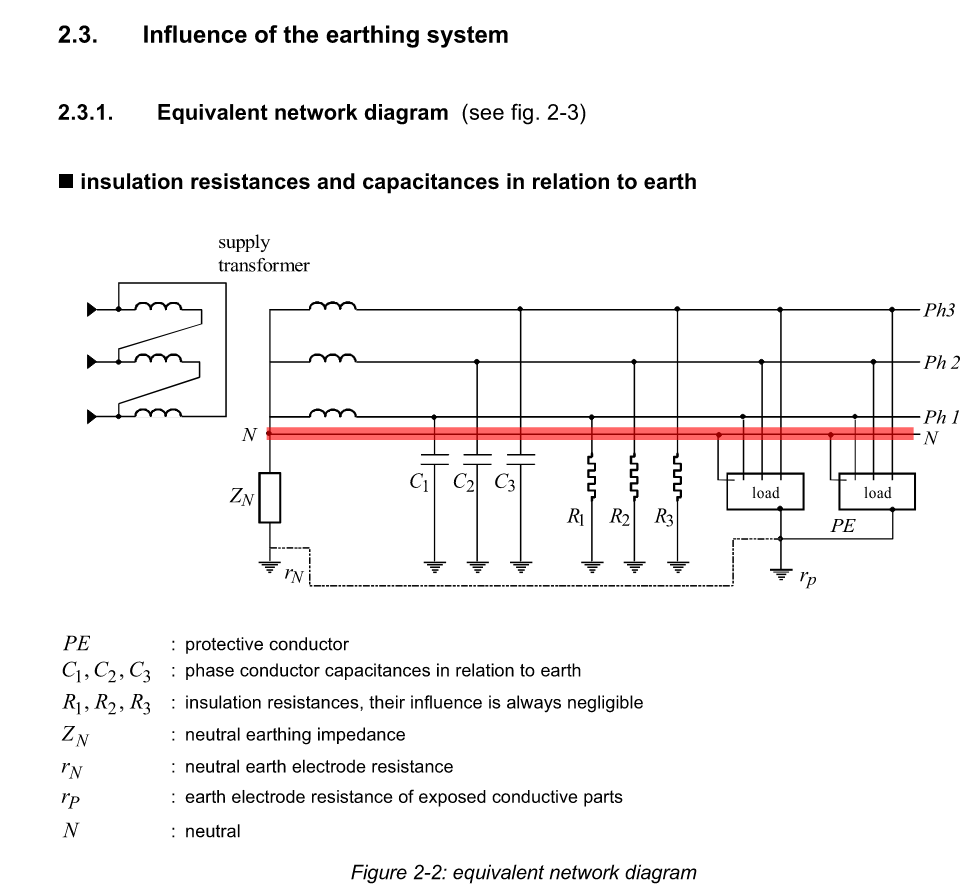
For High resistance earthed, LV systems, Can the neutral be used like this? Will there be any safety issues like increase voltage in the neutral?
It is certainly done, and is a half-way house from TNx to the fully floating supply (IT) situation,. There are a couple of advantages in terms of fault currents being reduced, and everyone knowing how much earth leakage there is while in use (from the neutral to CPC voltage) . Earth bonding diverted currents are lower, as are the chances of an imposed shock voltage on things like outside taps or neighbours plumbing and gas pipes
But,like IT the insulation, and perhaps test , requirements need to be stricter - in the event of a hard fault to ground on say phase 1, during the time it takes ADS to pick up, the other two phases are at 415V to ground, and the neutral is a 240 to ground, Correctly wired loads don't care, its a situation similar to the wild leg 3 phase in the US, the voltages between the wires remain correct.
But, those of us used to assuming that neutral is at or near earth potential, and that includes designer of CUs with unshrouded neutral rails, might be set up for a failure.
The resistor itself needs to be extremely robust, as it only ever get shock loads, and must work at least as reliably as the RCDs, ideally more so.
But yes, its very much a thing in parts of the world where the ground is a poor conductor, or nearer to home, like the London Underground DC traction, where the power is maintained against a first fault, to allow trains to be limped out of tunnels. I have been told In the old days the traction supplies were earthed at the centre tap of two lamps, and an earth fault on one line meant that sides status light went out, and the other lit up extra bright, but power could be kept on if required, and the fault current was only that of the filament lamp, and unlikely to start a fire.
Mike

As Mike says, but to add that BS 7671 does "strongly recommend" that the N is not distributed in IT systems (NOTE to 411.6.1) ... although not prohibited,
- Andy.
I disagree it's a 'hybrid' ... IT systems can be impedance-earthed. So can TN systems if the impedance is low enough to permit timeous operation of the appropriate protective devices providing fault protection for ADS (which since BS 7671:2008 clearly includes RCDs), or to satisfy the formula for additional protection by supplementary protective equipotential bonding.
Effectively, there is a 'sufficiently high' impedance where a TN system actually becomes an IT system, see Regulations 411.6.1 and 411.6.2. Until that point, it is still a TN system.
If it crosses the threshold into an IT system, then agreed, BS 7671 recommends the neutral is not distributed in polyphase systems.
(Side debate here ... can a single-phase system have a neutral? According to BS 7671, at the moment, it can ... but is this correct ?)
(Side debate here ... can a single-phase system have a neutral? According to BS 7671, at the moment, it can ... but is this correct ?)
I guess it depends on your definition of neutral - I think originally it was the point/conductor where everything else cancelled or balanced out (compare with a "neutraliser" in plumbing) or the point about which everything else moved around or was referenced against -e.g. the star point in a polyphase system. This side of the pond though it become synonymous with the earthed conductor, which isn't necessarily quite the same thing although if you never earth the system at some other point the difference is immaterial.
If we'd followed our cousins on the other side of the pond and adopted more imaginative methods like earthing the centre tap of one winding of a delta 3-phase system, or one leg of a 3-phase star arrangement, we'd probably have needed more robust definitions.
Single phase is a bit of an edge case - at first glance without any other phases to cancel against you could say there's no N point as such ... but then you could equally argue that the same would be true of a true 3-phase system where two of the phases happened to have no loads .. in which case it's little more than a matter of labelling - the end of the winding where other phases would have connected had they existed is deemed to be the N. Some of BS 7671 choice of words (e.g. "if a neutral point ... is not available ... a line conductor shall be earthed") is perhaps unfortunate.
- Andy.

I guess it depends on your definition of neutral
Agreed ... have a look at the international standard definitions: https://www.electropedia.org/iev/iev.nsf/welcome?OpenForm&Seq=1
In reality, there are four types of 'single phase' ... truly single-phase, single-phase (from two line conductors of a polyphase system whose neutral is earthed), single-phase from a mid-point earthed system (i.e. two line conductors, and a non-distributed mid-point that is earthed), and what most of us have at home (but not all), a single-phase taken from a polyphase system line conductor and its neutral.
The problem we have in the UK, is that we permit the neutral conductor not to be switched in certain circumstances (in both single-phase and three-phase systems).
And we permit (for skilled/instructed persons) the neutral conductor to be accessible without special precautions. Because it's connected to Earth.
So, the neutral conductor (the blue one) is "sort of safer" than a line conductor (brown, black or grey one) ... the craft practice 'rule of thumb' is, from a safety perspective, at least in the UK, more important than the 'scientifically correct' ...
The problem we have in the UK, is that we permit the neutral conductor not to be switched in certain circumstances
I suspect it's not just a UK tradition - even in the parts of the world that used to have 220V from two lines lightswitches were still normally single pole (and don't ask about ES lampholders!). In comparison our N perhaps sometimes not being close to E (most dramatically where N is broken but L remains connected so N is pulled up by any connected loads) is mild. DP switching perhaps introduces an extra risk, as moving contacts are generally less reliable than solid joints, of N being broken without L. Sometimes you just can't win.
- Andy.
The problem we have in the UK, is that we permit the neutral conductor not to be switched in certain circumstances
I suspect it's not just a UK tradition - even in the parts of the world that used to have 220V from two lines lightswitches were still normally single pole (and don't ask about ES lampholders!). In comparison our N perhaps sometimes not being close to E (most dramatically where N is broken but L remains connected so N is pulled up by any connected loads) is mild. DP switching perhaps introduces an extra risk, as moving contacts are generally less reliable than solid joints, of N being broken without L. Sometimes you just can't win.
- Andy.
We're about to take you to the IET registration website. Don't worry though, you'll be sent straight back to the community after completing the registration.
Continue to the IET registration site