This discussion has been locked.
You can no longer post new replies to this discussion. If you have a question you can start a new discussion

Unconventional lighting project.

Good evening all,

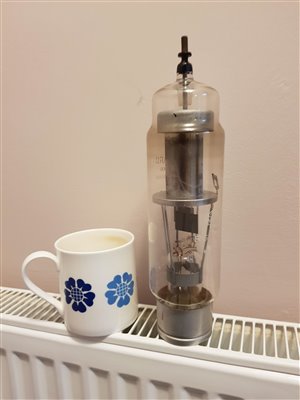
A friend has given me a beast of a thermonic valve, a half-wave rectifier, RG4-3000, to turn into some sort of table lamp.

Access appears to be somewhat tricky as i'd need to remove the glass envelope. I remember removing the envelope of a smaller glass tube pentode when I was 15-16 years of age to produce a scaled technical drawing, but for the life of me I can't remember whether or not I broke the glass asm I never bothered to replace it..

My question is, has anybody attempted anything similar and how did they remove the glass envelope in tact so that it could be attached at a later time?

Legh

regards to all and thanks for reading

  • This is a low pressure gas filled valve (aids anode cooling)

    There will be a gas fill tube 'pinch' usually under the valve base, but not always. Should look like a length of glass tube filed flat.

    Masking tape on the exposed part, and then use a triangular file or a diamond cutter to slowly cut though the tape and the glass to reuinite the atmosphere and the vacuum until it just starts to hiss .  (tape stops the crack from 'running' )

    To open the depresuried envelope in a big way I am less sure. In the days of CRT regunning, a hotwire cutter would be used to cause a fine line of local stress and to 'plink' a straight cut that could then be re-sealed with a glass lathe.
    about 30-40 seconds into this video shows that.

    I suspect/fear  no-one except perhaps university chemistry dept technicians has this kit or the ability nowadays.

    Goggles, gloves,  and somehere that  sweeping up if it all goes wrong can be done easily, so perhaps not the kitchen..


    Folk who cut thick walled bottles use a jig holding a glass cutter to create a uniform scratch around the circumference - a variation on that method may be worth considering, and perhaps combining with the thermal shock technique
  • Would it be easier to cut the bottom off the base, leaving the rest of the valve intact, and then mounting a high power LED underneath, pointing upwards?
  • ab67ccd697fa3e7da12c29bc1672a21f-original-20201105_1636111.jpg

    I suspect that your idea would be the best point to cut at the crimp where the ceramic base is held.

    I plan to use the connector pins to hold the fitting in place and to make connection to a PSU in the mounting fitted beneath the tube. Not sure how the light would be exhibited within the tube as there are lots of metallic obstructions.

    Legh
  • seems a shame to kill it really - they are very much a thing of their time.

    I'd consider putting LED "filaments" in there and hiding a bridge rect and series cap in a hardwood box beneath it - do you have the socket for it ?
    this sort of thing    - depending on length the best ones for a mains lamp are the one with  all the LEDs in series - those are  typically 40-60V each, but need to be current limited to perhaps 10mA peak per LED  as they have almost no cooling,


    For battery use ones with all LEDS in parallel ~3V and in a hybind series parallel layout for 12V or so are also made. Again, current limiting, and polarity is important....

    you can make suspension loops from insulated wire between the anode caps perhaps?