Why are some broadband routers emitting ultrasound?

I'd recently been cajoled into changing ISP and having FTTP installed. The new ISP quickly sent out their router and I've had chance to test it for ultrasound emissions before having the telephone line replaced with a fibre cable. I did this knowing that I'd been in a house where my tinnitus was being stimulated and found that the broadband router positioned a few feet away, was emitting a sharp 21 kHz signal.

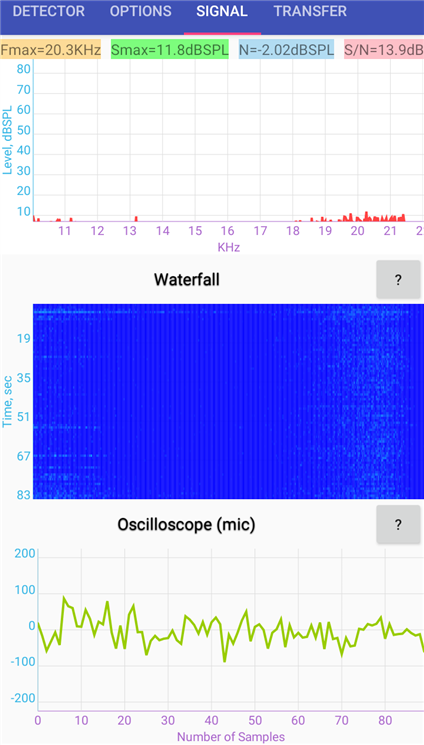
Here's what the ultrasound app I use revealed for the new ISP's router once it had completed its boot up sequence:
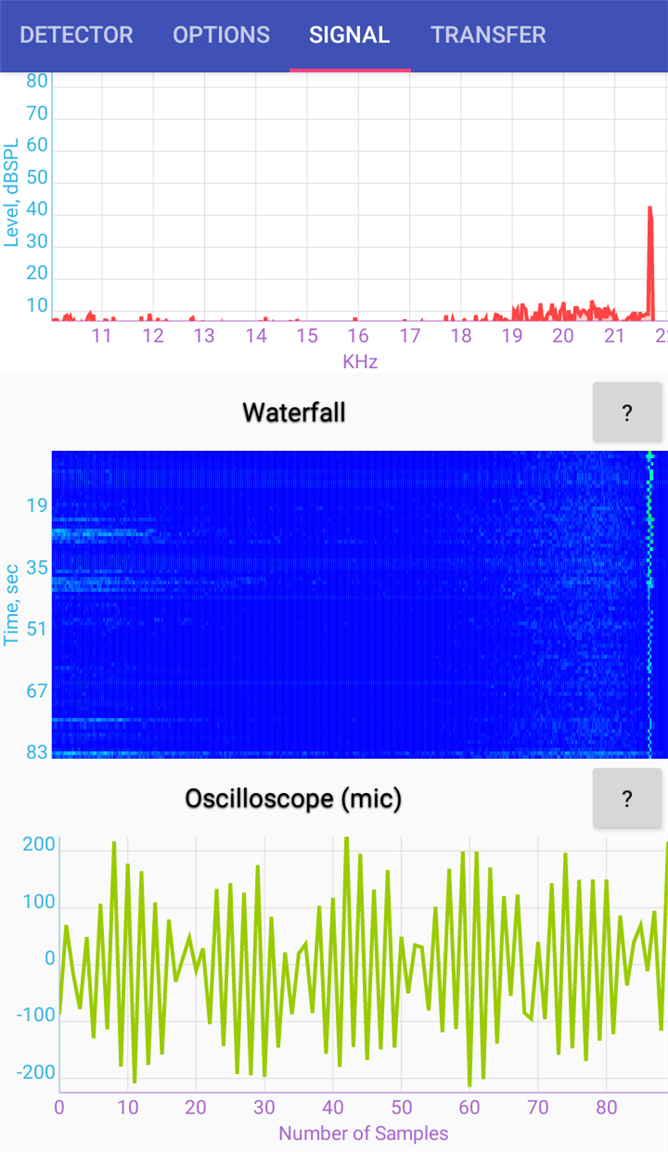
That's over 40 dB at 21.75 kHz, measured around 6 to 8 inches away. The ultrasound was being emitted by the router itself, not the power supply built into the mains plug a couple of feet away. When I'm exposed to ultrasound up to at least 30 kHz, it results in the perception of a high-pitched audible tone at approximately 14 kHz, my tinnitus tone, thanks to suffering from the "ultrasound hearing" phenomenon, as discovered previously. (See the discussion:Reasons why I suffered tinnitus, insomnia, chronic fatigue, and other health problems after having digital electricity meters installed ) (Also, I know the range as my dentist uses a 30 kHz dental descaler, painfully at times.)

Frequencies between 21 and 22 kHz are just over the top of the normal audible range for human hearing, particularly very young children, so for some people they may hear the exact tone. If these emissions are somehow accidental, then it may be possible that some routers emit sound just under 20 kHz. Cats and dogs have much more sensitive hearing than us and would have no problem hearing tones well over 20 kHz as normal sounds, probably very unpleasantly.

If you search online, you will be told that routers do not emit ultrasound, but this is clearly untrue. I've now found 2 out of the 4 I've tested doing so, subject to the microphone's limit of 22 kHz.

There's no purpose, at least not that I know about, for routers to emit ultrasound, so the simple question is; why?

Parents
  • Mostly buzzing and feezling of ferrite cores in switching  step-down regulators. The mains is stepped down to 12V or something that can sensibly be piped a few metres, but inside the router a no of other voltages are required for logic  typically 3.3V 5V and perhaps higher voltages for a pseudo phone line if one is fitted.

    At each stage, where there is a voltage change, a linear regulator would have to dissipate significant heat, and a switching design is more suitable.

    some theory 
    https://learnabout-electronics.org/PSU/psu31.php  stepping down

    https://learnabout-electronics.org/PSU/psu32.php stepping up.

    Usually the raw switching is at a far higher frequency, typically hundreds of kHz, with fast switching MOSFETs in modern commercial electronics, (or in military stuff, low MHz and gallium nitride devices....) 

    What happens with many such stages on a common supply is that there are beat frequencies generated between them and these are however lower, and quite often in the region you suggest. Additionally, loads vary with network traffic and flashing lights etc and this leads to additional lower frequency modulation of the switching wave-forms. Also when lightly loaded some deigns can  'squegg' i.e. stop altogether when the output target is exceeded, and then restart as the voltage on the reservoir capacitor falls leading to burst of a a few cycles of operation interspersed with pauses again this can occur at lower ultrasound frequencies but in a very hard to predict way.

    The main acoustic generation mechanism is magnetostriction in inductors (the same same reason 50Hz transformers buzz at 50Hz and click and thud when switched on and off), additionally some semiconductors and certain designs of ceramic capacitor are mildly piezo electric.

    Mike.

  • Usually the raw switching is at a far higher frequency, typically hundreds of kHz,

    But also is quite often in the 10s of kHz range. I've also got a USB charger (which will only be a simple single stage converter) that must be in the low kHz since even at my age I can hear it!

  • Unless it is an unusually heavy power supply, it is far more likely that what you can hear is a squegging frequency, and there are short bursts of oscillation with an audio frequency repetition rate - in effect you are not hearing the transformer buzz, but the regularly repeated HF version of a transformer inrush thud- this is far more likely to be at an audio rate.
    Silicon is cheaper than ferrite core material gram for gram and has been for about 20 years now, so its the latter that is skimped, and that pushes you up in frequency ;-) 

    If you have a scope then  a loop of a few cm of wire to give some tens of turns around a  finger sized former, (perhaps not too tight if wound around an actual finger), slid around over the outside of the plastic case will serve as a millivolt level magnetic leakage pick up - the waveforms can be pretty horrible on cheaper kit! 

    you can also buy commercial probes based on SMD coils as the pick up for checking a power supply oscillator is running.
    These amplify the AC induced by the leaking magnetic field and if it exceeds a threshold, light the 'its running' LED. Crude but occasionally useful.

    Mike.

  • One day when I'm really bored - or happen to have one of my scopes in the bedroom! (I've fitted this charger with a time switch because it was so annoying at night.)

    More urgent job is mending my beloved c. 1990 Tektronix analogue / digital scope which sadly died (emitting brown smells) last time I used it a few days ago...

    Simplest search coil I used to use when I was doing this stuff in the day job was just clipping the earth lead of the scope probe to the tip. As you say, it was horrifying how much rubbish even that would pick up from SMPSUs. Somewhere I must still have the design details for a BBC designed search coil for audio frequency work which I used across the audio and railway signalling industries which worked extremely well up to a few 10s of kHz. Fortunately when I changed industry no-one touched my old filing cabinet, so when I phoned up a year after I left the design was still exactly where I left it!

  • Thanks Mike for your answer, much appreciated.

    That's how, now it's a question about whether the designers of these switching electronic circuits and the companies that sell or pass on devices using these circuits (I fear lots more than just broadband routers) know what they are inflicting upon the public? For the record, ultrasound is known to cause the following symptoms:

    • Fatigue
    • Persistent headache
    • Migraine
    • Nausea
    • Tinnitus
    • Sensation of fullness or pressure in the ears
    • Dizziness
    • Light-headedness
    • Anxiety
    • Temporary or permanent hearing threshold shifts

    Ref: International Commission on Non-Ionizing Radiation Protection (ICNIRP). "Validity of the 1984 Interim Guidelines on Airborne Ultrasound and Gaps in the Current Knowledge". Health Phys. 2024 Aug 1;127(2):326-347. doi:10.1097/HP.0000000000001800  Epub 2024 May 17. PMID: 38768315.

    Yes, that what's none other than what the ICNIRP have to say about the International Radiation Protection Association (IRPA) interim guidelines dating back to 1984 that are still current and now in the care of the ICNIRP. In 1984, how many electronic devices were to be found in homes creating ultrasound, whether deliberately or incidentally as in the case of routers? There's plenty of science backing up these symptoms as being a consequence of ultrasound exposure, including this as posted by Mike in my aforementioned discussion on electricity meters causing tinnitus and symptoms that are included in the above list:

    T. G. Leighton; "Are some people suffering as a result of increasing mass exposure of the public to ultrasound in air?Proc. A 1 January 2016; 472 (2185): 20150624. https://doi.org/10.1098/rspa.2015.0624

    The ICNIRP know they need to update the IRPA guidelines, but surely the electronics industry should act responsibly and not wait for ages for that to happen when there are worrying numbers of people suffering tinnitus, migraines (both estimated currently to be 1 in 7 of the UK population), fatigue, anxiety, dizziness etc? Note, I am finding other tinnitus sufferers who are experiencing a combination of these symptoms, including recently someone who reported worsening tinnitus and the feeling pressure on their ears while in their own home. Thinking

    Andrew

  • Thanks Andy for your response. The more harmful frequencies are I believe, those below 100 kHz, but ultrasound hearing has been found to extend as far as 225 kHz. This study cites an earlier study concerning the limit, but unfortunately that one is available in Russian only and very difficult to translate due to the way it was scanned:

    Gavrilov, Leonid & V., Gersuni & al, Pudov. (1980). Gavrilov L. R., Gersuni G. V., Pudov V. I. et al. "Human hearing in connection with the action of ultrasound in the megahertz range on the aural labyrinth." Sov. Phys.-Acoust., 1980, 26, 4, 290-292.. Sov. Phys.-Acoust. (Acoustical Physics). 26. 290-292

    I don't want to go into EFs and EMFs in this 'Question', but can ultrasound be similarly suppressed?

  • I presume you are aware that https://www.researchgate.net/publication/14466051_Application_of_focused_ultrasound_for_the_stimulation_of_neural_structures 

    is online and is a quick summary flyover of the areas that had been looked at in the early 80s. Note that whiile that paper is a bit vague about it, the power levels used when triggering nerves to erroneously report heat, cold touch etc are quite high, as a percentage of the levels that would lead to tissue damage (~watt  per cm2) which is very high compared to SPL where an Lw of 0dB is normally taken as 1 picowatt, - so a 120dB source is 1 watt of at the source.

    Of  course when thinking in terms of power density, spread out over an ever increasing area with distance. (not to be confused with loudspeaker input power - 1kW of electrical power producing a few watts of acoustic energy filling the whole night club is quite common, the rest goes as heat ! )

    The acoustic conversion of rattling inductors that are not deliberate loudspeakers is very low, sub 0.1%, and that means the effect on circuit efficiency is not normally considered. It also allows us to put an upper bound on what power levels you are hearing  - the router DC input power is likely to be less than 10W, and of that perhaps 50% is stepped up or down, say 5W, of that say 500uW to  5mW is converted to sound, that is somewhere between a traditional dual  bell alarm clock and a revving car engine. If that was in the audible range, we'd all notice it at a few inches ! but it is still 3-4 orders of magnitude lower than levels that induce false sensation in nerves below the skin in normal test subjects,

    Yes, ultrasound can be suppressed in much the same way as normal sounds can by baffles, and acoustic absorbers, and closing doors and windows, but it tends to get through proportionally  smaller gaps and holes, as the wavelength is shorter.  To make equipment harder to detect from its acoustic  emissions, internal modifications   as simple as blobbing mastic or conformal coat (a heavy varnish) over the inductors and even hot melt glue  are a common initial strategy and can be quite effective.

    regards Mike.

  • TDK, an inductor maker, give some advice in this publication https://product.tdk.com/en/techlibrary/solutionguide/acoustic-noise.html

    Mike.

Reply Children
  • Hi Mike,

    Thanks for your 2 further replies.

    I rather doubt sound proofing will be practical as the devices will need air flow to cool any components that can get hot and ultrasound is going to get through some small gaps. I was wondering if there were electronics that could prevent or substantially reduce the vibrations and therefore the emissions. The TDK advice shows there are choices that can be made to reduce noise, but do the manufacturers of electronic devices, particularly those we are putting in our homes, realise the consequences of the polluting emissions their devices are generating?

    Re Gavrilov's paper on focused ultrasound stimulation of neural structures; ultrasound has its good medical effects, but it also has its bad effects as those of us with ultrasound hearing can testify. Having any device in the living room, study, possibly bedroom emitting frequencies in the tens and low hundreds of kilohertz is potentially a health disaster and how many people with this sensitivity actually know that they've got it? The medical profession doesn't seem to be aware of it at all and therefore unable to diagnose it.

    I wouldn't have had a clue about ultrasound sensitivity without the major problem I have with unsuppressed SMPSs in electricity meters. Take dental descalers for instance, which of course deliberately use ultrasound: I always hear a high-pitched tone during descaling and used to think it was normal and that everybody did. It didn't result in tinnitus fortunately, but it was exactly the same tone as the tinnitus that began with the first smart/digital electricity meter installed in my house. Descaling since the tinnitus started has been painful and the dentist once asked me what was wrong. He had no idea some people could hear a tone while having their teeth cleaned, even though the dental nurse with us at the time told us that she too hear a tone during descaling. There are people complaining of actually suffering tinnitus after having their teeth ultrasonically cleaned. Here's an example of a case from PubMed: 

    Andersen TL. Tinnitus na behandeling met ultrasone scaler [Tinnitus following treatment with ultrasonic scaler]. Ned Tijdschr Tandheelkd. 2023 Nov;130(11):447-450. Dutch. doi: 10.5177/ntvt.2023.11.21080. PMID: 37933721.)

    Without previous experience of suffering ultrasound hearing and tinnitus, I would have installed the new router and slowly developed tinnitus and other symptoms. Depending on how quickly the tinnitus developed and it's variation in volume with location in terms of being in the house or not, I might have suspected the router was the cause and turned it off to see what happened, but the chances are that it wouldn't have made any noticeable difference. I would have gone to a GP, told them I had this horrid tone ringing in my ears keeping me awake most of the night, to which they would not doubt responded; "tinnitus is all about stress, go and have a holiday" etc. (That's what they told me when I knew the meters had caused the tinnitus that I still have 4 years later.) Stress and tinnitus do go together, but with ultrasonic inflicting tinnitus, the stress comes from having the tinnitus, not the other way around, plus a bucket load extra due to not being believed.

    Of the ultrasound symptoms listed earlier, only the ear pressure I previously suffered responded quickly to leaving the house and returning, or by turning off the electricity in the house and back on again. Eventually I found the surround sound system was the source of the ultrasonic emissions (probably as EMFs rather than acoustically), but even that wasn't noticeable for the first 15 hours. Working out that an electronic device is the source of symptoms such as tinnitus, fatigue, dizziness and insomnia can be virtually impossible and of course, everything we buy and install ourselves or by utilities is of course made to British Standards, so officially deemed "safe" to use. However, the more I find out about my sensitivities and finding others suffering similarly, whether they understand they are sensitive or not to these frequencies, the more alarmed I'm becoming about the true scope of this problem.

    Andrew

  • Really low acoustic noise  has to be designed from the outset at board level , and as above if you want to be stealthy then a heavy varnish and mastic over the offending components is the way forward or even potting the whole PSU module.  Unless you are happy to open the box however such measures are  not a practical retrofit.

    It is possible to identify many designs of switch-mode devices using a similar  sort of set-up to that used for detecting bat calls. (and even the vibration of 32kHz watch crystals with some difficulty and an fft

    )

    M.

  • Hi Mike,

    I think we'd better issue a warning:

    Anyone thinking of opening up electronic devices and using things like mastic to cover components and block ventilation holes up to baffle any type of noise being generated, acoustic or ultrasonic, this may lead to overheating issues and hence be dangerous. This should not be attempted unless you are sure about what you are doing and of course, utility provided equipment like routers are the property of the utility and should not be interfered with. If you can gather enough evidence that utility equipment is causing you to hear noises that you should not be hearing, please complain to the utility and ask them to replace it. The more people who do this, the more likely action will be taken to stop such devices being issued and installed in the first place.

    There are at least 2% of the population with ultrasound hearing, that's 1.4m in the UK, most of whom will have routers, electricity meters and other electronic kit that incorporate these ultrasound generating switched-mode electronics in their design, that risks these people suffering from a combination of the symptoms I listed earlier, plus other symptoms if they are also electro-sensitive. (That's if ultrasound hearing is not considered a form of ES itself. It certainly indicates a higher risk.) Most of the people affected will not understand why they have acquired their symptoms and the medical profession will not be able to diagnose them let alone provide useful treatment. Hence, awareness of this problem is needed on all sides and the use of circuitry that generates hidden ultrasound at levels that can cause awful symptoms in humans and pets, ought to be stopped.

    I calculated the cost of fitting suppression in smart/digital electricity meters and compared it against the cost of the health care provided to myself during the time I had them in my home. (See:RE: Reasons why I suffered tinnitus, insomnia, chronic fatigue, and other health problems after having digital electricity meters installed) The health care costs for the minority affected is hugely more expensive compared to the cost of the suppression for all meters and there's no way I can put a cost to the utter misery caused by suffering the symptoms.

    Andrew