This discussion has been locked.
You can no longer post new replies to this discussion. If you have a question you can start a new discussion

EICR and IR Testing

Former Community Member
Oh the bane of IR testing on EICRs

Now its just impracticle to disconnect all loads to carry out IR testing, I think everyone can agree on that. And that Phase and Neutral are connected then tested to earth.


This is what I do, and then test @250V as to avoid damaging any equipment in the installation. And unless the IR value was <.5 Meg, would not bother me. What BS7671 states, but BS7671 is maybe somewhat unclear in that if that voltage (250V) was used then .5meg value should used, but that value should only be used on SELV, and PELV. Now experience also tells me that even if you had a return 0.0, and then did Kohms by using the ohms setting, even values of 100Kohms are fine. (Actually can be much lower than this) and we are pretty clear that its not the cable reurning these values.


So question is when doing an EICR @ 250V, at what point would you recommend an FI? For me the value would have to be <.5Meg
  • Sparkingchip:

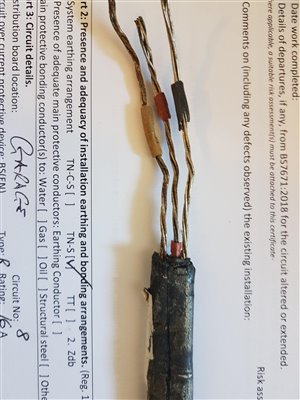
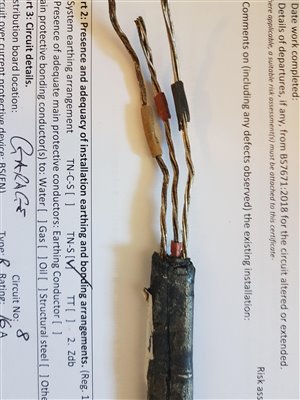
    I went south of the river last Thursday to do what should have been a straightforward job, until I saw the cable that supplied the central heating system that I was planning to extend.


    You do have to appreciate just how bad the insulation is on some cables that are in use without tripping a RCD or MCB in a relatively new dual RCD consumer unit.


    cc3c406e19459a9746a2bb1eee2815e0-original-20200820_144553.jpg


    Going off topic, try identifying the conductors by the colour of the remnants of the insulation around them and although I said it’s rubber cable, I not actually certain that is a precise description. The house was built as a very upmarket semi-detached in one of the best locations in Greater London and this cable may be the last bit of the original installation from 1935 that was still in use, so may be eightty give years old, the rest having been rewired around sixty years ago.                                                                                                                                                                                                                                                                                            


  • John Peckham:

    Chris


    You have fallen in to the usual trap of not understanding the major difference between Initial Verification and Periodic Inspection and Testing.


    John, that's a bit unfair!


    My point was that for a periodic, L-N testing is unnecessary and as the OP said, practically impossible. How would you test a socket circuit with SRCD or USB where the manufacturer's instructions are that it should be disconnected when IR testing?


    As an aside, when testing at stages during erection, to start with the IR rapidly goes up to > 999 MΩ; but after a while it creeps up more slowly, especially when testing live to CPC. > 500 MΩ is certainly enough for me, but one could stop pressing the button as soon as it gets over 2 MΩ, or any value in between.


  • Bare conductors placed out of mind does seem to be a known installation method, but not a recommended one! (some time last century we were pulling that sort of thing out, often with black cloth tape repairs as well,  clearly some is still left operational)

    The sad thing is that a cable even in that state,  laid out like that,  probably can still passes an IR test at 1000V as well as 500V, so the instruments are useful but not all-seeing -  so looking behind a few fittings at the cable itself is really important - and that cannot find the unhelpful cases where both ends have been changed, but not the hard to reach section of cable in the middle. Still, better out than in.

    edit crossed in post, but agree totally. The IR test only gets you so far.
  • No rubber cable is visible within the consumer unit at that house, so from looking in the CU you could assume the whole installation is wired in PVC insulated cable. So a bit of cable like the one in the photo is one of the things you are looking for when doing an EICR, I did not mess about doing an insulation test on that cable, but I know from experience that they can pass an insulation test even in that state.


    Inspection trumps testing.


    Andy Betteridge
  • I actually disconnected the existing circuit completely and tapped into another one which meant taking the landing carpet and floor up, then relaying them, which was not part of the plan.


    That photo was taken whilst I was deciding what to write on the certificate as comments on the existing installation!


     Andy B.
  • I went south of the river last Thursday to do what should have been a straightforward job, until I saw the cable that supplied the central heating system that I was planning to extend.


    You do have to appreciate just how bad the insulation is on some cables that are in use without tripping a RCD or MCB in a relatively new dual RCD consumer unit.


    cc3c406e19459a9746a2bb1eee2815e0-original-20200820_144553.jpg
  • Former Community Member
    0 Former Community Member
    Chris, that is a fantastic answer! Exactly what I was looking for.


    Thank you
  • Chris


    You have fallen in to the usual trap of not understanding the major difference between Initial Verification and Periodic Inspection and Testing.


    Initial Verification is the I&T of a new installation before being put in to service and periodic inspection and testing is for an installation already in service.


    The tests for Initial Verification are done in sequence and if any test fails then the process stops and any defects are rectified before re-commencing testing and repeating any test that could have been influenced by the defect, see Regulation 643.1. IR testing being one of the dead tests that must be satisfactory before energising the installation for the first time for the live tests. Regulation 643.3.2 allows for 250V IR testing where equipment could be damaged or SPDs cannot be removed.


    Periodic Inspection takes place with the installation having been in service and there are no prescribed tests in BS 7671 and any tests need not be done in any set sequence. Periodic Inspection and Testing (Chapter 65) majors on Inspection and testing is an ancillary activity as Regulation 651 .2 says "supplemented by appropriate tests and measurements from Chapter 64". 


    I see >200M for large installation Live/Live on EICRs and ask for an explanation as how that test was carried out. knowing full well that is a blatant fabrication!
  • I agree with Mike that 500V is a bit of a compromise, but is certainly better than using 250V dc. Andy has already pointed out that 250V dc is less than the RMS value of the mains. Certainly at LV, you are more likely to get a reading from the carbon produced by a fault than an arc between conductors. Certain appliances are more likely to be damaged than others - satellite boxes are a favourite, as the power supplies are (or certainly were) rated only just outside the normal mains tolerance. In fact, one manufacturer supplied a “power supply repair kit” which contained the components only just in voltage tolerance, and therefore those that usually failed. 


    Regards,


    Alan.
  • Michael Moore:

    So question is when doing an EICR @ 250V, at what point would you recommend an FI? For me the value would have to be <.5Meg

    If lives together to earth are satisfactory, why do L-N at all?