This discussion has been locked.
You can no longer post new replies to this discussion. If you have a question you can start a new discussion

New Thread

Rather than hijack an existing thread I thought a new thread might better serve.

A few times I have stated my dislike of the way some folk few acceptance of installations undertaken to earlier editions of our "Regs" being compared to installtions being done very recently.

For those of you (if any) who are not aware of my stance I will repeat it (Yes again, sorry folks).

When doing an EICR/PIR a defect is noted and if that defect was compliant at the time of the actual install then some would not code it at all or perhaps code it more leniently.

I say this is very silly.

A defect should be recorded and if you think it sufficiently impacts on "safety"  (relative safety reallY) then should be coded as appropriate.

We I & T to todays standard and compare it to that.

We might reasonably consider how safe/unsafe we perceive it to be if we compare it to things past.

Those of us who are older and remember earlier Editions of Regs might ,admitadley, be less severe with our coding than a more newbie electrician. That should not be the case but in reality it might well be. We often use that as a mental reference to effect our perception of "safety".

However, no relevance in coding different outcomes should ever be based purely upon the install date (therefore Reg Edition in force at that particular time). It must be purely based on how it compares with our standards now.

So quick answers as to what items we would have not felt aprehensive about in days gone but might concern us a bit more nowadays?

I`ll start of with inclusion of RCDs and Bonding presence/sizing.

Any more?

  • ebee: 
     

    Rather than hijack an existing thread I thought a new thread might better serve.

    A few times I have stated my dislike of the way some folk few acceptance of installations undertaken to earlier editions of our "Regs" being compared to installtions being done very recently.

    For those of you (if any) who are not aware of my stance I will repeat it (Yes again, sorry folks).

    When doing an EICR/PIR a defect is noted and if that defect was compliant at the time of the actual install then some would not code it at all or perhaps code it more leniently.

    I say this is very silly.

    A defect should be recorded and if you think it sufficiently impacts on "safety"  (relative safety reallY) then should be coded as appropriate.

    We I & T to todays standard and compare it to that.

    We might reasonably consider how safe/unsafe we perceive it to be if we compare it to things past.

    Those of us who are older and remember earlier Editions of Regs might ,admitadley, be less severe with our coding than a more newbie electrician. That should not be the case but in reality it might well be. We often use that as a mental reference to effect our perception of "safety".

    However, no relevance in coding different outcomes should ever be based purely upon the install date (therefore Reg Edition in force at that particular time). It must be purely based on how it compares with our standards now.

    So quick answers as to what items we would have not felt aprehensive about in days gone but might concern us a bit more nowadays?

    I`ll start of with inclusion of RCDs and Bonding presence/sizing.

    Any more?

    I agree with the above. B.S. 3036 rewireable fuse carriers in fuse boxes. Still allowed to be used but liable to dangerous misuse by the home owner are on my list. Also B.S. 1361 cartridge fuse fuse boxes, where the ability to obtain the correct size new fuses these days is becoming much more difficult and expensive. Silver paper wrapped around a blown cartridge fuse is just plain wrong and dangerous.


    Oh, and '80s flimsy plastic consumer units where the plastic cover fixing screws often do not work properly, and the cover is only just held in place more by luck than anything else.


    Z.

  • Former Community Member
    0 Former Community Member

    We I & T to todays standard and compare it to that.

    Half way down p473 requires you to fill in “in accordance with BS 7671:2018 (IET Wiring Regulations) as amended to…………………………………………………………………………………………”

    No option to enter 1966.

    Regards

    BOD

  • perspicacious: 
     

    We I & T to todays standard and compare it to that.

    Half way down p473 requires you to fill in “in accordance with BS 7671:2018 (IET Wiring Regulations) as amended to…………………………………………………………………………………………”

    No option to enter 1966.

    My reading of that declaration is that the inspection has been carried out in the manner described by BS 7671:2018 chapter 65, not that the installation has been compared against the rules in BS 7671:2018.

    Chapter 65 itself only mentions compliance with BS 7671 in two places: 651.2, where it notes that older installations are not necessarily unsafe; and 653.2, where it says that the report should include “any non-compliance with the requirements of BS 7671 which may give rise to danger”.

  • Ebee, I'm not sure that your description of inspection to older versions of the regulations is correct. No one should do this, but dealing with discrepancies from the latest regs is somewhat complex. You use RCD protection as an example, and it is worth looking further.

    You inspect an install from around 2000, which has RCD protection on some circuits but not the lighting. You compare it with the latest regs (and I am going to use the Amdt 2 DPC here, you will see why in a moment). 

    How would you code the lighting circuit, assuming it is otherwise compliant except for RCD protection? The DPC said it is required. Would you code this as a C3 or a C2? If a C2 it must be corrected before letting, the installation is unsatisfactory. The question you must answer is “how is this potentially dangerous”? I think that you might find that quite difficult unless you make quite a number of “what if” statements that suggest abusing the system as a whole.

    The new regs have made something actually dangerous that was not before because of a slight change of a few words? What evidence have you to support that view?

    Take AFDDs, what evidence have you that they improve safety in any way? I know, a man in a pub told you? Where is the data?

    If I have an installation to the 15th edition, should I bother to assess all the additional bonding which will be present, some probably broken? Should the lack of RCDs be considered a C1?

  • Well I certainly hesitated before replying - All of the comments below are going to create controversy. Yes all of the below will create a better installation, but when they're not there due to age of install………….. 

    My current biggest annoyances are all on the modern insistence on:

    1. RCDs for everything - there's often ways to design out the need to install an RCD……Many circuits that lack RCDs are not going to suddenly kill everyone who approaches. As ebee has said though this is maybe because we didn't used to fit millions of RCD everywhere and it was fine.
    2. Type A RCDs……..is the current buzz word in fashionable electrics on line in chat rooms ---- I don't even know where to start here (IMO obviously) I understand that these items detect DC leakage, but if you've got an installation with no expectation of DC leakage (Your common household with no EV or multiple Variable speed drives for example) - A type AC RCD is surely absolutely fine. I hover around a face book group that's very much pushing forwards this idea that type AC RCDs need coding and are somehow a safety issue. (The contributors in the forum, not the forum its self) A Few LED lights and a TV don't count either (IMO) for expected dangerous levels of DC leakage in an installation.
    3. Surge Protection - every where - its becoming more affordable so its easier to fit but somehow the lack of these things is becoming a safety issue all over the show.
    4. AFDDs. Well hell- I cant yet bring myself to believe these are going to solve all our ills. But coming to a regs book near you, they are……….
    5. Plastic fuse boards - they're not so bad - surely? Metal is better, but a good condition plastic DB - it OK still……
    6. Clearly I don't respond to fires and shocks/deaths caused by all of the above though and understand the reasons for creaping change; those more affected by, or more sold on the idea of infinite safety for every situation will far different to myself.
    7. And as for no RCD protection for sockets likely to supply out door plug in equipment in a typical household environment, I cant think of a single item I've owned in the last 20 years that wasn't class 2 anyway, but am aware that class 1 exists, obviously, and that reg has been around for so long that I recon any inspector would have to code 2 now, even - in my case - with a big sigh and a grimace. But then a socket outlet with RCD built on it is somehow no longer acceptable, I've heard all the reasons why - sigh - really - this them opens up the need to RCD the circuit, which leads to - it cant fit in this DB, which leads to an easy sale of - a new DB is required etc etc………and accusations of incompetence and cowboyery. (I often understand how the chain of logic leads to unnecessary DB changes for example). I've heard guys chase their tail around and around, until the only conclusion they can come up with is - do everything and then there's a safe installation done, with no one to argue differently.
    8. Office sockets - especially floor boxes supplying desks - requiring RCD protection through out and all the difficulties that brings, because all of the costs to rectify this problem in bulk are huge…..
    9. Sockets in ceiling voids of offices supplying anything from TVs to AV equipment etc, not available for common use as they're above the ceiling and 3m up, requiring RCDs etc etc. The need to RCD all sockets in every situation is a real pain in my aris. Server Racks. Even the clause of a risk assessment, in all of the environments I work in, no one is will to put their name to a risk assessment that says a safety feature may be left out, because that's not the mentality of health and safety professionals. Sigh……
    10. In new installs and in changes - it all gets done to the last dot and dash I assure you; I don't have to like it or not,,,,,, but sigh…..its all becoming a lot overboard. Isn't it?
    11. Kind Regards. Tatty.


  • Reading my post again I realise that it might infer the opposite of what I intended.

    So just to be clear.

    Any install tested today needs to be compared to the requirements of the regs as stands today.

    Any defects are defects and should be recorded as such.

    Some defects that might arise might well have not been considered a defect at the time the install was completed. That is not relevant. A defect is still a defect.

    What guiles me a bit is some folk seem to think that on an install that previously complied with a defect that was a non defect at time of install is therefore not a defect now. does not matter when it was installed, a defect now is a defect now.

    Two exactly identical installations , one completed last week and one completed 20 years ago must be given the same defect list when we inspect it.

    one property cannot be given a C3 and another a C2 for exactly the same defect.. they both attract a C3 or a C2 (or even a C1) for that same defect.

    I hope I`ve cleared it a bit


  • Some defects that might arise might well have not been considered a defect at the time the install was completed. That is not relevant. A defect is still a defect.

    So, post us a definitive list of what you personally would classify as ‘defects’

    Would 'Wrong colour of consumer unit"  be a C1 perchance?

  • Ebee, that is an argument for retrospective application of the regs, as you are close to judging unsatisfactory any installation to an older edition.

    I think rental properties are different and there is a danger of treating all installations as if they are rental.

    David 

  • No David, regs change, some installs become defective to current regs even though they complied with the regs in force when the original install was undertaken

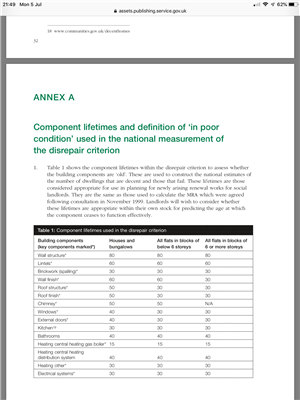
  • 9302203ce2034984c7bc6e97ff3b5337-original-b54d8737-7d72-40ce-82f7-6308b6eaefab.png

    https://assets.publishing.service.gov.uk/government/uploads/system/uploads/attachment_data/file/7812/138355.pdf

    Any electrical installation installed more than thirty years ago, so prior to 1991, should be considered to potentially in a state of disrepair and is possibly in need of replacement or upgrading as it may be past its useful life.