Do current limiting MCBs differ from Type B, Type C MCBs?
I can do no better than point you at this explanation by Schneider
in summary they break or at least start to arc so there is some voltage drop, in less than a half cycle of the AC mains, such that the let through energy is no worse than (in the case of 50Hz) as if the PSSC had only flowed for 10msec.
In general the B, C and D breakers are not guaranteed to do this, but most will do so to some extent in practice. Makers device specific data is needed to see the I2t trends beyond the minimum 0.1second called out by the Euronorms
Mike.
A bit more info here: https://www.eaton.com/content/dam/eaton/products/electrical-circuit-protection/molded-case-circuit-breakers/current-limiting-circuit-breaker-pa01213001e.pdf
By the looks they tend to be MCCBs rather than MCBs.
- Andy.
The French load limiter is more like an MCB with a very accurately set trip limit, but designed to be operated many times by modest overload ,not just the occasional high value fault.
A current limiting breaker on the other hand is for systems with high PSSC and acts more like an HRC fuse, in that it cuts off fast enough to take the edge off the energy let-through.
Actually to a degree all MCBs act in this way, but not very impressively as at very high currents the breaking time stops getting faster, so let-through energy tends to rise with ~PSSC - but then it does a bit with some designs of fuse as well - in all cases it all depends how the arc is quenched.
BIG circuit breakers sometimes do things with compressed air and magnets to chop the arc up as it forms or to direct it onto a series of blades.
Mike,
Makers data is needed to see the I2t trends beyond the minimum called out by EN610009
Do you mean EN60898 (Or possibly 60947-2)? 
Can't see the one you quoted, could be 61009 RCBOs or 61000 series for EMC, did find a range of RCBOs in Aus here 3 Pole 20A RCBO 10KA 30MA C Curve TYPE A (Busbar Type with Neutral Pigtail) - LSTO20C/003A (agmelectrical.com.au) but i think they added a 0 by mistake

Presumably as will be combined RCBO and AFDD.
Maybe on paper. However, as the devices get fuller with electronics, current transformers and so on, the space for decent arc traps and big springs needed to stretch & kill an arc fast gets taken up.
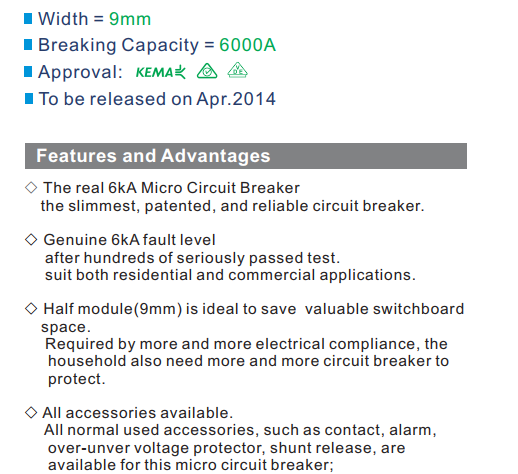
It is harder to dump the same energy in what is in effect a smaller space, so the margin of being better than the absolute minimum required may not be exactly the same. Rather like the 9mm wide MCBs that came and went a few years ago and never seemed to touch the sides, where the PSSC was a bit doubtful. Looking the other way there is a very good reason that MCCBs etc for big fault currents are made as larger sized lumps.
Remember things like this being the device of the future but not actually available ?
To be fair they do claim to have made one that manages 6KA now and I guess the live and neutral breaking RCBOs are similar in terms of contact size and swing to a half size MCB.
Mike.
We're about to take you to the IET registration website. Don't worry though, you'll be sent straight back to the community after completing the registration.
Continue to the IET registration site