


What do you put on an EICR when there is no/faulty smoke detectors in a domestic property?
What do you put on an EICR when there is no/faulty smoke detectors in a domestic property?

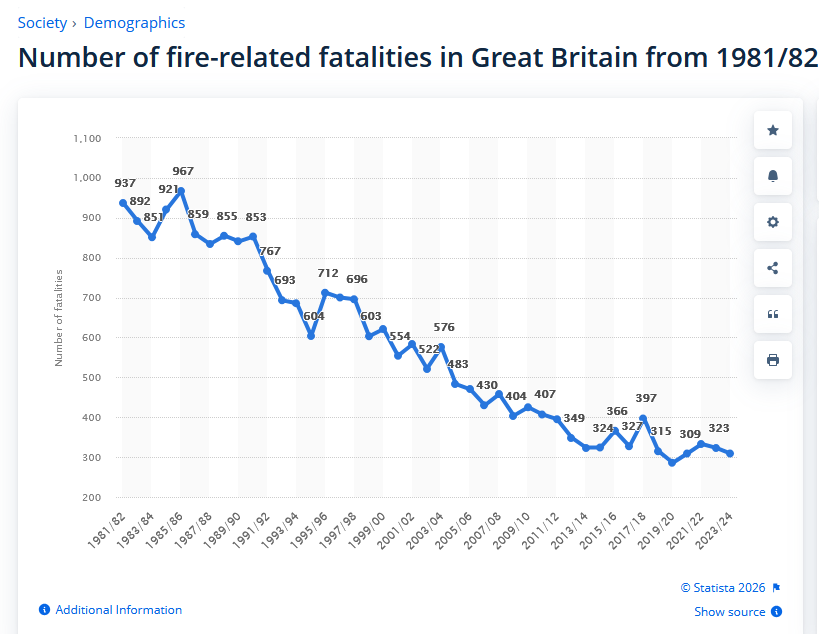
That is an interesting and article & indirectly suggests that 80% of fires occur in homes with fire alarms probably because they are pretty common. It is important to balance this with the fact that fires are mercifully rare - most houses will reach demolition and never have seen one, so most of the folk not checking their alarms because it is not very likely, are in a way correct, it is not very likely. (compared to say a car crash or tripping over the stair carpet).
Even if we disabled all fire alarms at once, we'd never get back to the rate we had before they were invented, as we no longer have open fires, or anything like as many people smoking indoors, or worse smoking in bed..
I wonder how much of an up-tick they would consider serious.
Mike.

As a Friday Folly, it would be interesting to see if of all the same people that were surveyed about testing smoke alarms monthly how often they test their RCBO every 6 months. (Hopefully when they change their clocks for daylight saving) I suspect fewer people test their RCD in the UK than test their smoke alarm.
Now this could indeed be masking an issue. Does the RCD actually work as intended?
Eg of fails
Type AC RCBO in the domestic dwelling being blinded by DC
Jamed/Fused/seized mechanism
Unable to re-initialise circuit due to device fault

As far as domestic alarms are concerned, somebody needs to be there to hear them, which isn't much use if vandals have broken in and set fire to the place.
Of course if the real purpose is to alert any occupants so that they may escape, that does not really matter. ;-)
suggests that 80% of fires occur in homes with fire alarms
Well, it is easy to demonstrate associations and give a probability, but much more difficult to show that A caused B, or B caused A, or C caused both short of randomized controlled trials.
I doubt that open fires caused many houses to burn down, but gas appliances still blow up the odd house.
Perhaps people with (functioning) smoke alarms are more risk-averse and, accordingly, careful?
not very likely. (compared to say a car crash
I wonder how many of us have used an airbag? We want them to be there when necessary, but AFAIK, there is no test mechanism.
not very likely. (compared to say a car crash
I wonder how many of us have used an airbag? We want them to be there when necessary, but AFAIK, there is no test mechanism.
an airbag? ... there is no test mechanism.
Almost true - the car electrics verifies the bridge wire of the ignitor is intact by passing a small current, well below the 'no fire' threshold every time the ignition is turned on, and indicates a fault code if the loop is not a suitably low resistance. The firing current is a large factor above the 'all fire' threshold of course. But apart from that electrical conservatism, there is no real guarantee of the state of the chemicals which may be damp or or even absent in a car that is say 10-20 years old of unclear previous history.
But, as most of the time the airbags are not needed, and perhaps so long that of those that are needed, at least a reasonable percentage work as planned, that is a sensible balance of risk. Alternatives such as perhaps an annual replacement of the pyrotechnic material would not be justified and would introduce new dangers with handling and safe disposal that might even be worse than the original problem.
Mike.
Fair enough.
It might not be unreasonable to change the main air bags' pyrotechnics as a service item every 10 years - just like you replace your smoke alarms. :-)
The culture around car failure is not as precautionary, we don't generally change things that are not already broken, or showing signs of wear - brake pads are changed by condition, not age, and while in Germany brake hoses and rubbery suspension parts seem to be changed every 5 years if needed or not, here we seem happy to wait for them to fail or for the MOT inspector to comment. Partly of course because most car accidents are not mechanical failure so much as the nut behind the wheel as it were.
I mention this in part because often on this forum we try and engineer out the human element completely, and I think this is rarely possible. Folk at some situation will fit the wrong lamp, or leave the covers off, or trail leads out of doorways and there is not a lot we can do about it apart from say 'it was not designed for that' , In the same way we cannot force folk to check their smoke alarms or RCDs.
Mike
Try £500-odd for a spark plug change every 4 years irrespective of mileage!
You might just get the owner of a low-mileage 10 y.o. car to pay for new air bag bits, but unlikely at 20 years. The thing is that modern cars do not rust to bits like they used to do.
However, if the test button of your 10 y.o. smoke alarms still works, why change them? Why indeed if they are mains-powered?

Not as such, but they do have continual built-in-test and a warning light on the dash to indicate if there is a problem.
We're about to take you to the IET registration website. Don't worry though, you'll be sent straight back to the community after completing the registration.
Continue to the IET registration site