Three days ago I said:
”The question that Graham asked was quite specific:
”However, if the lamp is damaged, and the user is being protected against accidental contact with live parts, say after the rectifier, would the type AC RCD operate is perhaps another?”
in that he said “after the rectifier”, so assume there are some diodes charging a capacitor, which discharges to supply the DC current, and the input current is 25 mA at 230 volts, what is the DC output current and voltage?”.
So presumably after the rectifier the current and voltage is peak, not RMS? So if the current and voltage is 25 mA at 230 volts AC measured RMS, then after the rectifier it should be 35,35 mA at 325 volts pulsed DC unless there are a few more electronic components to drop the voltage?
problems of nomenclature
Exactly. Given that definition, the half wave rectified shape can never contain any DC component (which by most definitions is the 'smooth' component).
Probably drop into the 'superposition' of components discussion here. "Clearly defined areas of Doubt & Uncertainty"
I agree that there is a problem with nomenclature.
BS EN 61008-1:2012+A12:2017 hardly helps. Under, "definitions" at 3.1.3: pulsating direct current current of pulsating wave form which assumes, in each period of the rated power frequency, the value 0 or [my emphasis] a value not exceeding 0,006 A d.c. during one single interval of time, expressed in angular measure, of at least 150º
Please forgive me if this seems pedantic, but a definition cannot contain the word, "or".
BS EN 61008 specifies 3 groups of tests for type A RCDs: sinusoidal a.c.; pulsating d.c. (assuming a value of 0 for at least 150º of the cycle); pulsating d.c. superimposed by a smooth direct current of 0.006 A.
So I think that we need to be careful what we mean when we say, "pulsed d.c."
I'm not sure of the exact derivation, but the IET Wiring Matters article concurs:
'When the Type A setting is selected on the instrument, a half wave pulsating residual test current superimposed on a smooth direct current of 6 mA is produced, which effectively applies a 1.4 multiplier to the rated residual current (IΔn). For example, if the 30 mA setting is selected, the RCD will be subjected to a test current of 42 mA (30 x 1.4 = 42 mA)'
That may well be an error.
The manual for Megger 1700 series instruments states:
'Type A' RCDs are sensitive to pulsed DC as well as AC fault currents, and are tested with a pulsed waveform. The RMS current is √2 x the rated operating current of the RCD.
There is no mention of a smooth component.
but a definition cannot contain the word, "or".
I think it's just a wordsmiths way of saying between 0.0 and 6.0mA
- Andy..
Then say so!
I think that you are correct (as ever) and the clue may be the "EN" in the document reference, but if you delete, "the value 0 or a", the meaning of the definition does not change.
Of course, if wordsmiths got it right first time, every time, there would be no amendments and no need of appellate courts (of which I have experience).
but
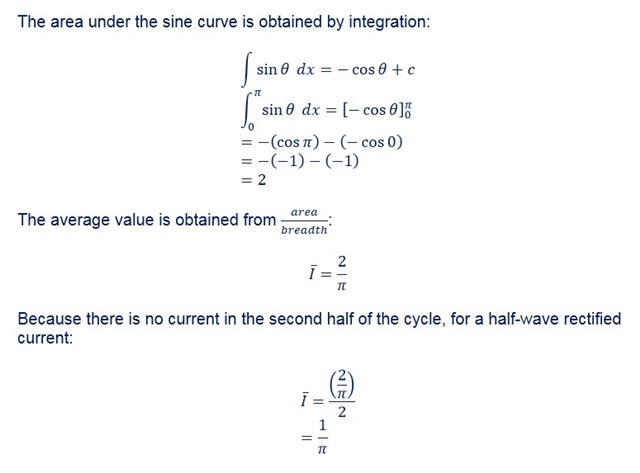
but for a half-wave pulsating current, it is half the peak value.
Is also not true I'm afraid, - its only about 33%, as half sine waves are bottom heavy, not a triangle... and yes we do have pantomimes.
But actually the whole thing could have been solved by actually showing, and annotating the waveform intended, by providing the existing oscillogram with labelled axes. Sadly that was not done.
Luckily perhaps we don't need to worry about it, as we only have to test RCDs at 250mA RMS with a sinusoidal AC. But it does rather beg the question of what happens with other waveforms, and if makers are in fact all testing in the same manner.
Mike.
I don't have a problem with the word "or".
For 150 360ths of the cycle period it is at 6mA, for the rest, it is zero,
The problem is, that is not describing a DC, by any stretch of the imagination. It may be unipolar - i.e. non-reversing, but the one thing is is not is steady over time.....
They meant, and should simply have said, a square wave with an asymmetric duty cycle.
Mike.
but for a half-wave pulsating current, it is half the peak value.
Is also not true I'm afraid, - its only about 33%, as half sine waves are bottom heavy, not a triangle... and yes we do have pantomimes.
Oh yes it is.
Mike, you appear to be thinking of the average current, which is indeed about a third.

An alternating current reverses direction periodically. a direct current is one which does not. So long as the value is always zero or positive, it is d.c. It does not have to be smooth.
it is d.c. It does not have to be smooth.
hmm..
Would you consider a unipolar square wave, or a triangle wave where the lower crest is at zero, as examples of DC?
I would not, because in addition to a DC term (0Hz, non changing, there for 'ever' or at least for the duration of the measurement) , there is a clear fundamental frequency, and some harmonics...
I agree there is a de-minimis case where the 0Hz term dominates - a DC with a bit of ripple on it is a common situation and makes sense described as such.
I might even consider the output of a 3 phase bridge to be in that class, but I'm not sure I'd consider something that fell to zero for a non-trivial part of the time to be quite the same.
I'm not sure how well that fits with the more 'power electrical' definitions, it is certainly open to more than one interpretation.
Mike
Perhaps we should re-introduce the term "continuous current"....
- Andy.
Perhaps we should re-introduce the term "continuous current"....
- Andy.
Save that, for example, your 42 mA half-wave rectified d,c, superimposed upon 6 mA of smooth d.c. would be continuous.
Here is a Boxing Day question for all of you. It may be unlikely to occur, but if you had one device on a circuit with a fault to ground of 15 mA r.m.s. a.c. and another one with a fault of 15 mA r.m.s. half-wave rectified pulsating d.c., would a 30 mA type A RCD trip?
... re-introduce the term "continuous current"....
maybe we should, but I think we'd have to agree what we meant by it first, which is kind of where we came in. If we assign a single figure to something that is changing, are we refferring to its mean, its RMS or its peak ?
I'm not sure..
Mike
fault to ground of 15 mA r.m.s. a.c. and another one with a fault of 15 mA r.m.s. half-wave rectified pulsating d.c., would a 30 mA type A RCD trip?
haha - maybe only half the time ;-)
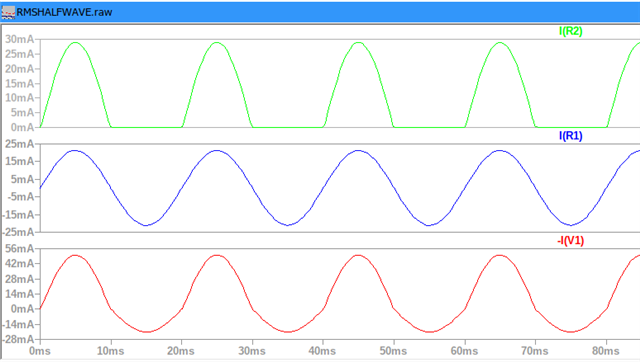
you have defined exactly what you want, The sum of these upper 2 current traces, making the lower one

We do not, however, as we have just discussed, know for certain what the RCD spec actually means.
Mike
PS for those interested, this is a simulation in LTspice, a tool I find helpful for this sort of stuff.
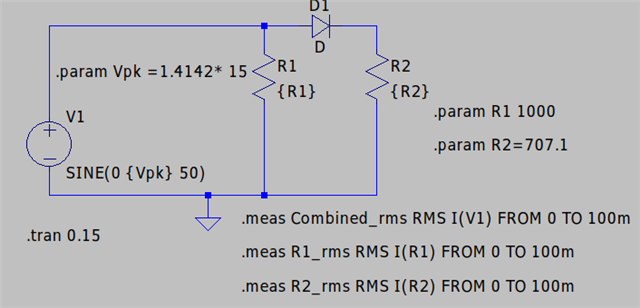
This is the circuit being simulated.

haha - maybe only half the time ;-)
Mostly not, IMHO.
If my maths are correct, the RMS value of the combined current is only 16.8 mA.
But is, "mostly not" (or 50% of the time) a single RCD being exposed to an imbalance many times, or many RCDs being exposed only once?
If we assign a single figure to something that is changing, are we refferring to its mean, its RMS or its peak ?
We need to take care with the peak, average (mean) and rms values of such signals.
I think that we are all agreed on that. :-)
P.S. this discussion beats the dross on the telly by a country mile.
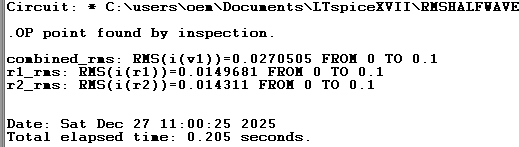
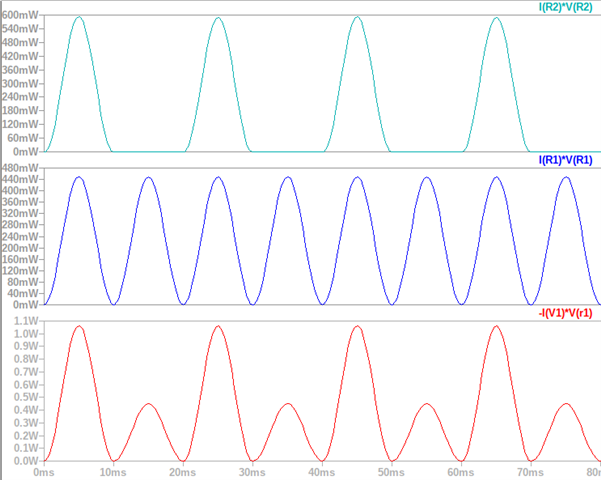
I have added the RMS calculations to the simulation above (and updated the screenshot image in the post above, to reflect that just in case someone else wants to know how to try this sort of thing at home ) and the combined RMS is not as low as you might think, coming in at almost exactly 27mA. - it is not simple power addition (which would be root of sum of squares - think Pythagoras) because they are synchronous functions, - that is to say the peaks of the rectified and un-rectified waveforms are always aligned, and not independent of each other and those peaks, while only there half the time, count for most of the RMS energy.
The spice log is as follows.
I appreciate that there are quantisation errors, so the nominal 15mA RMS in the 2 limbs is not quite, but this still illustrates the point
It may help to visualise this by considering the power as a function of time, rather than smoothed over many cycles,

regards
Mike.
PS schematic edited to create named nodes r1 and r2 so that we can plot the current in the component times the voltage across it with a meaningful name.
We're about to take you to the IET registration website. Don't worry though, you'll be sent straight back to the community after completing the registration.
Continue to the IET registration site