Adding up current

In a ring final circuit
(Based on Paul Cooks commentary of the 17th edition)

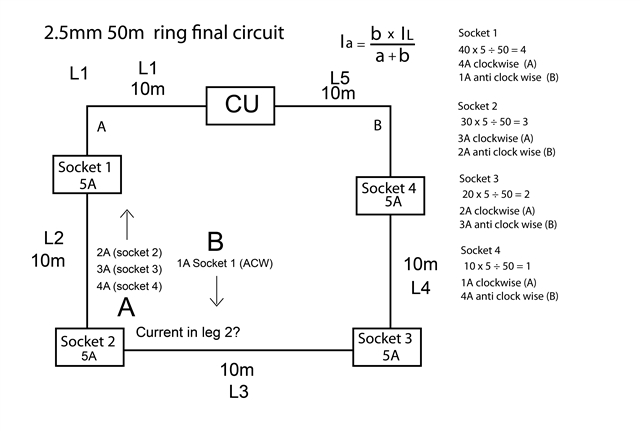
Very simple curent split using both legs of the ring

Not sure about adding up the currents in each leg
Take leg 2 Than will have the Ia of sockets 4,3 and 2
and the Ib of socket 1
How do these add up so you know the current in this leg?
Hope that makes sense
Thanks
Parents
  • Thanks for the help.
    The heating of the cable as mentioned above I guess is the prime consideration in a ring final circuit
    Especially as the sharing of the loads, cable lengths and installation methods play a large part in the 'total' overcurrent protection
    of the cable, especially as the protective device is rated higher than the cable


    Couple of questions if thats OK

    In the very first example where each leg was perfectly balanced. the currents add up to zero.
    This is a mathematical phenomenon of the net current?
    Im trying to visualise what actually happen say if a If a clamp meter was placed around the cable?
    It will measure a magnetic field (s) but there is a lot going on in a RFC with clockwise and anti clock wise currents
    and with AC direction change and unpredictable loads. Its hard for me to visualise...

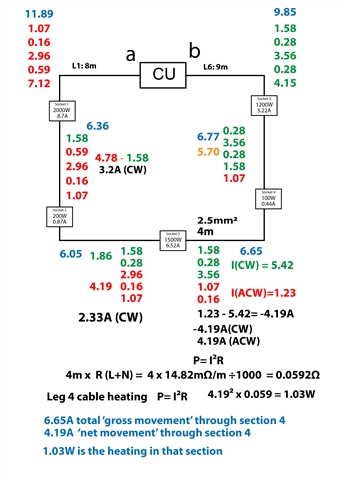
    Ive done another example and tried to work out the heating effect in one section of cable.
    Am I doing this correctly (as in basic principles) Anything with heat i realise can get really complex

    Thanks very much


  • If a clamp meter was placed around the cable?

    If you clamp the whole cable (i.e. both L & N together) you'd likely read zero whatever current the cable was carrying - a the L & N currents should be equal but in opposite directions and so would cancel out the magnetic field the clamp meter reads (actually, if you did get a significant reading, it would suggest that L & N were not balanced - thus indicating a break or high resistance connection in one of the conductors around the ring).

    If you could clamp just one core (L or N) then yes, you should be able to verify your calculated  "nett" values.

    The bottom line physics is that to get a current to flow along a conductor (which will always have some resistance) you need to have a voltage difference between the ends of that conductor - higher voltage at one end and lower at the other and the current flows in one direction, reverse the voltage difference and the current reverses too. It's not possible for two currents to be flowing in different directions in the same conductor at the same instant. (The currents can flow in different directions at different times of course - which opens the door for a lot of cleverness when it comes to 3-phase work or combining different frequencies) but for d.c. and simple single phase a.c. using r.m.s. values, it can be treated quite simply).

    AT first glance, your power loss calculation looks right to me (I've not checked your actual numbers though). P=I²R is a re-arrangement of P=IV where V would be the voltage drop along the conductor - so it all stacks up.

       - Andy.

  • In the very first example where each leg was perfectly balanced. the currents add up to zero.
    This is a mathematical phenomenon of the net current?
    Im trying to visualise what actually happen say if a If a clamp meter was placed around the cable?
    It will measure a magnetic field (s) but there is a lot going on in a RFC with clockwise and anti clock wise currents
    and with AC direction change and unpredictable loads. Its hard for me to visualise...

    Think of water flowing down pipes. 

    In the first case, let's say 20 l/min flows through the stopcock (the CU). 10 l/min flows anticlockwise to tap 1. 5 l/min comes out of the tap, which leaves 5 l/min to come out of tap 2. Similarly 10 l/min clockwise to tap 4 where 5 l/min comes out leaving 5 l/min for tap 3. All the water has come out of the four taps, so there is nothing left to flow along leg 3.

    As for a clamp meter, I am afraid that the line and neutral will cancel each other out. You do have two conductors (or pipes) in each cable, but the flow is in opposite directions.

    To measure the current with a clamp meter, you would have to bring one of the conductors out of the sheath and clamp it on its own, but then you have destroyed your T&E.

  • AT first glance, your power loss calculation looks right to me (I've not checked your actual numbers though).

    Agreed. It would be easier to check the numbers if we knew the length of all of the legs!

  • It's not possible for two currents to be flowing in different directions in the same conductor at the same instant.

    That's *net current* (after all contributions are added/subtracted as appropriate). [Just calrifying]

    One of the nice, but some times confusing, things when we all talk about this stuff is that there is the idea of "superposition" where each loop of voltage/current (must be a loop) can act independently (the voltage around the loop must be zero, and that at each junction point the currents (in and out) also add to zero. All that is a consequence of basic classical maths/arithmetic (3+2 = 2+3; 2*3 = 3*2; 3+3 = 2*3; etc). 

    In the ring final circuit  we have L-L loops, N-N loops, L-N loops, so fun all round. Here we 'suddenly' shift from perfect conductor ideas (which generate zero heat) to needing to be aware of the heat generated in these not quite perfect conductors as the *net current* in each cable is considered.

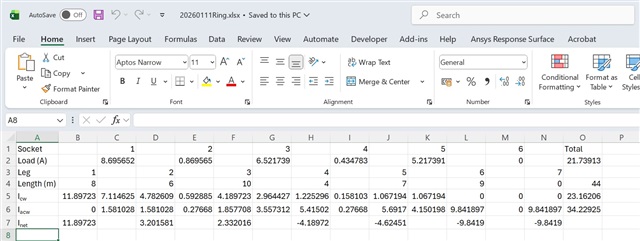
  • OK, I have deduced that the lengths of legs 2, 3, and 5 are 6 m, 10 m, and 7 m respectively, in which case the figures seem to be correct save that it is not clear what some of them mean. Calculations attached. I drew it up for 6 sockets, so the last leg and socket have values of zero.

    (Can we upload e.g. spreadsheets, or just pictures?)

  • Thank you for this, spot on with the lengths
    The legs were 1:8m  2:6m 3:10m  4:4m  5:7m  6:9m

Reply Children
No Data