The car park

There are several main types of car park in the UK

Open air
Multi-storey open sided
Basement
Basement with dwellings or commercial space above

The UK is seeing a large move towards EV (Electric Vehicles) from traditional ICE (Internal Combustion Engine) there have also been several well documented Car park fires in the last decade.  Eg Luton Airport Car park October 2023 with over 1500 vehicles destroyed or damaged

Should all UK Car Parks apart from Open air have 
Fire detection with 24/7/365 monitoring with backup power supply
Increase amount of manual fire call points per floor and throughout stairwells to increase evacuation alert
EVSE auto shut off for power in the event of a fire or an alarm
Battery backup for emergency lights for a min of 6 hours
Increased amount of illuminated fire exits signs
Fire resistant cabling throughout
Fire restitant cable management/containment throughout
Increase IP rating throughout in case of fire due to the amount of water that may be used
Annual EICR
Technology/Mechanisms to assist evacuation of disabled and mobility impaired persons, this could include evacuation lift replacing the passenger lift


As always please be polite and respectful in this purely academic debate.


Come on everybody let’s help inspire the future

Parents
  • "The UK is seeing a large move towards EV (Electric Vehicles) from traditional ICE (Internal Combustion Engine)"

    if that is Battery EV, then please ... i hope not   (for various reasons)   as then all the 'solutions' needed for it just go away and sanity (at least for me)  returns.  :-)

  • The plan of course is for no brand new petrol and diesel cars to be sold in the UK after 2030, and that may well occur.

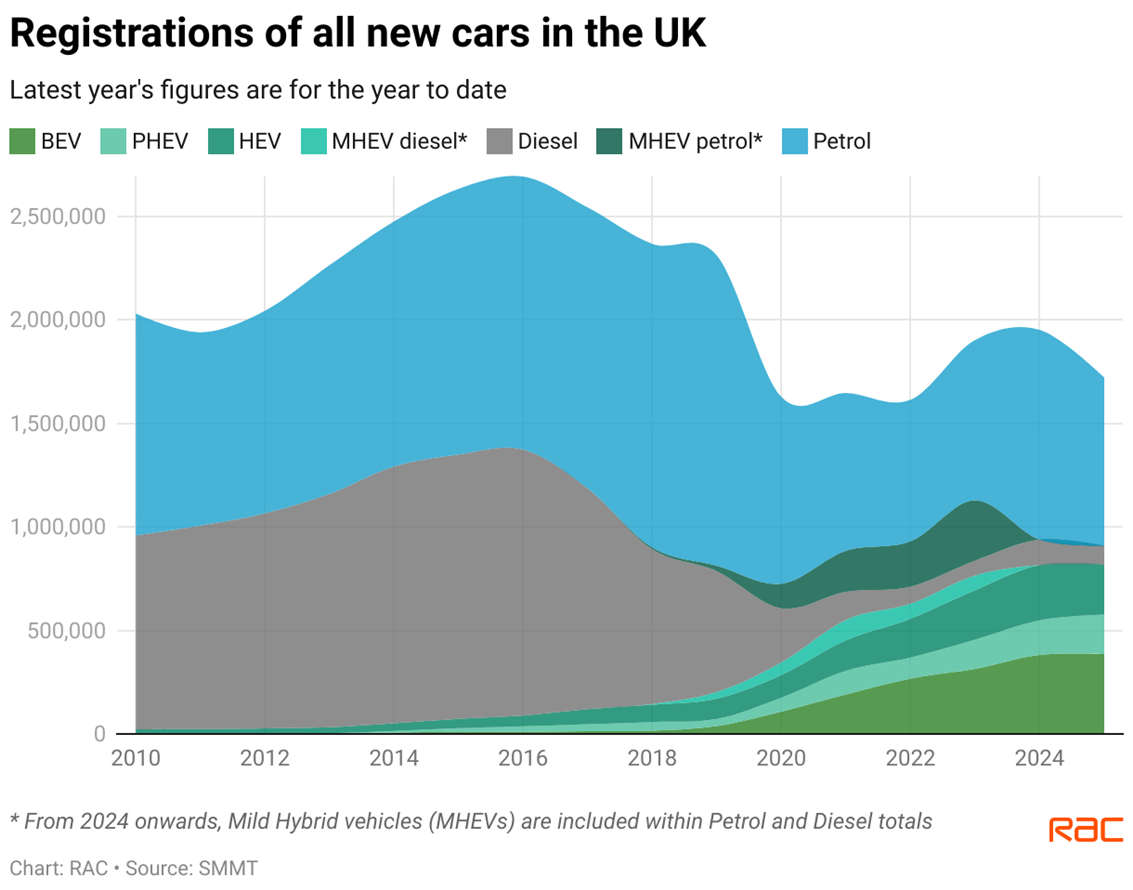
    This article shows the trends with some nice graphs. 

    https://www.rac.co.uk/drive/electric-cars/choosing/road-to-electric/ 

    This graph below is pretty good, overall sales of new cars are declining, but the fraction of new cars that are some kind of EV, is very much on the rise.

    Bear in mind however that there are some 35 million roadworthy cars in the UK in total, and the average petrol car is just over ten years old, and the average Diesel a few months younger. ( www.racfoundation.org/motoring-faqs/mobility#a9 ) so unlesss there is a step change, then up to perhaps 2050 there will still be a lot of internal combustion engines on the road. 

    Mike.

  • The only non battery EV I can think of is hydrogen fuel cell. But that has been tried and failed commercially. Hydrogen is more expensive than mains electricity.

Reply
  • The only non battery EV I can think of is hydrogen fuel cell. But that has been tried and failed commercially. Hydrogen is more expensive than mains electricity.

Children
  • There was a theory that "Hydrogen" was promoted by the Oil & Gas lobby as mechanism for delaying the inevitable need for CO2 reduction by the O&G industry. While H2 has 'great' energy storage, it's terrible at most other aspects of engineering a working supply system, so ideal for engineering research efforts. 

    It's a common trope across the wider climate denial industry to avoid mentioning the CO2 part, and suggest that some other single tech will never supply 100% of the energy (Nuclear powered scooters - no thanks; Hydro storage everywhere - not enough water; etc.)  5% H2 in the gas pipelines isn't a meaningful reduction in hydrocarbon usage.

    If anything, we should have banned hydrocarbons (flames!) when the motor car was invented. Unfortunately all the lighting at the time was by gas mantles... (History is such a problem!)

  • lighting at the time was by gas mantles... (History is such a problem!)

    More importantly, at the time of peak gas mantle, the gas was coal gas, and if your house was heated more than just the kitchen you lived in luxury, and the fuel of choice for almost everything in the UK was coal. 

    (I can remember the coal fired chip shop in Filey, just about, and very clearly counting the bags as the coal man delivered so there was no chance to underdeliver. ) Lights were electric by then however, except on the railway stations for some reason.

    At the point Keeling (of curve fame) was just starting to collect his CO2 data, coal was king and in the UK at least, the cheap north sea gas, and the central heating to burn it was still some way off in the future.

    I like gas mantles in some situations however, they give a good light in a marquee or similar, and unlike a generator do not keep awake those on camp who wish to sleep.

    Mike

  • if your house was heated more than just the kitchen you lived in luxury

    That was only 'cos the range had been lit.

    I also like gas lighting and remember it at my local station. There are still some rather rusty remains at home.