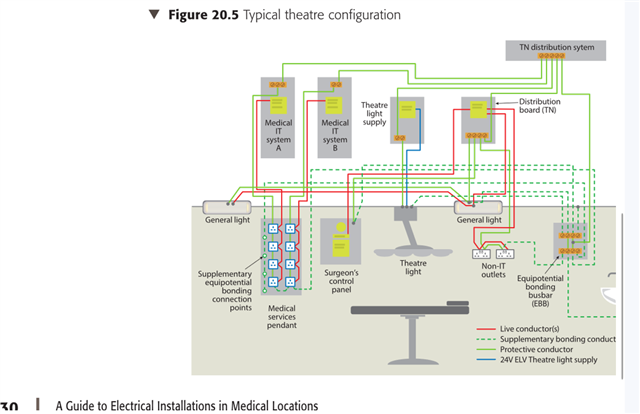
Cable connection between the equipotential earth bonding bar (EBB) and the and distribution board

This follows on from a prior question and discussion: Cable size between equipotential earth bonding bar and distribution board in a Group 1 medical location

Regulation 710.415.2.3 states: The EBB shall be connected to the system earthing using a protective conductors having a cross-sectional area greater than or equal to the largest cross-sectional area of any conductor connected to the EBB.

Note HTM 06-01 provides no further definition of the point of connection of the EBB and the connection to the systems protective earth.

The clause is silent on the location; however, the consensus was:  the local Distribution Board  rather than the origin suffices.

Question 1 : The following statement has provided by a hospital engineer questioning this. Is this considered a user preference rather than regulatory compliance:

''Where practicable, medical equipotential bonding should be connected directly to the main earthing terminal to ensure integrity and clarity of the earthing system. 

 Risks of wiring EBB to a DB;

  •  Increased dependence on downstream connections
  • Higher chance of unnoticed disconnection
  • Harder inspection and fault tracing
  • Greater lifecycle risk
  • You are relying on the DB & MET connection
  • Any future alteration, loose termination, or undocumented change can ;Increase impedance/break the bonding path
  • The EBB is a safety reference, not just a CPC
  • Increased impedance & higher touch voltages under fault conditions
  • DBs are: Opened/modified/extended & re-terminated
  • During future works: Earth Bars get disturbed/conductors get moved or resized/Temporary disconnections occur
  • The medical equipotential system can be compromised without anyone realising
  • Parallel earth paths and circulating currents cause issues with testing

 Direct MET connection provides a solution that is as follows;

  • Lowest risk
  • Clearest compliance
  • Preferred by healthcare AEs on a new project 

Question 2 : From the statement above is this statement correct:  The EBB is a safety reference and not just a CPC

  • Medical locations aren't my area at all, but I imagine what's intended is similar to supplementary bonding in other situations - i.e. to reduce to a minimum the touch voltages between simultaneously accessible exposed- and extraneous-conductive-parts. To that end, connections are normally kept short as possible as longer connections inevitably mean higher resistances and so larger voltage differences for a given fault (or other protective conductor) current. Connections to remote parts of the installation also increase the risk of "importing" voltage differences from elsewhere.

    As for "not just a c.p.c", yes in general bonding conductors are protective conductors,  but not circuit protective conductors.

      - Andy.

  • What is a "reference safety" [deliberate juxtaposition]?

    is it a 'clean reference'?

    Is it a 'safety connection' (i.e. a waste disposal for electron floods)?

    Could it mean something else? ("reference" tends to imply a measurement). Could there also be a "Stimulus reference" - the bodily point for the return path of an electrical stimulus.

    This has all the same hallmarks as trying to discuss EMC / RFI effects in complex systems.

    When multiple return paths are possible the test equipment becomes more complicated (especially for detecting disconnected paths..) 

  • Not my area of expertise either - but I'd imagine that you're trying to achieve a localised potential in a defined area - such as in an operating room or theatre or something; So that voltage between any conductive parts rise and fall together with the least resistance and hence potential difference between them.

    So does the earth path prior to the DB matter - other than it's importance for the DBs earth, not as part of the EBB?

    In this case - I've assumed the EBB to be an earth bar local to each room, and providing supplementary equipotential bonding to a specific location. And not the MET.

  • Are the diagrams in Fig 710.2 and 710.3 not illustrative of the requirements?

    If you don't connect the EBB and the medical IT system to the TN system earth:

    1. Won't they require their own independent earthing system, rather than providing the PE connection to Earth from the medical IT system through the mains earthing system?

    2. Won't you still need to bond the TN system to the EBB and equipotential bonding system in the location anyway to prevent touch voltage and meet the requirements of the equipotential bonding system for the location? Aren't more bonds between systems better at reducing impedances?

  • The clause is silent on the location; however, the consensus was:  the local Distribution Board  rather than the origin suffices.

    I agree that the clause is not entirely clear, but "protective conductor" is in the singular, which might be read as a single cable without any junctions.

    The requirement appeared in BS 7671:2018+A2:2022, so there must be existing installations which do not comply in respect of the CSA. So why was the requirement introduced?

    Are the diagrams in Fig 710.2 and 710.3 not illustrative of the requirements?

    They are, but although Fig 710.2 shows the "connection to protective earth in distribution system" (to the left of the EBB), it does not specify where the other end is attached to the system earth. It merely shows TN distribution system, which implies that a local DB would suffice.

    If a local DB is used, then presumably the CPC of the distribution circuit which supplies it must also meet the minimum CSA requirement for the bonding connexion.

  • They are, but although Fig 710.2 shows the "connection to protective earth in distribution system" (to the left of the EBB), it does not specify where the other end is attached to the system earth. It merely shows TN distribution system, which implies that a local DB would suffice

    I think this depends on particular situation, although the 'source earth' in the TN system may well be common. Another example, from the IET Guide to Medical Locations:

    Surely it's the 'most efficient' place to provide the earthing, and somewhere hopefully that's common to the TN supplies feeding the primary of the IT system, and any 'TN' equipment in the location? Hopefully all these places are rather near the location itself?

    BS 7671 isn't, and can't be, a 'manual' or 'handbook' that covers all eventualities. There are good reasons to keep things more flexible ... to permit a multitude of conformant designs.

    But in doing that, there is a reliance on designers having knowledge of the pro's and con's of doing something one way vs another.

  • Thanks for the responses. For the situation I am referring to is for Group 1 Medical locations and not for Group 2 which requires an IT system.


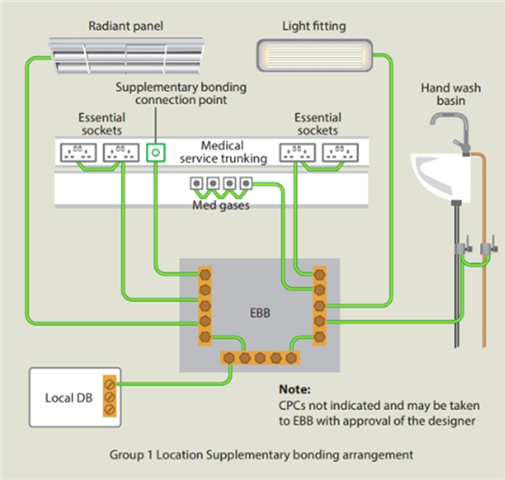
    The IET publication:  GUIDE TO ELECTRICAL INSTALLATIONS IN MEDICAL LOCATIONS

    Has the following diagram:

    This diagram does show the connection to the local DB - and hence the comments made the hospital engineer, would appear incorrect. Is there a consensus on this? 

  • It appears that the book you are referring to was published nine years ago in 2017, so you need to check your copy of the current edition of BS7671 as requirements have changed since then, but you also need to consider that Amendment 4 can be implemented immediately when published on 15 April 2026 and the previous version, BS 7671:2018+A2:2022+A3:2024, will be withdrawn six months later.

    In amendment 4 requirements concerning supplementary equipotential bonding have been modified and extended. Furthermore, a new Annex B710 model form to record supplementary bonding connection resistances.

    electrical.theiet.org/.../


  • Thanks for the responses. For the situation I am referring to is for Group 1 Medical locations and not for Group 2 which requires an IT system.

    I'm not sure I follow the logic.

    In Group 2, a Medical IT system is required for ME electrical equipment, but, as evinced by Regulation 710.411.5, a Medical IT system is not precluded in Group 1 locations?

    But, the bonding system is required in both, and the rationale of "the 'most efficient' place to provide the earthing" still applies?

  • In BS 7671:2018+A2:2022+A3:2024 there is no diagram for Group 1 EBB connections to the TN system, just for a Group2 location, which I included in my original; question. I recognise that guidance document is from 2007, however it is the only current document that shows a Group 1 image which is why I used it.

    Amendments to the regulations with respect to this part of the installation since that date have not changed.

    I am aware that the 15th April 26 may change this, however at this juncture our design related to this specific query will already be in construction.