USB charger outlet in Bathroom Zone2

I've been asked to add a USB charging port into a bedroom with a bath in it.

My understanding of BS7671 is that a room with a bath is a bathroom. As such the outlet would be in zone 2 of the bath.

Would I need to power the charger via a safety transformer and could this be built into a +IP4 enclosure similar to a shaver outlet

Thanks for your assistance

  • Connections to Earth (or bonding) aside, when someone is immersed, current thinking is that there isn't an agreed limit of voltage below which things can be considered "safe" - so the device itself might be bad enough in some cases ... but that is not clear.

    It makes you wonder how they can put the electrode right inside the heart (for ablation purposes) and get away with it.

  • The interested may find 

    https://www.researchgate.net/profile/G-Cargill-Iii/publication/335250921_Electric_Shock_Drowning_Causes_and_Prevention/links/5d5b416b45851521025227f1/Electric-Shock-Drowning-Causes-and-Prevention.pdf 

    informative. The problem is current in the body, and that in turn depends a lot what sort of wet - fresh water, tap water and sea water are very different terms of currents in the body, and the 2 cases,

    1) where a body is part immersed in water that is one of the 2 contacts, where low resistance water as a series element makes it worse,

    2) Where the body is  fully immersed in water carrying a current to and from elsewhere, and it might be better if the liquid was a lower resistance parallel path to reduce the current through the body.

    In practice voltages as low as 28 have been reported as lethal but the circumstances that achieved that have been very unlucky coincidences of all the unfortunate factors.

    The most reliable safety measure is to have current and time limiting, rather than voltage, which is where RCDs have an advantage.

    Mike.

  • I guess there are a number of factors to consider - water getting into the socket contacts themselves and causing problem (either directly or by causing corrosion, which can leave conductive deposits where insulation is needed), water getting into the "conversion unit" with the risk of bridging the mains side to the USB side (in additional to the usual damage) and then there's water ingress to whatever device is connected to socket. Mind you most of those devices contain batteries so the problem doesn't necessarily go away entirely with the removal of the socket..

       - Andy.

  • Other factors include:

     - Skin resistance when substantially immersed is unknown ... and may drop to very low (nearly zero) values. This factor means that very low voltages, perhaps into single figures, might actually be very bad to someone who is substantially immersed in a bath.

     - the passage of electricity through water is complicated by the fact we are looking at electric fields emanating from the 'electrodes' in the water, and the passage of current is through the path of least resistance ... which might not be where you think it is because of things like concentration of salts increasing near the body, and also the points of entry/exit to tbe body seem to concentrate around the lowest impedance path through it ... usually the chest/trunk, where they can cause a lot of damage.

     - in electric shock drowning, the direction of current flow without the person in the water comes into play, due to the distances involved.

  • Assuming there is no 230V socket, is not the 5V of the USB already  derived by transformer inside the fitting ?

    It is not always 5V anymore, I believe the first version of USB was 5V only but more recent versions and variants, particularly USB-C are now variable voltage and have communications between the power supply and the device that can raise the voltage upto 20V - 30V or more, to allow rapid charging of mobile phones, tablets or powering of laptops, while keeping the current at manageable levels.

    Many laptops now use USB-C for power supplies, just from a quick search, it looks like laptop power supplies to USB-C PD 3.1 can even get upto 48V for 240W power output !

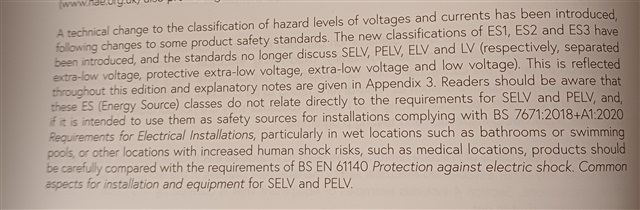
  • Can we clarify the use of Energy Source Classes 1, 2 and 3 for hazard levels of voltages and currents and the standards not discussing SELV, PELV, ELV and LV since 2020, six years ago?

    Reference IET Code of Practice In-Service Inspection and Testing of Electrical Equipment 5th Edition published 2020.

  • Skin resistance when substantially immersed is unknown ... and may drop to very low (nearly zero) values. This factor means that very low voltages, perhaps into single figures, might actually be very bad to someone who is substantially immersed in a bath.

    I assume that most of us have licked a PP3 battery Relaxed so it cannot just be voltage.

    If 30 mA is the safe limit, 9 V across 300 Ω could be risky.

  • In what way "clarify" ?

    You refer to the IET Code of Practice for In-Service Inspection and Testing of Electrical Equipment from 2020, and will note that the prohibition on the use of sources to 414.3(iv) for certain of the Part 7 'special locations' was implemented in BS 7671:2018+A2:2022, which is a similar time-frame?

    The fact that there is no alignment with BE EN 61140 is the issue ... the products effectively use what we used to term 'limitation of discharge of energy' (although this is somewhat complicated by the use of semiconductors and doesn't fully align with 'limitation of discharge of energy' either ... but certainly neither SELV nor PELV as defined).

    I am in no way implying products to certain are dangerous per-say ... the fact is that BS EN 62368-1 only considers products for use in dry condition ... BS EN 60950-1 was no different in this regard; however, BS EN 60950-1 implemented SELV and PELV, which makes it a "horse of a different colour" when looking at supplies sourced from such products for use in certain special locations?

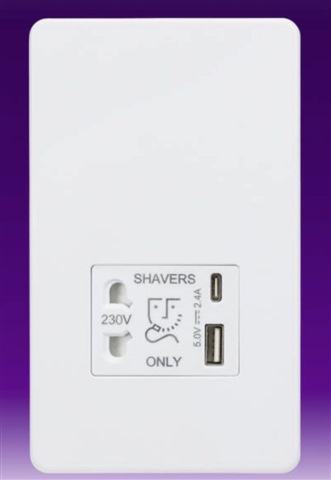
  • I will read Appendix Three of the IET Code of Practice In-Service Inspection and Testing of Electrical Equipment 5th Edition again over the weekend, as I am still trying to decide what the practical application of the guidance is regarding a fitting like this:

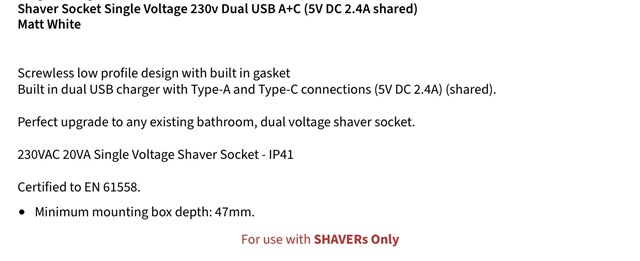
  • Despite having a choice of USB sockets the technical information on the website says it is only for use with shavers.

    But in reality it will be used for charging electric toothbrushes, phones, tablet computers, Bluetooth speakers and all sorts of other gizmos.

    As it stated that it complies with BS EN 61558 it appears to be suitable for installation in Zone Two, so long as direct spray is unlikely.

    But I have an image in my head of someone using a phone in the bath whilst charging it from the unit with a long USB lead, rather than using it to shave whilst standing and looking in a mirror over a wash basin.