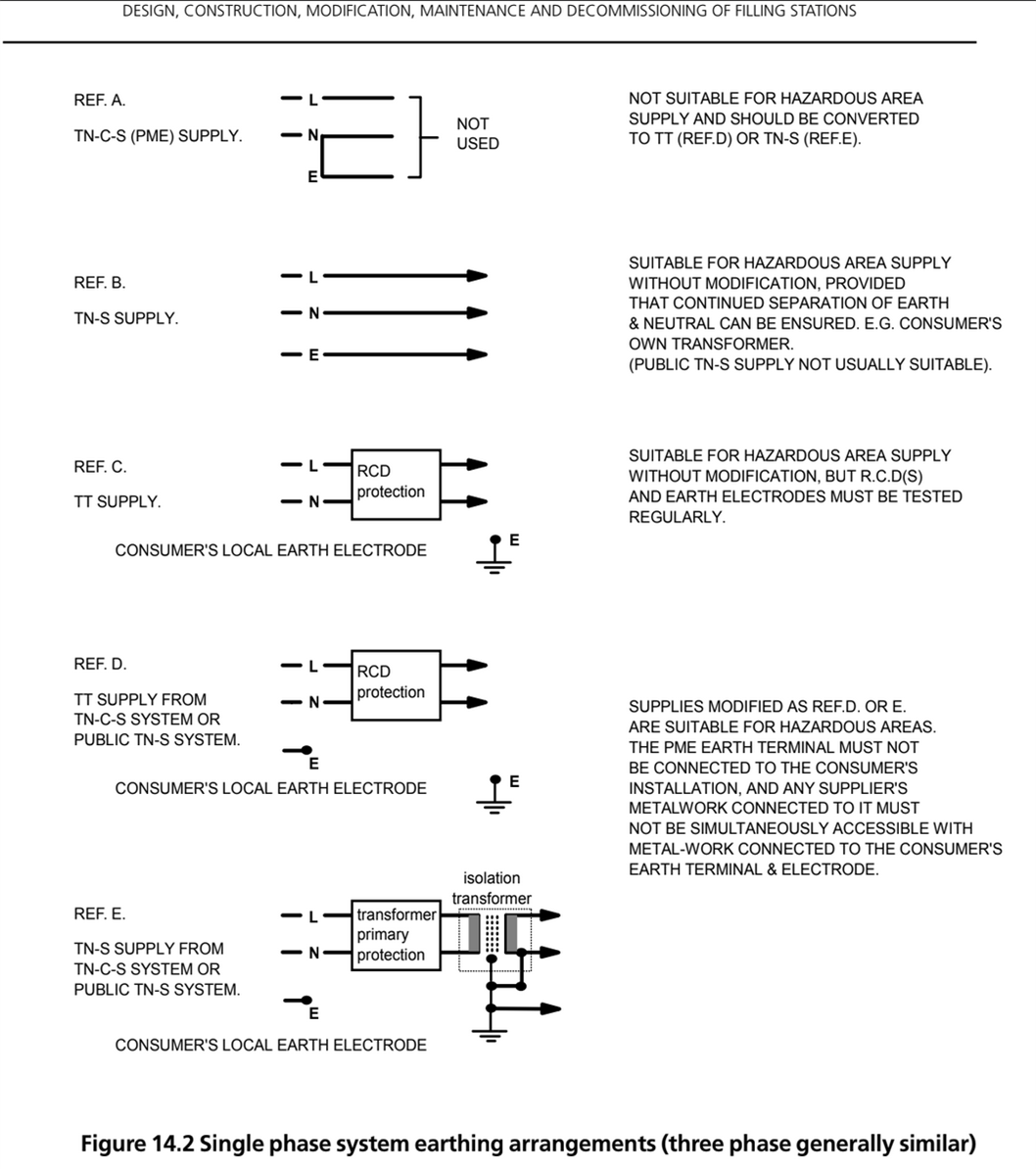
DNO TN-C-S supply to an industrial unit building which contains ATEX zones

Hi,

Could anyone offer any advice in relation to the earthing arrangement within ATEX zones please?

If a building (a large steel frame industrial unit) has a DNO TN-C-S supply, could it be acceptable for this earthing arrangement to enter ATEX zones? I'm considering a PEN conductor fault potentially representing an issue which should be avoided.

Is it reasonable to expect the ATEX zones required earthing arrangement to be defined in the project Hazardous Area Classification and DSEAR Risk Assessment and or project performance specification?

I appreciate BS EN 60079-14 may provide appropriate recommendations, which I intend to review a.s.a.p.

(Apologies if the above outline is too brief).

Thank you in advance for any responses.

Parents
  • Here is a excerpt from APEA 'Blue Book' Guidance for Design, Construction, Maintenance and Decommissioning of  Filling Stations.

    It has a bit more detail than 60079-14.

  • It has a bit more detail than 60079-14.

    Agreed ... but even there, there's still a need to understand that physical separation is needed between the earth electrode, protective conductors and exposed-conductive-parts in REF C and REF E supplies, from exposed-conductive-parts and buried metalwork connected to the primary supply ... both to conform to BS 7671 Regulation 411.3.1.1, and to prevent transfer of voltages and currents below ground. The worst-case transfer of voltage we are looking for is not 70 V AC, as in EV charging installations, but 25 V AC.

  • I wonder if filling stations might be a bit of a special case - with the pumps being basically outdoors and lots of connections to buried metalwork there are hazards there that might not be the same for maybe an indoor situation where a decent equipotential zone could be established and perhaps diverted neutral currents avoided.

       - Andy.

  • where a decent equipotential zone could be established and perhaps diverted neutral currents avoided.

    Andy, an 'equipotential zone' might only promote diverted neutral currents from outside the installation, especially in certain types of building construction, or where there are multiple 'fortuitous electrodes' etc. ... This would be little different in a general BS EN 60079-14 hazardous area.

    A filling station typically has an earth grid under the hazardous area to help in a similar manner to an 'equipotential zone' ... and there's a need to avoid diverted neutral currents flowing through that in the same way.

  • Ref B. How many filling stations have their own transformer?

    IIRC, the EVCPs at my local one are plugged straight into the adjacent main.

Reply Children
No Data