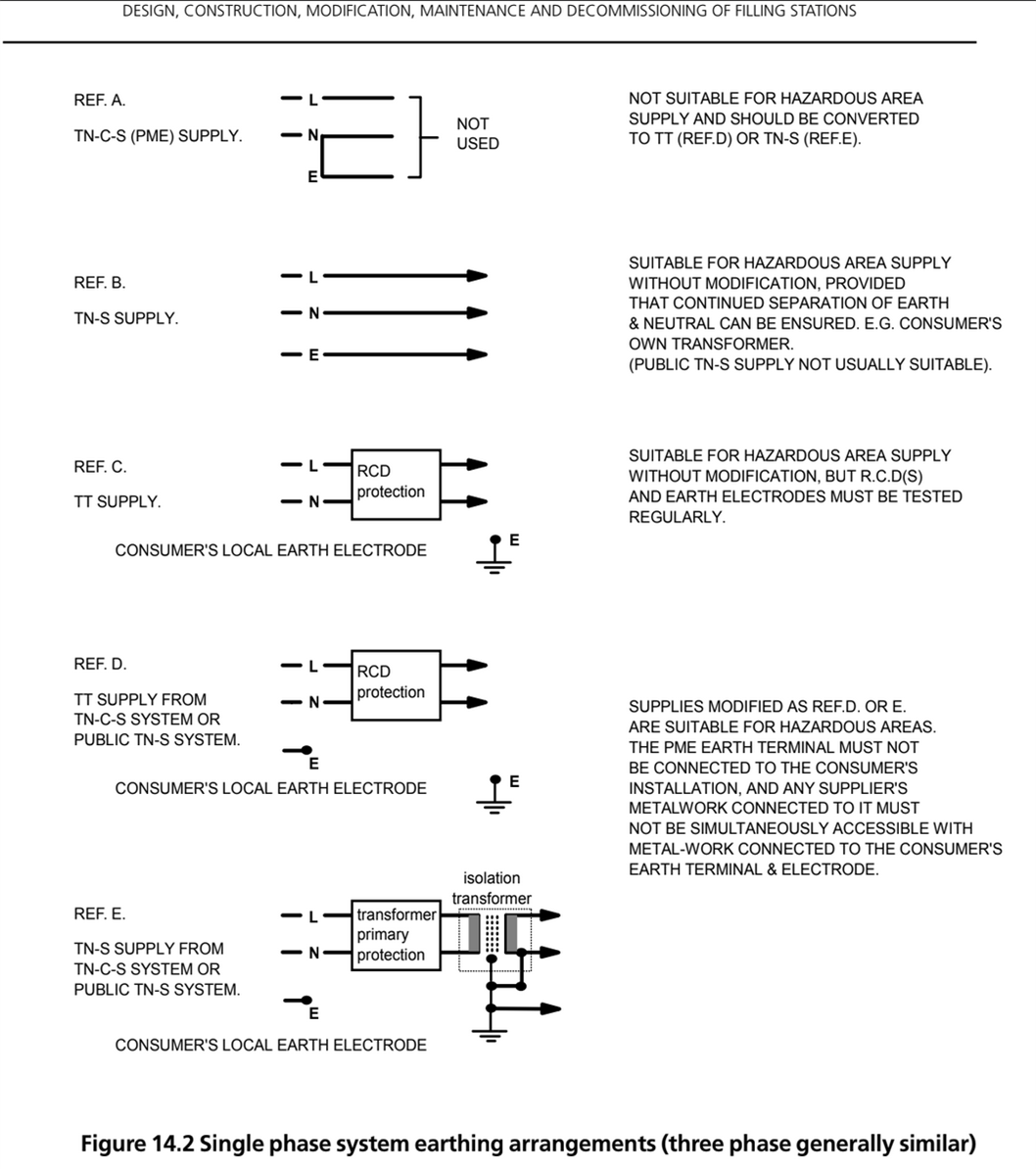
DNO TN-C-S supply to an industrial unit building which contains ATEX zones

Hi,

Could anyone offer any advice in relation to the earthing arrangement within ATEX zones please?

If a building (a large steel frame industrial unit) has a DNO TN-C-S supply, could it be acceptable for this earthing arrangement to enter ATEX zones? I'm considering a PEN conductor fault potentially representing an issue which should be avoided.

Is it reasonable to expect the ATEX zones required earthing arrangement to be defined in the project Hazardous Area Classification and DSEAR Risk Assessment and or project performance specification?

I appreciate BS EN 60079-14 may provide appropriate recommendations, which I intend to review a.s.a.p.

(Apologies if the above outline is too brief).

Thank you in advance for any responses.

Parents
  • Here is a excerpt from APEA 'Blue Book' Guidance for Design, Construction, Maintenance and Decommissioning of  Filling Stations.

    It has a bit more detail than 60079-14.

  • It has a bit more detail than 60079-14.

    Agreed ... but even there, there's still a need to understand that physical separation is needed between the earth electrode, protective conductors and exposed-conductive-parts in REF C and REF E supplies, from exposed-conductive-parts and buried metalwork connected to the primary supply ... both to conform to BS 7671 Regulation 411.3.1.1, and to prevent transfer of voltages and currents below ground. The worst-case transfer of voltage we are looking for is not 70 V AC, as in EV charging installations, but 25 V AC.

  • I wonder if filling stations might be a bit of a special case - with the pumps being basically outdoors and lots of connections to buried metalwork there are hazards there that might not be the same for maybe an indoor situation where a decent equipotential zone could be established and perhaps diverted neutral currents avoided.

       - Andy.

  • where a decent equipotential zone could be established and perhaps diverted neutral currents avoided.

    Andy, an 'equipotential zone' might only promote diverted neutral currents from outside the installation, especially in certain types of building construction, or where there are multiple 'fortuitous electrodes' etc. ... This would be little different in a general BS EN 60079-14 hazardous area.

    A filling station typically has an earth grid under the hazardous area to help in a similar manner to an 'equipotential zone' ... and there's a need to avoid diverted neutral currents flowing through that in the same way.

  • Ref B. How many filling stations have their own transformer?

    IIRC, the EVCPs at my local one are plugged straight into the adjacent main.

  • Andy, an 'equipotential zone' might only promote diverted neutral currents from outside the installation, especially in certain types of building construction, or where there are multiple 'fortuitous electrodes' etc. ...

    I was just thinking aloud as it were - I don't know what the standard require. I was thinking though that an equipotential zone of itself doesn't promote current diversion - but (as you mention) it's the things that form electrodes (or paths to other potentials outside of the zone) that create the difficulties. I was just pondering that such things might be easier to avoid in a zone that's contained within a building, at least within a specific (ATEX) area, than one outside that invariably has a lot of buried metalwork as an integral part of the installation.

       - Andy.

  • In a similar fashion, we assume an 'ideal' TN-C "main" or "supply", that we infer (because we now have cables with plastic oversheath) has only one connection with Earth, doesn't suffer from diverted neutral currents. Howeve,r once we bury the cable, we know that the oversheath will become damaged eventually ... even in systems that don't have multiple earthing.

    The reality is, with TN-C or TN-C-S, we will almost always have diverted neutral currents, and it's not easy to predict their magnitude, and how that magnitude will change over time.

  • Entirely agree that there will be diverted N currents around the system in general (to some extent all earthing systems, even TT, could be troubled by them as it's hardly possible these days to guarantee that two different points on the Earth's surface (or below it) will be at the same potential).

    But what I had in mind was the possibility (not applicable in all cases by any means, but  possibility for some perhaps) of being able to arrange things so diverted N currents couldn't flow through the ATEX zone - e.g. maybe some "lollypop" arrangement where there was only a single point of connection to wider earthing systems. That sort of thing would be practically impossible for a petrol station with it's undergound storage tanks and pipework, but might be possible in other situations?

        - Andy. 

  • Chris,

    Of the just over 8000+ public fuel filling stations. I would have indicated that up until approx. 2021 none of them had their own transformer where TN-S could be guaranteed. Primary reason of course was the Max demand load wise for even a large filling station didn't require a direct substation connection. Since 2021 and the introduction of high powered EV chargers on UK filling stations then depending on the particular set up and owner of the substation DNO/IDNO then some not all of those substations will guarantee a guaranteed TN-S supply to the filling station.

    But I'm speaking about perhaps less than 200.

    The requirement for a UK filling station only to have a TT earthing system or a dedicated and guaranteed TN-S system goes as far back to 1989 and the HSE Guidance note HS(G)41.

    Regards GTB.  

  • GTB, thank you. I assume, therefore, that the majority of petrol filling stations are TT.

    I also assume that the intake, or at least isolator must be at the shop (or kiosk) so that staff may open it in the case of emergency. If that is the case, then perhaps the Instavolt EVCPs round the corner from here may be entirely free-standing and not subject to earthing restrictions.

  • Evening Chris,

    Your assumption is correct, majority of UK Filling stations are all TT. However the detail provided in HS(G)41 and all subsequent APEA/EI "Blue Books" indicate changing the earthing system from TNC-S or where the Public TN-S earthing arrangement could not be guaranteed wasn't to immediately condemn them and demand a change to TT. There is of course the requirement they will not obtain a full "A" classification on the annual PIR the classification will always be at least a "B" or a "C" depending on a number of factors the primary one being the measured value of the DNC. Anything more than 100mA on a earthing conductor requires investigation and risk assessment approach.

    In shared premises and old premises, converting to TT from TNC-S could actually be detrimental. We indicate that sites going under a knock down rebuild or major refurb, then yes the earthing system should be changed to TT as part of those site works.

    There is a full annexe in the "Blue Book" how this matter should be treated by electrical inspectors.

    Now your question on Instavolt etc and EVSE installed on a UK Filling Station curtilage is for the fuel filling stations emergency stop system when activated (These can be a mixture of traditional emergency stop stations at the till position to automatic interlocks with leak detection systems) will automatically "trip/activate" to open the primary protection device serving the EVSE with the preference for that interlock to be by a fibreoptic link rather than a copper cable to help prevent "Mixing" different earthing systems.  

    Its all actually detailed in the following publication and in the APEA/EI "Blue Book"

    https://shop.theiet.org/guide-to-electric-vehicle-charging-installations-at-filling-stations-2nd-edition-e-book

    I was very much involved in the development of that publication along with this forum contributor "GKenyon"

    Best Regards GTB

Reply
  • Evening Chris,

    Your assumption is correct, majority of UK Filling stations are all TT. However the detail provided in HS(G)41 and all subsequent APEA/EI "Blue Books" indicate changing the earthing system from TNC-S or where the Public TN-S earthing arrangement could not be guaranteed wasn't to immediately condemn them and demand a change to TT. There is of course the requirement they will not obtain a full "A" classification on the annual PIR the classification will always be at least a "B" or a "C" depending on a number of factors the primary one being the measured value of the DNC. Anything more than 100mA on a earthing conductor requires investigation and risk assessment approach.

    In shared premises and old premises, converting to TT from TNC-S could actually be detrimental. We indicate that sites going under a knock down rebuild or major refurb, then yes the earthing system should be changed to TT as part of those site works.

    There is a full annexe in the "Blue Book" how this matter should be treated by electrical inspectors.

    Now your question on Instavolt etc and EVSE installed on a UK Filling Station curtilage is for the fuel filling stations emergency stop system when activated (These can be a mixture of traditional emergency stop stations at the till position to automatic interlocks with leak detection systems) will automatically "trip/activate" to open the primary protection device serving the EVSE with the preference for that interlock to be by a fibreoptic link rather than a copper cable to help prevent "Mixing" different earthing systems.  

    Its all actually detailed in the following publication and in the APEA/EI "Blue Book"

    https://shop.theiet.org/guide-to-electric-vehicle-charging-installations-at-filling-stations-2nd-edition-e-book

    I was very much involved in the development of that publication along with this forum contributor "GKenyon"

    Best Regards GTB

Children
  • GTB, thank you again - every day is a learning day. ;-)

    I have managed to have a look at the Blue Book, but I am a bit reluctant to shell out 50 notes on the Guide.

    The Instavolt EVCPs (and a green cabinet) round the corner are on the boundary of the site. I see what you mean about remote isolation. However, for all I know, there may be EVCP's at neighbouring houses just on the other side of the fence.

    All this has been brought into focus because about 3 months ago an axe-wielding miscreant set fire to one of the pumps. He was due in court for arson, etc. last week.