


"Ed Throws Trade Bodies Into Chaos Over DIY Solar!" (efixx) :-) lol
Cue another early amendment and Section in BS7671 and another 'membership' level in the brilliant CPSs for the trade to do DIY Solar installs.
:-)
"Ed Throws Trade Bodies Into Chaos Over DIY Solar!" (efixx) :-) lol
Cue another early amendment and Section in BS7671 and another 'membership' level in the brilliant CPSs for the trade to do DIY Solar installs.
:-)
I am not sure why we need to back feed into a 13 amp socket? There are a load of grid tie inverter/battery units which can connect to solar panels, so any item plugged into the unit is using solar and battery backed, without any back feed into a 13 amp socket. And they can't give away solar power without payment.
Clearly a battery feeding back into the grid without payment would be a bad move. And not much better with just solar.
My first thought was designed to allow tenants to have solar, owner occupiers already have the option. But to get paid for export, one needs a second MPAN number, so the solar would need to be less than the base load, and smart meter only show every half hour, so one has no idea of the base load, unless one already has solar.
A iboost+ can use any export over 100 watt, which is OK with a 6 kW array, but with 800 watt maximum it seems a bit pointless. Unless everyone is going to get a second MPAN number.
The phrase "balcony solar" or "plug in solar" or "grid tie solar" can equally apply to a battery/inverter with outlet sockets on the battery, which puts nothing back into the grid, to a device which does feed back into the grid. I note already a British plumbing outlet is offering solar which feeds into the grid, but there is a 99 day waiting list, but as someone who already has solar, I know solar really needs a battery as well, and also if I got balcony solar which feeds into the grid, who will know if the energy is from the G98 registered solar, or the plug in solar? I already have the MPAN number, so this would be a cheap upgrade for me.
But today's news, says we have too much solar, so to buy more solar when the export rate has already dropped from 15p to 12p seems a bit of a chance.

And there we need to modify or repeal the plug and socket regulations
If the Government wants to get these things on to the UK market, it can quite easily amend the Regulations. However, I suspect that there are other matters at the front of its collective mind.
Can't be used to connect a generator to an installation without a "changeover switch", and even there, the thing on the wall would be a "plug" ... certainly no good for parallel operation because of possible 'live pins'.
We are discussing plug-in balcony solar systems, which have the inverter connected to a plug with exposed pins, so in this situation the IEC60309 plug/socket would be used in the same way, the inverter connected to the plug, relying on the inverter's design and protective measures to only energise the plug once connected to a supply. The supply from the fixed wiring would be connected to the socket.
What you are describing is the arrangement for conventional portable generators, where the generator provides a continuous supply on the outgoing terminals from the generator, which quite rightly would require the use of an in-line socket on the generator side, connecting to a fixed plug on the fixed wiring side, where to ensure safety then necessitating a change-over or other protective arrangements such that the fixed plug pins are never live when exposed. This doesn't apply to these types of plug-in balcony solar system though.
In fact, a BS EN 61936-2 Type 2 connector would be a great idea, it's a British Standard, already .
Did you mean a BS EN 62196-2 Type 2 connector i.e. an EV charging plug? I would suggest the large size of the plug/socket design would make it impracticable for the application and arguably, significantly over-engineered and costly. It's designed for repeated use, replicating the look and feel of a petrol pump.
One feature of that design, and some IEC60309 plug/sockets, which could be useful is the use of a 'pilot pin' to control when the supply is energised.
But this is all getting rather complicated, the RST plug/socket or something equivalent looks a good, efficient solution and it's compact.
At risk of sounding political, there is a cost of living crisis. How much are these things going to cost? Whilst those on limited incomes would benefit most from "free" electricity, how will they afford them in the first place?
A new socket-inlet hardly helps.
One feature of that design, and some IEC60309 plug/sockets, which could be useful is the use of a 'pilot pin' to control when the supply is energised.
It depends on whether the pilot pin configuration operates a switch or a device for isolation ... and see below.
BS EN 62196-2 Type 2
Yes typo
What you are describing is the arrangement for conventional portable generators, where the generator provides a continuous supply on the outgoing terminals from the generator, which quite rightly would require the use of an in-line socket on the generator side, connecting to a fixed plug on the fixed wiring side, where to ensure safety then necessitating a change-over or other protective arrangements such that the fixed plug pins are never live when exposed. This doesn't apply to these types of plug-in balcony solar system though.
Well, yes ... and no.
What's not clear, if the connecting arrangement isn't specified for bidirectional usage, is whether any overheating will be expected, especially with the duration the connection is required to carry current for. Worth looking at the additional requirements for temperature rise tests for BS 1363-1/EV plugs and BS 1363-2/EV socket-outlets ... particularly the power factor.
However, this was at 10-13 A load current ... hopefully with 800 VA, this ought not to be so much of a problem.
Heating will be proportional the I^2R, so you would expect 800W / 3.5A should be well within ratings.
What I'm not clear on yet, is why the German VDE standard writers allow a regular Schuko socket (comparable to BS1363 or IEC60309 plug) to be used to connect an 800VA inverter with upto 800Wp (+20% / 960Wp) of solar PV modules (i.e, panels), but if a 'special energy plug' which appears to be these better shrouded and locking, Wieland RST 20i3 plug/sockets, then the same 800VA inverter can be connected to upto 2000Wp of solar PV.
https://www.vde.com/en/press/press-releases/first-product-standard-for-plug-in-solar-devices
Some interesting analysis in this blog article below, discussing the energy within the inverter power conversion circuits, which could be present on the plug pins if the inverter were disconnected while in use. Does the greater connected PV modules powers increase the potential stored energy accessible on the plug pins, requiring shrouding and the locking feature on the the RST 20i3 plugs? Or is it a I^2R heating, concern than 3.5A for very long durations as would be seen with DC module over-sizing, it requires a better, lockable plug/socket?
https://cn-cob.com/blog-detail/vde-standards-an-in-depth-analysis-of-germany-balcony-power-plant
Some interesting engineering, and that blog article makes it apparent just how much the design of these systems interfaces with national standards for fixed wiring, so this really does need to be a topic which the BS7671 standards committees are engaged with.

At risk of sounding political, there is a cost of living crisis. How much are these things going to cost? Whilst those on limited incomes would benefit most from "free" electricity, how will they afford them in the first place?
It's all politics.
Some of the issues with cost of living crisis is the result of policies.
Doesn't help also that policies around energy permit energy trading at different levels that also affect prices. This has been brought about by policies (for good or bad).
Some county councils have invested in renewable energy for the benefit of people in their area ... others have not. Again, political policy at a local level.
etc.
Those docs are an interesting analysis, especially the variation of cable assumptions between countries. and slightly at odds to the german technical press, with the 800W limiting the export to the grid, but far higher figures supporting local loads in the building and filling local battery storage...
Truth will be in between as always and unmonitored installations could do almost anything.
Mike.

The cost of living crisis is partly to do with the rising cost of energy which helps to raise inflation.
A lot of people don't know or understand that oil in part makes electricity in the uk. Nuclear does the stable daily amount and oil/gas make up the fluctuations eg when people put the kettle on in the tv advert break so to speak. Wind/solar and renewables make up still a small percentage of uk energy.
So when there is Geo-Political issues like the closure of the Strait of Hormuz or russia invades yes invading Ukraine then the price of oil rises and thus UK energy cost go up and so does inflation. People need to understand that as a nation we buy in a lot of our energy from abroad and that is the start of our fundamental issue. We have the North Sea it has oil and we should use/drill/extract our own oil and gas. The oil and gas is also used for the production of a lot of plastics and other petro chemicals.
Many people is America do NOT want the war with Iran but American companies are profiting from it. Especially the US stock market. Over the last 6 months, the American stock market has seen significant growth and reached record highs. The S&P 500 has surged roughly 13% in rolling six-month returns, while the Dow Jones has climbed over 50K points and the tech-heavy Nasdaq has advanced above 26K points.
The UK government needs a think tank (other committee names are available) to look at this and simply get the UK makeing energy and storing energy. The energy needs to be shifted across the UK with only a moments notice which at the moment it can’t as the links between England and Scotland are already at capacity which is why we see many wind turbine stationary. Old army/airforce bases could be used as locations for energy storage farms that are connect to the national grid.

The problem with the North sea oil of course is that it is old hat. Since 1970 we have taken out a touch under 50 billion barrels equivalent (volumes change pre/post refinement and separation of water hence 'equivalent' ) It made us very wealthy in the 1980s and 90s. and we outsourced a lot of industry while our GDP and exchange rate was propped up (up to 5% of GDP was oil and gas for many years)
Now mostly gone, and the great 'new' opportunities, like Rosebank and a couple of others offer perhaps up to 1 more Billion barrels between them, which will stem the decline for a couple of years. (for comparison right now Saudi Arabia do 3-4 billion barrels equiv per year, we squeeze out about 30 million a year, less than half of what we use - maybe less now .. )
Then we are back to having to buy in the rest (we need ) - so yes we should use it, but we should be aware that when its gone, its gone, and there is a balance - it may be even more valuable left so we have it in a few years time. Generally as much as poss we need to grab anything that is not fossil fuels whenever it is available - local batteries and panels on flat roof extensions and balconies make a lot of sense in that wider picture, as do better inter-connectors.
Mike.

Wind/solar and renewables make up still a small percentage of uk energy.
I wouldn't call 36% a small percentage - that's just wind and solar energy contribution to the total over last year - https://www.bbc.co.uk/news/articles/cz947djd3d3o
At times wind supplies over 50% of power, and solar is often over 30%.
- Andy.
Wind/solar and renewables make up still a small percentage of uk energy.
I wouldn't call 36% a small percentage - that's just wind and solar energy contribution to the total over last year - https://www.bbc.co.uk/news/articles/cz947djd3d3o
At times wind supplies over 50% of power, and solar is often over 30%.
- Andy.
But we really lack as a country a good way to store the energy for re-use. We need a technology to re-sync it back into the National Grid
In fact, it looks like wind actually out-generated gas for the 2025 calendar year (from electricinsights.co.uk/ setting for the Sum for 1 Year starting 01/01/2025):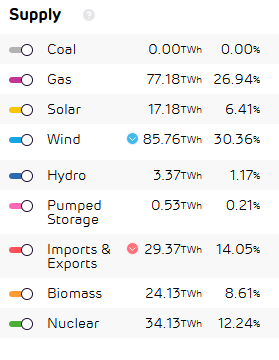
- Andy.
We're about to take you to the IET registration website. Don't worry though, you'll be sent straight back to the community after completing the registration.
Continue to the IET registration site