Who from the IET is working with the government to allow <800W inverters to be 'plugged in'?

The UK government made the following announcement at the end of March (www.gov.uk/.../government-to-make-plug-in-solar-available-within-months) regarding Balcony Solar/Plug-in Solar. The following section features in the 'Notes To Editors' at the end of the announcement.

"The government will work with the Energy Networks Association, DNOs and Ofgem to update the G98 distribution code and wiring regulations BS 7671 to allow UK households to connect <800W plug-in solar panels to domestic mains sockets, without the need for an electrician and with tailored safety standards."

So who is the government working with at the IET/JPEL64 to make these changes to BS7671? Or is the government simply going to bypass the IET and make amendments willy nilly?

Parents
  • In respect of BSI committee work (BS 7671 is developed by a committee jointly managed by the IET and BSI, but that follows the BSI rules for developing standards) specific discussions in committees cannot be shared. Similarly, content of standards and draft standards can only be discussed when they are published, or made available as drafts for public comment.

    Would those rules prevent someone confirming whether a committee (or indeed which sub committee) had been asked to consider a particular request or requirement?

    The comments on RCD operation seem somewhat unclear to me. Mark started off taking about a certain type of RCD that the Germans had the foresight to drop many years ago (which I take to be AC types) - but the article says "But some older RCDs were never designed for electricity flowing back into the circuit" - but bi-directionality is a completely different feature - and not one universally found even in the latest RCDs. I suppose we should add in single pole switching RCDs (mostly RCBOs) where the local generation isn't separated from Earth when the RCD trips, so the shock hazard persists until inverter shutdown - again a problem that isn't mitigated by ensuring your installation is up to current standards.

       - Andy.

  • 1. With the lawnmower lead, the lawnmower has stopped, because I cut the lead ..

    Not necessarily - I've seen leads that have been "shaved" - exposing (at least) one of the conductors (and maybe thinning it a bit) but not completely severing either of them.

      - Andy.

  • Question - TN disconnection times are based on a touch voltage of half the line voltage - 115V-ish so 0.4s - while TT disconnection times (due to much higher impedance between c.p.c. and Earth) are based on full 230V touch voltages - 0.2s (or 200ms) - so why 40ms for additional protection where the assumption is also that the victim is exposed to 230V?

       - Andy.

  • I agree, but my point is more that  we already do that every time we plug any appliance in that holds up the voltage for some short time after the breaker breaks - and there are more of those than just inverters, plenty in common use. As another example we also weaken the protection against direct contact when we plug in a bedside lamp and the protection damage with every flex. 

    Hi Mike, not sure you missed the following points:

    • the appliance is still going to hold up the voltage after the additional disconnection time, so it is definitely worse.
    • When I cut the lawnmower lead, there's an assumption there's always an appliance connected somewhere else on the circuit that holds up the voltage for a short period of time. Not necessarily. But if there is, see previous bullet.
  • so why 40ms for additional protection where the assumption is also that the victim is exposed to 230V?

    RCD measures the residual current, which is, potentially, all passing through the person. It's not a touch-voltage-for-time but a touch-current-for-time paradigm.

    Compare with a fault to Earth where most of the available current (hopefully) passes back down the CPC and, where applicable, supplementary local equipotential bonding.

    Different paradigms.

  • For me, the question is what is a reasonable (supply) hold up time for an appliance.  As mapj1 has pointed out, there is a standard for this (EN IEC 62368-1:2024) which imposes some limits.  I suspect that in many cases a solar inverter should be able to do a lot better as I suspect that standard is written around things like lawnmowers and vacuum cleaners where there is no cycle by cycle control of current drawn / returned.

    If we take the pure solar (no battery) case, solar is a constant power device (at least over the timescales we are talking about here) - in most cases in the event of a protective device trip I would expect the inverter output to over or under voltage and trip within half a cycle or so.  It is only in the case where the loading on the inverter side of the protective device is such that a stable equilibrium can be reached at a voltage within the permitted range that the delays associated with RoCoF or similar come into play.  Have the studies been done to understand what proportion of the time that might happen?  Is it practical to reduce the permitted voltage range to somewhat narrower than standard so as to reduce the likelihood of that happening?

    The solar plus battery case is more complex.  The simple solution is to force the interface to the supply to act like constant power solar if export is to occur.  That doesn't prevent the equipment itself having UPS like sockets but there will need to be a contactor to disconnect the inverter from the supply once loss of mains is detected.  That contactor will mean that systems featuring batteries will be slower to disconnect than pure solar (unless we're willing to accept a solid state device for that function?).

  • In this case I'm considering the main holding-up appliance is the solar inverter - its not clear what happens when you put multiple holding-up appliances in parallel or which ones you want to disconnect. 

    The situation is of course cleaner when the solar unit is on its own radial on its own special plug and socket, which is not much different to hard wiring,  and that should be the gold standard, but see my gripe in the other thread about the accidental consequences of the plug and socket legislation as to why we seem unable do the dedicated connector in the UK.

    The question is how much more dangerous is it if we throw caution to the winds and plug an inverter in anywhere, compared to any other combination of appliances with more or less hold-up

    Mike

    PS

    This non-standard plug is not as common as it used to be ;-)  but we need to remember why we once needed that sort of safety campaign and compulsory plug and socket stuff, so we we know where we came from in terms of common/acceptable behaviour.

  • They MAY be called Balcony solar but when the DIYer gets it home they could put it on a fence/wall in the garden or on the slopped roof of their house or even just lie it flat on the roof of the kitchen extenion probably with no mounting restraints at all.  (Just wait for a windy day and see what happens).  The mind boggles to the positioning options and how many PV units the DIY will buy in one go or over time as they percieve the savings of energy cost.  However if they don't get some kind of battery storage then they are only doing half a job.  Now when we start to talk about battery storage that opens up a whole can of worms/question about positioning and fire safety and......

  • It's not a touch-voltage-for-time but a touch-current-for-time paradigm.

    Understood - but they two aren't entirely unrelated (I'm sure Mr Ohm had a formula we could plug body resistance into).

    Compare with a fault to Earth where most of the available current (hopefully) passes back down the CPC and, where applicable, supplementary local equipotential bonding.

    At that's good if the detection method relies on higher currents (e.g. ADS by 100mA RCD) but unfortunately the conventional fault-of-negligible impedance still leaves a considerable current available to pass through the victim - e.g. with 230V and a 100Ω electrode we'd be looking at 2.3A flowing through the c.p.c. with negligible drop in L voltage as a result  - but a victim with a body resistance of say 1000Ω could still have 230mA flowing through them. But still 200ms (rather than 40ms) is considered OK (ignoring the 250mA vs 150mA/5x RCD testing debate for the moment).

       - Andy.

  • Is such an arrangement not rather unlikely for 'no skill' plug-in solar  ?

  • the risk presented by a plug remaining live (or a connected circuit remaining live after a RCBO has tripped) for more than a few milliseconds is intolerable

    Is it ? 

    That suggests you want a spec tighter than the current one for RCDs and to cut power in less than one half cycle. Given that without special measures, we often have to wait for the next zero-crossing to extinguish the contact arc, that's probably a bit keen and unnecessarily onerous.

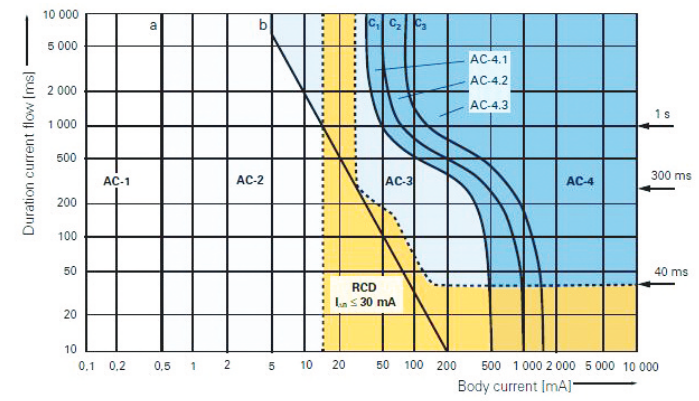
    Given the way humans are built, to avoid triggering a lethal fibrillation, you really want any high shock current to be off in about half a heartbeat period, hence the IEC curves all kinking between 100ms and just under a second .


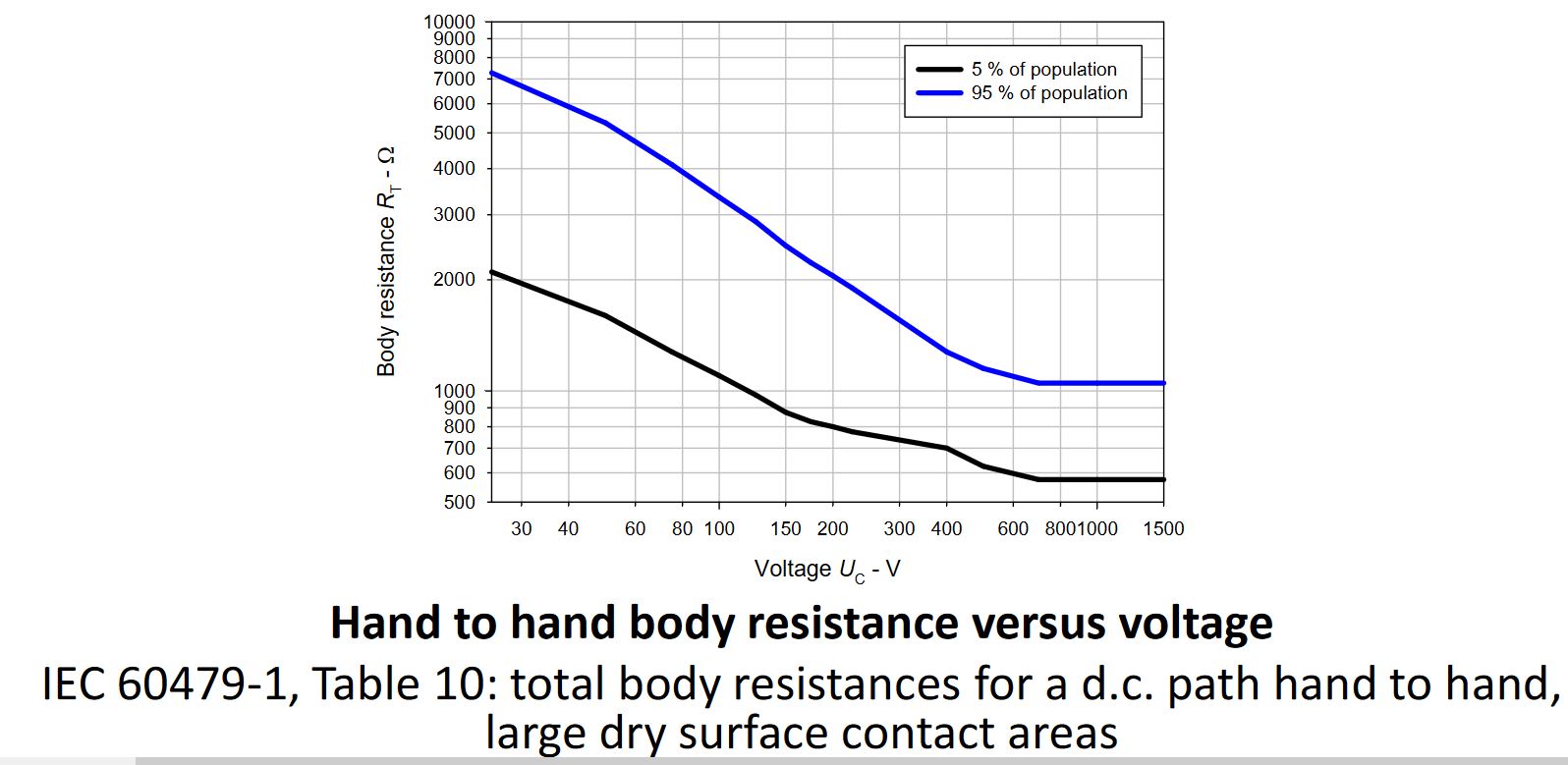
    There is a saving grace, that the initial resistance of a finger tip or even a palm's  worth of  epidermis is far higher than the one kilohm ohm figure often assumed when calculating shock current. It takes some finite time (a current dependant time) for the high resistance tissue at the point of contact to heat, char and breakdown to a lower resistance.  (its also why when you pick up the probes of a multimeter on the ohms range you get tens to low hundreds of k-ohms, and the current is low enough there is no  heating damage, so no change over a few seconds.)
    Once current flow has  established, you get the more or less standard behaviour as per the graph below.  Of course being wet or wounded so the surface resistance is bypassed, makes it all much worse. 


    And then, as I have said before in other threads, quite a lot of shocks are not across the  torso,  and in that case there may not be any fibrillation at all.

    Equally, there have been many tragic cases where a lethal current flows, but the contact area was large and there is no obvious damage to the skin.

    Electric shock is not anything like the  exact science some standards writers would like it to be....

    Mike.

Reply
  • the risk presented by a plug remaining live (or a connected circuit remaining live after a RCBO has tripped) for more than a few milliseconds is intolerable

    Is it ? 

    That suggests you want a spec tighter than the current one for RCDs and to cut power in less than one half cycle. Given that without special measures, we often have to wait for the next zero-crossing to extinguish the contact arc, that's probably a bit keen and unnecessarily onerous.

    Given the way humans are built, to avoid triggering a lethal fibrillation, you really want any high shock current to be off in about half a heartbeat period, hence the IEC curves all kinking between 100ms and just under a second .


    There is a saving grace, that the initial resistance of a finger tip or even a palm's  worth of  epidermis is far higher than the one kilohm ohm figure often assumed when calculating shock current. It takes some finite time (a current dependant time) for the high resistance tissue at the point of contact to heat, char and breakdown to a lower resistance.  (its also why when you pick up the probes of a multimeter on the ohms range you get tens to low hundreds of k-ohms, and the current is low enough there is no  heating damage, so no change over a few seconds.)
    Once current flow has  established, you get the more or less standard behaviour as per the graph below.  Of course being wet or wounded so the surface resistance is bypassed, makes it all much worse. 


    And then, as I have said before in other threads, quite a lot of shocks are not across the  torso,  and in that case there may not be any fibrillation at all.

    Equally, there have been many tragic cases where a lethal current flows, but the contact area was large and there is no obvious damage to the skin.

    Electric shock is not anything like the  exact science some standards writers would like it to be....

    Mike.

Children
No Data