Calibration of Approved Voltage Indicators and Proving Units.

There was an old discussion on this 7 years ago but it is locked now. In any case there was no definitive answer provided at the time. In years gone by, I would have thought that AVIs and PUs either work or they dont.

But searching online today, Martindale recommend that their AVI's and PU's do need calibrating. This has prompted me to rethink and I note that in GS38 point 30 talks about all test equipment being maintained by a competent person and one of the common errors being failing to verify correct function of illumination (eg indicator/lamp/neon).

If something were to go wrong, and it turns out the AVI and PU were not calibrated within the last 12 months, I can imagine this wording above being used to attribute blame to the person who was undertaking the proving dead.

When we prove the AVI with the PU, we are putting voltage onto the AVI and simply seeing that the lamps light up, but the PU just puts out the max voltage it is capable of, it doesnt step up or down each voltage level individually, so we dont control the level it is proving at. 

What's other peoples thoughts? I am considering now that we do need to calibrate these items.

  • Have you got a fox problem too? :-0

  • Further 'proving dead' is not really a correct statement of what we are doing.

    Energy isolation?

  • There was a product recall on some of the Fluke T series testers made up to July 2018, because the leads may fail causing an intermittent fault, so they might work when you check them, but not whilst testing.

    That is a product issue, not a procedural issue ... surely, the product is designed with the procedure (intended use) in mind ?

    There was a product recall, so we are all aware of the issue ... is there an issue?

  • There was a product recall, so we are all aware of the issue ... is there an issue?

    Quote “T110, T130, and T150 T-Pole Testers shipped from Fluke after August 28th, 2018 and with serial numbers greater than those specified in the last column above are NOT impacted by this recall.”.

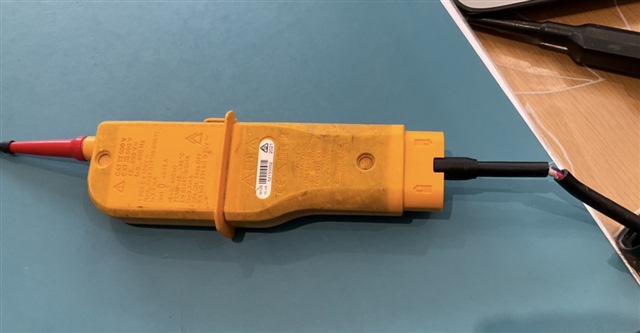
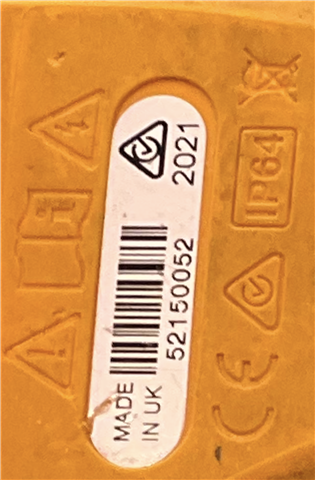
    So presumably the failure of the test lead sheath on this T110 made in 2021 is general wear and tear that should be identified as part of the regular user checks that should be part of the testing procedure, as the leads are deemed fit for purpose by the manufacturer?

    The test leads fail just inside the battery cover, so the battery cover needs to be removed to check the cable, in between replacing the batteries.

  • So presumably the failure of the test lead sheath on this T110 made in 2021 is general wear and tear that should be identified as part of the regular user checks that should be part of the testing procedure, as the leads are deemed fit for purpose by the manufacturer?

    The test leads fail just inside the battery cover, so the battery cover needs to be removed to check the cable, in between replacing the batteries.

    Or there is another process/procedure in your organisation to deal with this situation ... PUWER etc. ?

    I think the legislation has it covered ... 

  • If larger companies have a 'calibration lab', then one should ask oneself, "what do they do?", by inserting this extra layer of remoteness from 'proper' calibration (and for that matter, how the out-sourced calibration labs get away with not being the 'National Laboratory' or even 'bipm' - SI units)?

    Within that, there are things you/we can do ourselves.

    Firstly we are simply explicitly confirming that there are no gross faults (a primary concern). Lights come on when asked. Lights go off when asked. (Noted daily/weekly/monthly/yearly & task by task).

    Then there is cross calibration (a bit like cross bonding) where we cross check between known sources and complementary meters, And Record Our Comparison, to give a level of trust suitable to task. (Rhetorical, how does one trust an out of the box new meter?).

    Cross checking, like cross bonding, increases safety - we should make a note of it so it's as-inspectable as a cross-bond.

    "Calibration", like "PAT Testing", has become an industry of it's own... 

  • The terms "making dead" and "proving dead" possibly hail from the Electricity at Work Regulations

    I understand that they are terms used elsewhere and maybe from the past BUT things must progress.  In the same way we used to used the term Earth for everything but now we use the term PE (Protective Earth) and FE (Functional Earth).  

  • The term "Energy Isolation" I refered to above comes from the Mineral Products Association Guide to Energy Isolation and LOTOTO (Lock-out - Tag-out - Try-out).

     These energy sources could include electrical, mechanical, hydraulic, pneumatic, chemical, radiation, and thermal hazards. It is important to remember the effects of overloading conveyors as this can distort the belt and release energy as the load is removed.

    The point of a LOTO procedure is to identify a hazard that may injure or even kill employees if such an incident occurs due to the startup or release of stored energy during the maintenance of machines and equipment.

    www.safequarry.com/.../MPA_Energy Iso LOTOTO 32pg Handbook V8 Final Print Copy.pdf

  • Energy isolation?

    Regardless of whether you call it voltage, energy, or whatever, you can only gather evidence of its absence ... and even then only within the definitions you set yourself (or are set by your instruments).

    For example, using a 2-pole voltage detector, no voltage between all of the circuit conductors, and between conductors and CPC does not prove 'dead' on its own. It only proves, within the bounds of the test equipment specification, that it couldn't detect energy flowing in a circuit made by the instrument between the conductors. However, one or all of those conductors might actually have a voltage present on them with respect to Earth, hence the use of a contact and/or non-contact voltage detector also being recommended.