Calibration of Approved Voltage Indicators and Proving Units.

There was an old discussion on this 7 years ago but it is locked now. In any case there was no definitive answer provided at the time. In years gone by, I would have thought that AVIs and PUs either work or they dont.

But searching online today, Martindale recommend that their AVI's and PU's do need calibrating. This has prompted me to rethink and I note that in GS38 point 30 talks about all test equipment being maintained by a competent person and one of the common errors being failing to verify correct function of illumination (eg indicator/lamp/neon).

If something were to go wrong, and it turns out the AVI and PU were not calibrated within the last 12 months, I can imagine this wording above being used to attribute blame to the person who was undertaking the proving dead.

When we prove the AVI with the PU, we are putting voltage onto the AVI and simply seeing that the lamps light up, but the PU just puts out the max voltage it is capable of, it doesnt step up or down each voltage level individually, so we dont control the level it is proving at. 

What's other peoples thoughts? I am considering now that we do need to calibrate these items.

  • In fact would likely be more economical just to purchase a new GS38 compliant voltage indicator and proving unit each year, then get them calibrated.

    You can have a similar conversation about calibrating torque screwdrivers, Wera say:

    For the purposes of the normative recommendations and especially in your own interest, a torque tool should be checked, calibrated and, if necessary, adjusted and/ or repaired at the latest after every 5,000 load changes or, if the number of load changes can not be determined, every 12 months.

    www.wera.de/.../EN-Torque-Tools.pdf

    Which sounds fine until you hear how much the calibration will cost, it’s better to buy a new tool with a manufacturers calibration certificate and sell the old one on an internet trading site, but they should be okay for around a hundred consumer units anyway.

  • This is when you need a single pole contact voltage tester.

  • Oh really, i didn't know you could get PUs that step through the voltages, I assume then thta you can watch the PU and AVI indicator lamps together to see that the AVI is accurately reflecting the PU voltage at the time? My AVI and PU just all light up simultaneously to the max.

  • I didnt think of that, but I guess as soon as the MFT probes enter the PU the PU will automatically put out the maximum voltage, unless I had a PU which stepped the voltage as described by Newfutile above.

  • Although a different manufacturer, this PU looks no different from the one I already have. And there's nothing in the instruction download to suggest calibration is needed or that it isnt.

  • If we call it "potentially not live" instead of "proven dead", that would open a massive can of worms with everyone frightened to do any intrusive works at all for fear of liability issues!

  • Thanks, the link to that document gives me the black and white answer I am looking for.

    I do like the sound of the PU which steps through the voltage levels that Newfutile mentioned above though. At least I would be able to watch the AVI responding to various voltages.

  • You can have a similar conversation about calibrating torque screwdrivers

    For which a check box would give some reassurance.

  • What's other peoples thoughts? I am considering now that we do need to calibrate these items.

    My starting point would be to ask how many incidents have there been when someone using an AVI having checked it with a PU before and after proving dead, then subsequently found the item live and this was found to be due to a fault with the AVI? Has it ever happened?

    If it has happened, then then I'd ask, in what proportion of proving dead tests does this actually occur? How many tests are needed for one of these events to occur?

    But then to properly consider whether any action is taken, or what action should be taken, you actually need to know something of the risks from all the other causes of an AVI giving an incorrect reading. How does this cause compare to other causes, is this actually the biggest risk or are there other risks which deserve more attention.

  • User checks are essential every time voltage testers are used, including the leads.

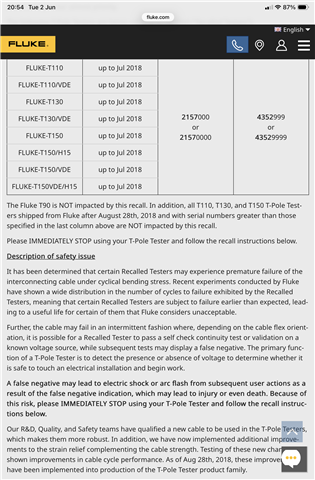
    There was a product recall on some of the Fluke T series testers made up to July 2018, because the leads may fail causing an intermittent fault, so they might work when you check them, but not whilst testing.

    www.fluke.com/.../tpt-recall

    But the tester in the photo below was made in 2021 and has the same issue.