Soil thermal resistivity and ambient temperature

For buried cables, the soil thermal resistivity and ground ambient temperature are required to be able to calculate the CCC of the buried cable.

The Regs states 2.5 K.m/W and 20 °C respectively but with the caveat that other values may be used either where measured or the ERA figures can be used.

Table 4A2 shows example drawings of buried cable which appear to show the cable buried direct in the soil with no indication of sand/pea gravel bedding, cover etc. (How many installations just dig a trench, drop the cable in then just backfill with the soil that's been dug out with no bedding/cover?)

Chapter 16 of the Commentary on the Regs states that the 2.5 K.m/W value is "conservative" and that "...BS 7769-3-1 (IEC 60287-3-2) provides standard conditions for the UK as follows:" and lists 1.2 K.m/W and 15 °C.

1. Why doesn't the Regs use the "standard conditions for the UK"?

2. Where does sand/pea gravel bedding/cover come into this, or is the "conservative" 2.5 K.m/W meant to cover such but it just isn't mentioned anywhere?

  • As a general rule with cable ratings the regs always err on the conservative side for the book values. As a noddy example, cables clipped direct ought to have 2 ratings, one for vertical and one for horizontal, as convection makes these noticeably different, but in the book only the more pessimistic case is given. (This latitude is then mopped up by installers failing to get the grouping factors correct. !!)

    Soil in the UK is very variable in thermal (and electrical) conductivity, at the extremes over a range of more than ten to one, and more commonly sand alone varies over about three to one with moisture content, but only a single figure is given, and unless the installer is going to look at testing the local soil type you have to assume a fairly  poor conductor, as that is where the cable heating is greatest.
    Thermal conductivity is set by several things, firstly  water in any gaps- it has a much higher thermal conductivity than air. Dry soil has low conductivity ( resistance as bad as 3K.m/W is possible.Sandy soils with a high quartz conduct heat better than similarly fine-grained organic soils;more densely packed soils are better conductors , allowing for better particle-to-particle heat transfer and higher thermal conductivity - any air pockets are good insulators. So a backfill of fine play sand below the water table is best ;-) 

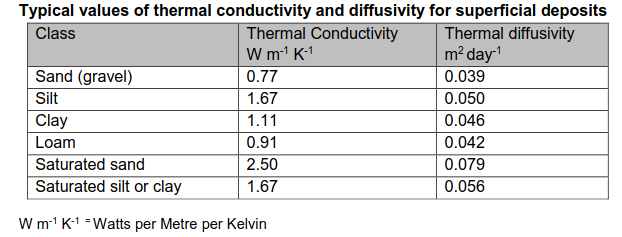
    The figures in the regs are probably inspired by (I'd hope) publications like this British Geological survey Geo report note the wide difference between dry sand at the top and wet sand near the bottom of the list.

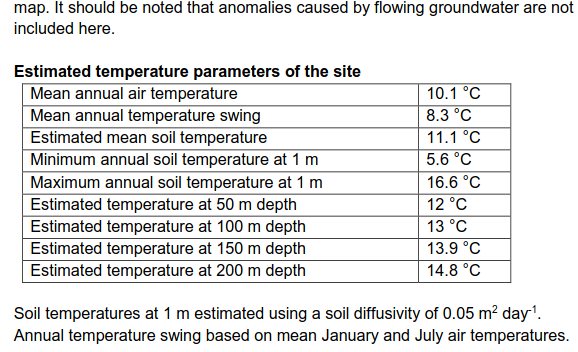
    Soil temperature vs depth is also important - from the same report some typical figures note the max/min at 1m depth are very much smoothed compared to the day time variations.

    In short to condense a proper site survey to a single figure to estimate a cable size is a huge simplification and has to be set to round up the cable size in most places to avoid cooking it in a few that run hotter.
    Mike.

  • Thanks Mike - it's just strange to me that the Regs doesn't mention bedding etc.

  • (How many installations just dig a trench, drop the cable in then just backfill with the soil that's been dug out with no bedding/cover?)

    I would have thought quite a lot - especially at the domestic end of the market. As long as the soil doesn't contain sharp stones and isn't going to be compressed significantly, it usually works out fine (obviously quite different in flinty soil under a roadway).

    Where does sand/pea gravel bedding/cover come into this

    There does seem to be a tendency to ignore such things - e.g. indoors adding capping or putting a cable into a conduit seems not to require a change in reference method - and until not so long ago, an underground cable could be buried direct, or in ducting, for the same reference method. So my guess is that the standard figures do make an adequate allowance for usual sorts of air gaps immediately surrounding the cable.

       - Andy.

  • Yeah, I suppose I'm thinking more of the industrial end whereby I'd expect bedding/cover etc.

  • For all the installation methods, dont forget that the figures in the big book are informative annexes, not normative rules you must follow, so if you have more accurate data for the specific cable or installation conditions or loading profile, you are always welcome to use that information. This may allow one  to deduce a less wasteful cable size, and on big projects where it is worthwhile it is done.  But equally, for short runs and JFDI jobs where something just has to be done right now and work first time, and the cable price is not dominant, the effort to perform and document the accurate calcs, and to be confident to do so, is not really worth it, and the one size fits all approach is more sense. 

  • Thumbsup

  • JFDI jobs

    "Jobs for direct implementation " ?? man shrugging

  • yep, or something like that anyway.  I could have used Urgent Operational Requirement  (UOR) - as the chaps in cammo also sometimes jokingly say before diving into the loo tent... 
    Up there with SNAFU, SWMBO and other (un)official short-forms commonly omitted from the bibliography to protect the innocent.

    ~M. 

  • 1. Why doesn't the Regs use the "standard conditions for the UK"?

    As explained in Section 2.2 of Appendix 4 to BS 7671, the 2.5 Km/W is for cables in and around buildings, where we are looking at cables passing through building materials, and not soil in general. Outside of the vicinity of buildings, if the soil resistivity is not measured Cs can be taken as 1.2 Km/W in the UK in accordance with BS IEC 60287-3-1 Electric cables. Calculation of current rating. Part 3-1: Operating conditions - Site reference conditions.

    2. Where does sand/pea gravel bedding/cover come into this, or is the "conservative" 2.5 K.m/W meant to cover such but it just isn't mentioned anywhere?
    The gravel is to stop cables being immersed for long periods in water in winter. It provides drainage ... important in much of the country because soil is often laden with clay that prevents drainage. The sand bedding over the gravel helps stop the gravel damaging the sheath.

  • e.g. indoors adding capping or putting a cable into a conduit seems not to require a change in reference method

    Agreed where the capping/conduit is embedded in plaster (and probably no change in installation method needed, see explanation under Reference Method C in 7.1 of Appendix 4 in BS 7671) but not in general, for example: