Cable Installation Reference Methods A–F – Practical Guide and Feedback Welcome

Hello everyone,

I have prepared this learning summary on Cable Installation Reference Methods A–F, based on BS 7671:2018+A4:2026, Appendix 4, Table 4A2.

The purpose is to explain how the cable installation method affects heat dissipation, current-carrying capacity and cable size selection.

Why do reference methods matter?

The way a cable is installed affects how easily heat can escape.

A cable installed in free air can normally carry more current than a cable enclosed in conduit, trunking or surrounded by thermal insulation.

Therefore:

Correct reference method = correct cable current-carrying capacity and cable size selection.

Cable selection rule

The basic design relationship is:

Ib ≤ In ≤ Iz

Where:

  • Ib = Design current of the circuit
  • In = Rating of the protective device
  • Iz = Current-carrying capacity of the cable after the relevant correction factors have been applied

The installation reference method is used to identify the appropriate cable-rating table and the correct value of Iz.

Reference Method A

Method A generally applies where cables are installed in enclosed routes or locations where heat dissipation is restricted, such as:
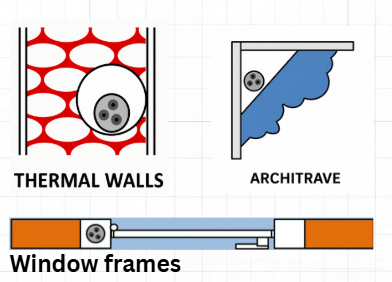
  • Thermally insulated walls
  • Architraves or mouldings
  • Window frames or similar enclosed routes

Because the cable is enclosed or surrounded by insulation, heat cannot escape easily, reducing its current-carrying capacity.

Practical example using Method A
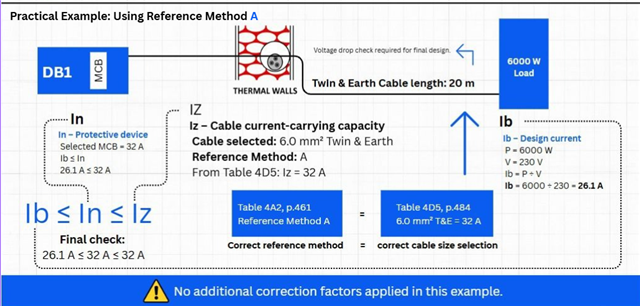
For a 6,000 W single-phase load at 230 V:

Ib = P ÷ V

Ib = 6,000 ÷ 230 = 26.1 A

A 32 A protective device is selected.

Using the relevant BS 7671 cable table for the installation conditions, a 6 mm² Twin and Earth cable installed using Reference Method A has an example current-carrying capacity of 32 A.

The design relationship is therefore:

26.1 A ≤ 32 A ≤ 32 A

The final design must also include voltage-drop calculations, correction factors, fault protection requirements and verification of the actual installation conditions.

Reference Method B
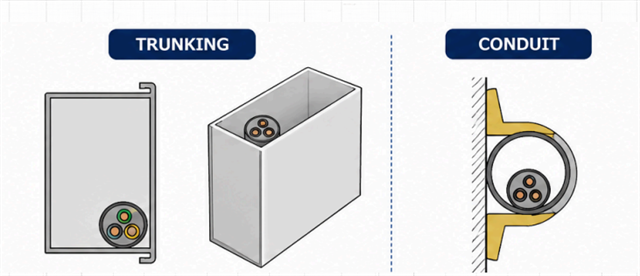
Method B applies where insulated conductors or cables are installed inside an enclosure, such as:

  • Conduit
  • Trunking
  • A round or square box

Because the cable is enclosed, heat dissipation is more limited than with a clipped-direct installation.

Reference Method C
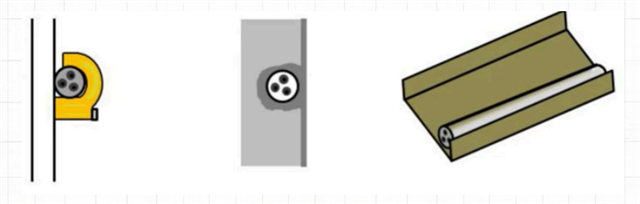
Method C applies where the cable is installed in a way that generally allows better heat dissipation, including:

  • Clipped direct to a surface
  • Chased into a wall
  • Installed on a non-perforated cable tray

Because the cable is not fully enclosed in conduit or trunking, it can usually carry more current than under Methods A or B.

Reference Method D
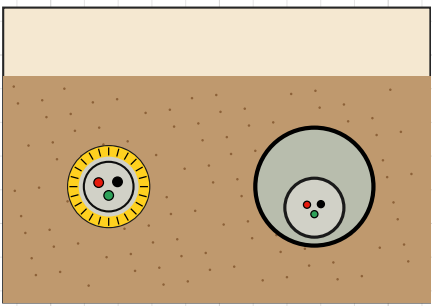
Method D applies to suitable cables installed below ground, including:

  • Direct-buried SWA or armoured cable
  • Cable installed in underground ducting or conduit
  • Underground supplies to garages, outbuildings or external equipment

Method D is only the starting point for cable selection. The final design should also consider:

  • Burial depth
  • Ground temperature
  • Soil thermal conditions
  • Ducting
  • Grouping
  • Mechanical protection
  • Voltage drop

Reference Method E

Method E applies to multicore cables installed in free air, where air can circulate around the cable.

Examples include:

  • Multicore cable in free air
  • Perforated cable tray
  • Cable ladder
  • Cleated cable with suitable ventilation

The improved air circulation usually allows greater current-carrying capacity than enclosed installation methods, subject to the relevant correction factors.

Reference Method F
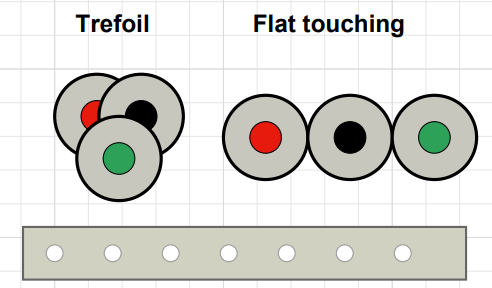
Method F applies to single-core cables touching in free air.

Common arrangements include:

  • Trefoil formation
  • Flat formation with cables touching
  • Single-core cables installed on tray, ladder or cleats

Method F applies specifically where the single-core cables are touching. Where the cables are spaced apart, a different reference method may apply.

Summary

  • Method A: Enclosed in insulation, architrave or moulding
  • Method B: Installed in conduit, trunking or an enclosure
  • Method C: Clipped direct, chased in or on non-perforated tray
  • Method D: Direct in the ground or in underground ducting
  • Method E: Multicore cable in free air
  • Method F: Single-core cables touching in free air

The reference method must be established before selecting the cable current-carrying capacity from the relevant BS 7671 table.

The final cable design must also consider correction factors, voltage drop, grouping, ambient conditions, fault protection and the actual installation environment.

I prepared this as part of my continuing professional development and my work towards the City & Guilds 2346-03 Level 3 Electrotechnical Experienced Worker Qualification – Installation route.

I would appreciate any constructive technical feedback or suggestions for improvement.

Kind regards,
Mohamad Alabdallah TMIET
This is a learning summary and is not a substitute for consulting the current edition of BS 7671 and the relevant manufacturer’s instructions.

Parents
  • It's a nice start. Some details need some more work though I think.

    Just from a quick 1st reading...

    • Method A doesn't cover cables "surrounded" by thermal insulation - but rather it presumes heat can escape on at least one side (e.g.through the surface of the wall) - where a cable is entirely surrounded by thermal insulation (a practice to be avoided were possible) its rating could be as low as 50% of its method C rating (see reg 623.9 and Appendix 4 section 2.6).
    • Ib ≤ In ≤ Iz is only appropriate where the protective device is intended to provide overload protection and where the circuit consists of only a single cable. With UK practice that's quite often not the case - from industrial motor circuits to the domestic ring final circuit.
    • Ib = P ÷ V is only true for purely resistive loads (i.e. where the power factor is 1.0) - in many other cases the overall current can contain an element of "wattless" (or reactive) current - i.e. current that flows alternatively towards the load and then returns to the source without providing any nett power (like a capacitor alternatively charging and then discharging on each cycle). Cables need to be sized to carry the overall current, not just the power delivering bit. The more general formula additionally divides by the power factor (cos φ) (and in some cases, e.g. when working from the tube power rating of fluorescent lights, may includes an additional factor for things like control gear losses).
    • Method D has recently been split into two separate reference methods in BS 7671 - D1 (cables in buried ducts) and D2 (directly buried).
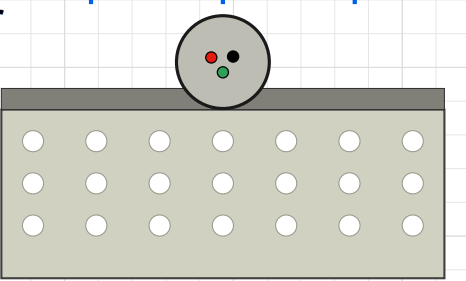
    • In the trefoil arrangement the cables touch, rather than overlap.(The red/black/green colouring also seems odd - it's reminiscent of old (pre 1970s) single phase cables - and seems especially inappropriate for trefoil as that's mostly used for 3-phase arrangements where there are advantages to be had from the effects of the three currents cancelling each other out.)

    But a good effort I think - you've certainly seem to have grasped the important principles.

        - Andy.

  • Agree a nice style - I assume you are preparing  a student hand out or a book chapter, and the regs alone are a bit too dry on descriptions.

    there are a few extra things that the more alert reader may find interesting.

    I might note that it is the heating over a time of minutes to hours that is an issue, so very short events ( capacitor inrush, motor starts etc) may exceed the rating by many times with no ill effect, while grouping cables together or a warm external temperature (roof voids in factories perhaps) this all eats into the safe temperature rise, and reduces the current rating.  

    Running cables a few degrees hotter than intended does not immediately cause a failure unless the overload is quite dramatic - usually its more of an early ageing
      A Commentary_2D00_UpdateApr04.pdf
    Shows the effect on lifespan of overheating by a modest amount. this implication is that  short life installations in cold places may be wired in thinner stuff than you might expect (and anything in cars seems to be using a different rule book altogether, but realise that even quite an old car has probably only seen a few thousand hours of run-time)

    Also note that the annexes in the regs are not able to cover all possible cases, and are informative , not nominative, so  where the designer and or installer knows different, - perhaps the environment, or a special cable, or a low duty cycle, then that information may be used to choose  different cable size if it is more  appropriate

    Mike.

Reply
  • Agree a nice style - I assume you are preparing  a student hand out or a book chapter, and the regs alone are a bit too dry on descriptions.

    there are a few extra things that the more alert reader may find interesting.

    I might note that it is the heating over a time of minutes to hours that is an issue, so very short events ( capacitor inrush, motor starts etc) may exceed the rating by many times with no ill effect, while grouping cables together or a warm external temperature (roof voids in factories perhaps) this all eats into the safe temperature rise, and reduces the current rating.  

    Running cables a few degrees hotter than intended does not immediately cause a failure unless the overload is quite dramatic - usually its more of an early ageing
      A Commentary_2D00_UpdateApr04.pdf
    Shows the effect on lifespan of overheating by a modest amount. this implication is that  short life installations in cold places may be wired in thinner stuff than you might expect (and anything in cars seems to be using a different rule book altogether, but realise that even quite an old car has probably only seen a few thousand hours of run-time)

    Also note that the annexes in the regs are not able to cover all possible cases, and are informative , not nominative, so  where the designer and or installer knows different, - perhaps the environment, or a special cable, or a low duty cycle, then that information may be used to choose  different cable size if it is more  appropriate

    Mike.

Children
  • while grouping cables together

    Good point - I missed that. I should have added that the "reference methods" are just a first approximation to the cable rating - there are a whole stack of correction factors that can increase or decrease a cable's actual rating according to more detailed circumstances. These cover a myriad of variables that give you Iz rather than just It - everything from the ambient temperature to cable grouping to different types of protective devices or even if you need to provide overload protection to an underground cable and depth of burial or soil type.

       - Andy.