Guidance for plug in solar for Electricians

We are now a few days from plug in solar being legal. The likes of Martin Lewis is recommending people should ask an electrician to check their installation before plugging a solar system in.

I have seen various comments referring back to changes in the law and changes to the specification for a 13A plug.

But I haven't seen any guidance from IET, NAPIT or NICEIC for electricians stating under what conditions it's acceptable to plug one of these systems in.

Personally as it stands today based on what I have seen I would not be willing to say iny installation is acceptable unless it was a single socket on it's own circuit protected by a bidirectional type A RCBO. Which I am sure isn't what the government wants.

Have I missed something, is something in the pipline?

I know lots of people will just do it, but in those situations I am not responsible.

  • Schuko to BS 1363 adapter

    Haha! 
    Or indeed cutting the Wieland plug off and putting a UK plug on it, or even wiring it to an outdoor socket or a  fused spur (but of course none of that would ever be compliant, would it, nor would the German DIY solar plus battery kit  for a touch over the price of the UK one without..)

    And note in Germany, to encourage rapid uptake, its all zero VAT rated ("Mehrwertsteuer 0%" ) while in the UK it very much isn't. 

    Mike  

  • which seems to leave homes with no RCDs at all without any constraint ... which seems a little inconsistent.

    That just continues the current inconsistency with napit at least. They guide that a type ac rcd is a c2 but no guidance for lack of rcd protection.

  • If you turn up for an MOT with a modern car and a seatbelt is defective, you get a fail.

    However, if you turn up with an older car which does not have seatbelts, you pass.

    I think that my regular MOT testers like the older cars, 'cos the test is quicker. Mind you, having logged on a test, they cannot complete it before a certain interval, so we just have a natter. :-)

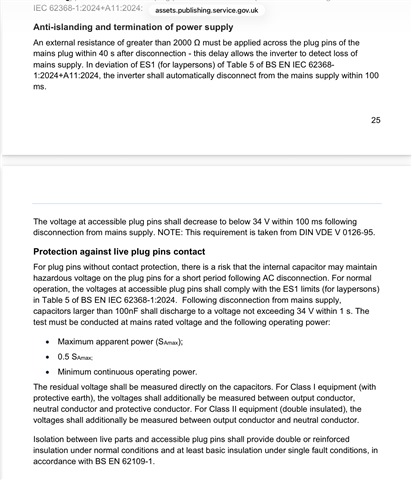
  •  Page 25: Anti-islanding and termination of power supply
    An external resistance of greater than 2000 Ω must be applied across the plug pins of the
    mains plug within 40 s after disconnection - this delay allows the inverter to detect loss of
    mains supply. 

    Is that really 40 seconds, or should it be 40ms?

  • And note in Germany, to encourage rapid uptake, its all zero VAT rated ("Mehrwertsteuer 0%" ) while in the UK it very much isn't. 

    It did occur to me earlier this evening that if HMG wishes to promote balcony solar, they could zero-rate it, or even match grid leccy at 5%.

    Of course if the situation were reversed, no German would even think of bending the rules. ;-)

  • That does not make sense. Why a resistor? Surely with a loss of supply the anti islanding should kick in and turn off the inverter? 

    JP

  • When I was at college doing the C&G2360 Part Two we had a workshop lecturer who did his apprenticeship in a carpet factory and then worked for the MEB and the companies that took over as the local DNO until he retired and was persuaded to come and teach us practical skills in the college workshop.

    He advised us that having carried out the safe isolation procedures to prove an installation or circuit “dead” that we should then put our insulated long nose pliers or something similar across the terminals as a final test, as to quote him “it's better to sacrifice your long nose pliers than your fingers”.

    The resistor in the plug in PV to prove dead is a test as simple and as unsophisticated as shoving your long nose pliers across the pins of the plug in PV 13-amp plug when you pull it out of the socket, it should not be necessary, but it’s a very good idea as it may stop you or someone else getting injured.

  • Forty seconds.

    assets.publishing.service.gov.uk/.../plug-in-solar-final-_interim-product-specification.pdf

  • Yes, that's the document I quoted from. Where did 40 seconds come from? It seems an awfully long time when we typically think of disconnection within 5 seconds.

    But , reading it again, it requires the resistor to be in place 40 s AFTER disconnection. So it will disconnect, then within 40 s a resistor will bridge the terminals so there is no chance of any charged components backfeeding the plug.

  • But, presumably the resistor will still be in place when the mains supply is restored and the system is reenergised?