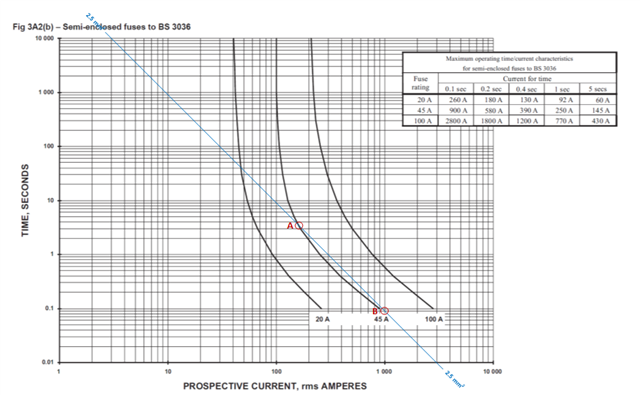
Cable selection for Max fault current

For Fault at load end: The cable has to withstand the thermal stress for the through fault.

For Fault at the circuit breaker terminal side or (at the beginning of the cable): if the fault happened, it is understood that cable is already damaged, so there is no need to check the thermal stress for this case.

Refer to BS7671 clause 434.5.2, " A fault occurring at any point in a circuit shall be interrupted within a time such that the fault current does not cause the permitted limiting temperature of any conductor or cable to be exceeded"

Is the intent of this clause is that the fault do not develop in to "Fire" hazard though the cable is damaged, therefore cable thermal stress to be checked for faults at the beginning of the cable as well.

Is my understanding correct?

  • if the fault happened, it is understood that cable is already damaged, so there is no need to check the thermal stress for this case.

    That's not my understanding - all the cable should be protected where-ever the fault occurs - after all if it's a long cable, repairing/replacing a short damaged section is often much more practical than replacing the entire length up to the point of the fault.

    I think it gets confusing, as the traditional approach treated the fault-at-the-far-end as being the worst case - which was true for fuses as their energy let-through tended to increase with longer disconnection times (i.e. lower fault currents) - but with MCBs where the disconnection time is much flatter, the reverse is often the case and the worst-case for energy let-through is often close to the start of the circuit. Some text books haven't caught up I fear.

       - Andy.

  • You are correct. When carrying out a thermal withstand calculation on a cable it should be done at the supply end and the far end of the cable to verify the cable is suitable for use.

    That said the far end of the cable is likely to be more onerous as the disconnection time will be longer due to the impedance of the cable being higher than the supply end.

    The far end may be a long, slow, blow heating up the cable for longer.

    When teaching this on the 2396 design course I found this the hardest concept for the students to understand. To illustrate this I had a slide showing potatoes being added to a carrier bag until it split with the potatoes representing energy and the bag as the thermal withstand of the cable. The thermal withstand being a re-arrangement of the adiabatic equation. 

    JP