What would a clean-sheet set of wiring regulations look like today?

The wiring regulations and associated legislation (on sockets etc) have developed in stages over the last hundred or so years.

As a result, the way they have developed is a product of the technological development over that time and of choices that were potentially made decades ago in very different environments.

When BS1363 socket or ring mains were developed, I doubt the people about them were considering a world with inexpensive multi-poles RCBOs, 8000 series Al alloys or the electronics of today.

So, if you could start from scratch with a new wiring regulations system to best achieve affordable, effective and safe electrical systems for installation in domestic or light commercial environments, how do you think it would differ from the status quo?

Parents
  • Standardisation of wiring colours would be a useful step. Green/Yellow for ground/earth is almost there but the rest of the colours are scattered in function between the different countries. If I remove a light fitting in my Swiss apartment I may find a black wire and a yellow wire. The black is phase, the yellow is neutral. 

    Redefining any of the current colours would merely increase the already huge legacy problem Confused

  • After all, decarbonisation will require people to use a great deal more electricity than they have before, even if the heat pump rollout delivers everything that is promised. 

    That might  be far harder then you imagine. If you envisage the ADMD rising to anything above about about 8 amps per house, then every substation, every HV main and all the kit that supplies it will have to be re-done or at least re-configured. Just because all houses in the street have a 60/80/100A fuse next to the CU does not mean the street can supply that to each of them without catastrophic failure.  60-80 houses per phase on a half megwatt unit, fused at 400A /phase is a typical set-up on a modern-ish housing estate, older ones are less generous. An "all-electric" estates may increase that  half up to a one megawatt transformer, and then two branches of 400A each doing half the houses.
    Given the speed with which we are still removing pre-war fused neutrals and looped supplies from terraces wired up in the early 1900s, I'm not sure we'll have the capacity to get your desired 3 phase to the house in time for the gas running out completely, let alone just getting rather expensive, as it is now.
    The cheapski method is to up the voltage and transform at both ends, but that is not as easy as it sounds either. (though uplifting 11kV routes to 33 has some appeal, it is still a lot of substations to change).
    So in the short term while we do that, probably only the first couple of decades, we either need heat pumps to be pretty efficient,  or to go back to a pre- central heating mentality, and learn to knit our own jumpers.

    Mike

  • If you envisage the ADMD rising to anything above about about 8 amps per house

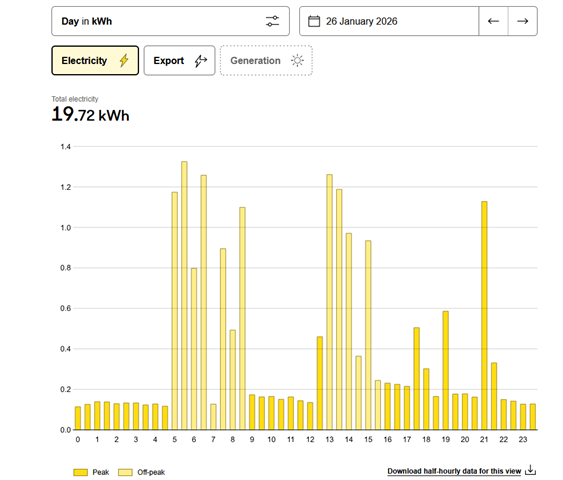
    I put in a heatpump to replace the ageing gas boiler about a year ago, so we're "all electric" now (other than not having an EV yet) - cooking is all electric and the gas has been disconnected. Even on the worst day I can find data for (Jan 26th) we used less than 20kWh with the highest half-hour reading of 1.3kWh - so less than 12A over that half hour- and that level only lasted a couple of hours - the average over the day is still below 4A.


    The place is pretty well insulated & airtight though - which probably makes a significant difference - but that's the sort of thing that can be replicated elsewhere if people have a mind to.

    Adding in say another 7kWh a day for an EV - if it could be spread sensibly between other loads - could still work. After all 27kWh over 24 hours is still below 5A average.

      - Andy.

  • Indeed, it does appear we've made a rod for our own back.

    Perhaps it would have been better if the first chief engineer at MANWEB, Peter d'Eyncourt Stowell, had been put in charge of the entire system. The Merseyside way of doing things, with a fully interconnected system and no tapered feeders would probably put us in a better position.

    The problem, as it I see it, is to get the required performance out of heat pumps we'd have to do major retrofit on the bulk of the housing stock, the majority of which is in truly awful condition. The labour for that level of construction work almost certainly does not exist. It seems to be one of the main reasons that the heat pump rollout is still not going particularly well.

    It may be that breaking feeders and fitting big 500kVA pole mount or pad mount transformers wherever we can, fed with 11/22kV aerial bundled conductor feeders is more tenable than tearing half the housing stock to pieces, but right now it appears to be a real mess.

    Suppose you need a way to churn out high voltage electricians to do that.

    Certainly makes me wonder if planning to reduce the supply voltage to a true 230V is a sane decision! I'd suggest changing the voltage tolerance to something like 230V-0%+10%

    Perhaps we should just pay everyone to have a battery bank behind the meter.

    Even if there is no further increase in car use, we're looking at something like 1.6A of ADMD per house just for electric cars. At some point we are going to have to tear the bulk of the system to pieces anyway, I think.

  • or to go back to a pre- central heating mentality, and learn to knit our own jumpers

    I fear that the genie is out of the bottle.

    EV or ICE, there were no heaters in cars until the 1950s. Anybody fancy a hot water bottle and a blanket? :-)

  • 60-80 houses per phase on a half megwatt unit, fused at 400A /phase is a typical set-up on a modern-ish housing estate, older ones are less generous.

    Maybe fewer than that in our road

    The transformer a couple of doors down was replaced last year. The old one was 500 kW, built in 1959. Unfortunately, the plate on the new one is too far away to read with the naked eye, and too close for binoculars.

  • No need to train an army, it will train itself, but only at the last possible moment.

    All you need to do is to convince people that they are competent to put in their own insulation, heat pump, battery storage ,etc ., and when it gets cold enough, they will. It would require general shift in the level of education  but its probably faster that trying to create a load of extra disinterested technicians in advance from kids who don't really want to learn how to do it.

    Folk on here often disparage the work of the misguided enthusiast (but not as much as they do on the screwfix forum), vs some time served tradesman, and I agree there is some awful DIY out there, as well as some very good stuff,  but that is partly down to a culture of secrecy. It is worse for gas  ' you can't install a boiler without belonging to this club' is assured by keeping the info about  how to do it well under wraps, as if an educated customer might be a threat.

    Well, a well educated customer should be a threat, to those who are on the inside but only doing a mediocre job. And there are a lot of those doing electricity too, not just drive by EICRs.

    I therefore view things like the recent  plug-in solar developments with some amusement, as a sign of things to come, first on batteries and maybe heat pumps as well. Initially we all gather round and decide how best to regulate for an ideal super safe situation, but that prices too many folk out of the market, so we have to lighten up a bit, and accept some things that are not that great will happen, and eventually, when it gets tight enough, the rule makers eventually get out of the way again..
    Mike.


    Mike.

  • All you need to do is to convince people that they are competent to put in their own insulation, heat pump, battery storage ,etc ., and when it gets cold enough, they will. It would require general shift in the level of education  but its probably faster that trying to create a load of extra disinterested technicians in advance from kids who don't really want to learn how to do it.

    Perhaps we should discuss means to write domestic wiring regulations (and associated regs) that allow even DIYers to easily do a competent job?

    To eliminate the traps and pitfalls that get them into trouble.

  • Well maybe,  or at least publish enough info at a digestible level for the intelligent 14 year old, so Joe Public can know what to ask for and warning signs to watch to se if  they are being fobbed off with poor work.

    As a slight aside my wife and  own a leasehold flat, and while ours has electrical and other works that I consider 'pretty good', we do have the  feeling of owning the 'best in show' prize bull as some of the other owners  in the building pay way over the odds for a very poor quality of works by 'professionals', not just sparks, but plumbing plastering and decorating too, who seem to know there is almost never any come-back.

    I realise private rentals are the shallow end of the market, but if we are serious about looking after people,  a bit more awareness in the general population would be good.
    However, it is straying a bit off this topic.

    Mike

  • Perhaps we should discuss means to write domestic wiring regulations (and associated regs) that allow even DIYers to easily do a competent job?

    To eliminate the traps and pitfalls that get them into trouble.

    A start would be to mandate lever terminals on all equipment. No more burnt neutrals because a screw wasn't tightened to the correct torque.

  • Perhaps we should discuss means to write domestic wiring regulations (and associated regs) that allow even DIYers to easily do a competent job?

    To eliminate the traps and pitfalls that get them into trouble.

    In the days when people read real books, there were plenty of DIY manuals about that would guide you through the practical side well enough. I guess the difference these days that it's all random snippets of information from the internet (youtube videos etc) without anyone ensuring it's collated into a sensible "big picture".

    When I were a lad the biggest problem in doing a proper job was getting hold of the right materials - the local shops would happily sell you a socket, back box and a cut length of cable - but grommets and green sleeving were unknown to them.

       - Andy.

Reply
  • Perhaps we should discuss means to write domestic wiring regulations (and associated regs) that allow even DIYers to easily do a competent job?

    To eliminate the traps and pitfalls that get them into trouble.

    In the days when people read real books, there were plenty of DIY manuals about that would guide you through the practical side well enough. I guess the difference these days that it's all random snippets of information from the internet (youtube videos etc) without anyone ensuring it's collated into a sensible "big picture".

    When I were a lad the biggest problem in doing a proper job was getting hold of the right materials - the local shops would happily sell you a socket, back box and a cut length of cable - but grommets and green sleeving were unknown to them.

       - Andy.

Children
  • the local shops would happily sell you a socket, back box and a cut length of cable

    And a couple of screws to secure the back box. All in a paper bag, which you could re-use for lighting a fire.

  • In the days when people read real books, there were plenty of DIY manuals about that would guide you through the practical side well enough. I guess the difference these days that it's all random snippets of information from the internet (youtube videos etc) without anyone ensuring it's collated into a sensible "big picture".

    I think the regulations are a lot more about risk assessments and such things than they have been historically. Especially with complex earthing arrangements for chargers and PME and all that. A lot simpler in the old days when everything was TT and TN-S!

    I think a DIYer would do much better if they had comparatively simple iron cast rules to follow. That's one of the reasons I started this thread originally.

    Labour is now so expensive relative to materials that I wondered if it was possible to make regs that could be followed almost blindly without getting people into trouble.

    "For sockets you use a 20A RCBO, 2.5mm LZOH twin and earth and can have up to eight sockets" is a lot simpler than even the onsite guide process.

    Indeed, we could probably spec 4mm T&E and still come out ahead, it's only 40p/m more expensive on TLCdirect and would render thermal overloads from insulation much less of a risk.

  • The more I think about this, the more I stand by my original suggestion that the Wiring Regulations would be similar to the First Edition.

    It's a bit like the Irishman who is asked for directions to Dublin: "If I was going to Dublin, I would not be starting from here."

    I think that the Regs and technical improvements have developed hand-in-glove. You can hardly mandate MCBs for ADS if they do not exist; additional protection could not progress from supplementary bonding to RCDs until they had been developed. Presumably some of the changes in BS 7671 are driven by previous tragic failures.

    So, if you want to start with a clean sheet, I do not think that you can start with where we are now.

  • As I understand it the USA wiring regulations are a series of prescriptive codes to cover (hopefully) all eventualities. A  coded (qualified ) electrician in the USA can command a high salary, possibly more than his uncoded boss.

  • I think, to some extent, American electrician salaries are related to the extensive permitting and work control apparatus they have in the US. Where the government in many areas has to approve electrical work, complete with drawings, before it even takes place.

    Additionally, the NEC is still a highly complex code that includes any number of edge cases and commercial and industrial installations. It's even longer than BS7671!


    Almost all domestic installs can probably be done with only three circuit types: a 6A lighting or small appliance circuit, a 20A socket circuit and a 40A "large appliance" circuit. Maybe another for things like very high power electric showers, but in new builds we probably don't want those anyway!

    Three phase would add a couple more, but I think you could probably write something suitable that is shorter than the on site guide in its entirety.


    The NEC is intriguing though, it is full of oddities to European eyes, such as the phenomenon of "pull out" disconnects, and a predilection for RCDs in socket outlets rather than in the breaker panel. The US is also essentially entirely TN-C-S, which as noted above has its own complications.