My war against dual rcd boards

As each (RCD) Residual Current Device must not have more than 30% leakage current on it.
It's hard to see how dual (RCD) Residual Current Device boards can be fitted at all these days.
i come across so many dual rcd boards with solar, evse and heat pumps on them, these have all been recently installed.
i wonder if BS7671 should state: Dual (RCD) Residual Current Device boards shall not be fitted, unless it can be shown (and documented) that they are suitable for the combined leakage currents expected .
otherwise developers will keep specifying them and i will have keep educating them on the many reasons a type A rcd should not be shared with other equipment!.
maybe manuafactuers instructions should also state : not suitable for a shared rcd, for certain equipment.
Parents
  • Three days ago I said:

    ”The question that Graham asked was quite specific:

    However, if the lamp is damaged, and the user is being protected against accidental contact with live parts, say after the rectifier, would the type AC RCD operate is perhaps another?”

    in that he said “after the rectifier”, so assume there are some diodes charging a capacitor, which discharges to supply the DC current, and the input current is 25 mA at 230 volts, what is the DC output current and voltage?”.

    So presumably after the rectifier the current and voltage is peak, not RMS? So if the current and voltage is 25 mA at 230 volts AC measured RMS, then after the rectifier it should be 35,35 mA at 325 volts pulsed DC unless there are a few more electronic components to drop the voltage?

  • Would you consider a unipolar square wave, or a triangle wave where the lower crest is at zero, as examples of DC?

    I think that I can see Mike's point. Whilst square-wave d.c. might be useful, e.g., for a flashing lamp, I suspect that the usual aim is to obtain smooth d.c.

  • Save that, for example, your 42 mA half-wave rectified d,c, superimposed upon 6 mA of smooth d.c. would be continuous.

    Here is a Boxing Day question for all of you. It may be unlikely to occur, but if you had one device on a circuit with a fault to ground of 15 mA r.m.s. a.c. and another one with a fault of 15 mA r.m.s. half-wave rectified pulsating d.c., would a 30 mA type A RCD trip?

  • We need to take care with the peak, average (mean) and rms values of such signals.

    The 'pi' value keeps cropping up in a lot of situations (e.g. see also noise bandwidth vs signal bandwidth factors).

    As an aside, what is truly missing, is the explanation as to how/when these half sine [pulsed DC] style currents actually 'blind' the RCD. The pragmatic engineering/ material/physics are just (if not more) interesting than the mad/bad maths definitions Smiley.

  • ... re-introduce the term "continuous current"....

    maybe we should, but I think we'd have to agree what we meant by it first, which is kind of where we came in.  If we assign a single figure to something that is changing, are we refferring to  its mean, its RMS or its peak ?

    I'm not sure..

    Mike

  • fault to ground of 15 mA r.m.s. a.c. and another one with a fault of 15 mA r.m.s. half-wave rectified pulsating d.c., would a 30 mA type A RCD trip?

    haha - maybe only  half the time ;-) 

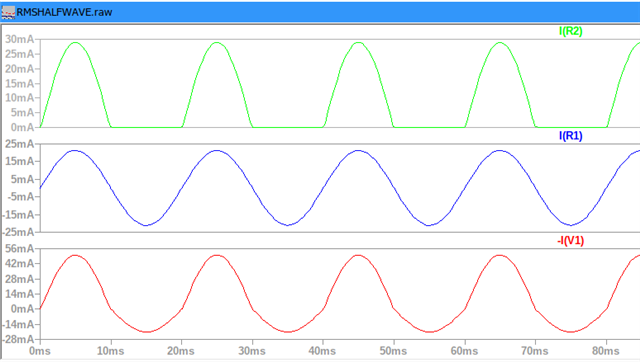
    you have defined exactly what you want, The sum of these upper 2 current traces, making the lower one

    We do not, however, as we have just discussed,  know for certain what the RCD spec actually means.

    Mike

    PS for those interested, this is a simulation in LTspice, a tool I find helpful for this sort of stuff.

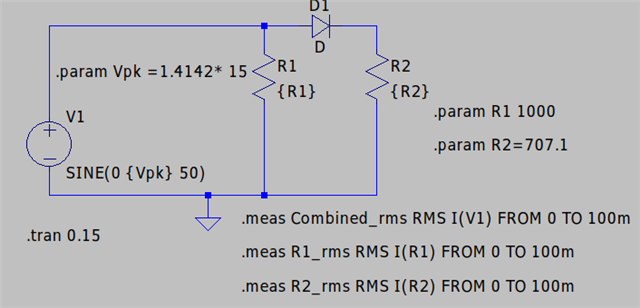
    This is the circuit being simulated.

  • haha - maybe only  half the time ;-) 

    Mostly not, IMHO.

    If my maths are correct, the RMS value of the combined current is only 16.8 mA.

    But is, "mostly not" (or 50% of the time) a single RCD being exposed to an imbalance many times, or many RCDs being exposed only once?

    If we assign a single figure to something that is changing, are we refferring to  its mean, its RMS or its peak ?
    We need to take care with the peak, average (mean) and rms values of such signals.

    I think that we are all agreed on that. :-)

    P.S. this discussion beats the dross on the telly by a country mile.

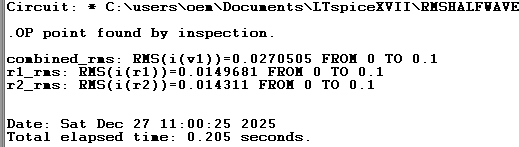
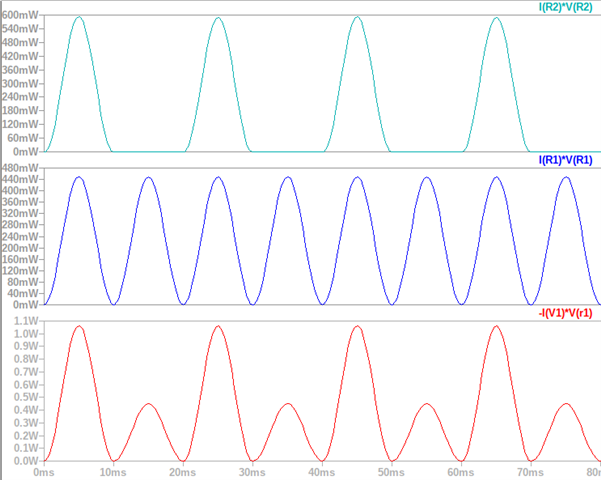
  • I have added the RMS calculations to the simulation above (and updated the screenshot image in the post above, to reflect that just in case someone else wants to know how to try this sort of thing at home ) and the combined RMS is not as low as you might think, coming in at almost exactly  27mA. - it is not simple power addition (which would be root of sum of squares - think Pythagoras) because they are synchronous functions, - that is to say the peaks of the rectified and un-rectified waveforms are always aligned, and  not independent of each other and those peaks, while only there half the time, count for most of the RMS energy.

    The spice log is as follows.


    I appreciate that there are quantisation errors, so the nominal 15mA RMS in the 2 limbs is not quite, but this still illustrates the point

    It may help to visualise this by considering the power as a function of time, rather than smoothed over many cycles,

    regards 

    Mike.

    PS schematic edited to create named nodes r1 and r2 so that we can plot the current in the component times the voltage across it with a meaningful name.

  • you appear to be thinking of the average current,

    very true, indeed I am, my mistake and while embarrassing it sort of reinforces the  point that it is important to be clear about these things, and easy to be confused ! Oops.

    Mike.

    PS missed this post at first as the website had carefully folded it away...  

  • what is truly missing, is the explanation as to how/when these half sine [pulsed DC] style currents actually 'blind' the RCD.

    well in a few experiments I did here at home some years with an old 'AC' type RCD, they really don't seem to - so at least one manufacturer probably only needed to change the label, rather than the internals of their design. Equally a large smooth DC clearly does blind the RCD - as the D-lock series of meters clearly demonstrated, presumably by saturating the magnetic core, so it forgot to be a transformer at all, but there is an element of sneaking up on it, so at no time is the rate of change large enough to induce a significant secondary voltage.

    The problem is that it is no easy to be sure for some generic RCD, as the saturation behaviour will be horribly dependant on material choices and construction layout of the magnetic behaviour.

    Mike

  • The other "problem" is that we generally don't have a good handle on the magnetics that cause the perceived 'average dc' to create the blinding effect.

    I've long thought it's probably a combination of the ferrite ring/core's saturation and hysteresis that shifts the operating point of the putative 'difference current transformer' to a point that has a low effective turns ratio (which would mean the trip solenoid would not activate at the expected [AC] leakage current).

    The saturation & hysteresis are determined by the specific material / ferrite in the particular RCD / GFCI brands. so likely to be highly variable as to test outcome for our general test of a random spare RCD from the disposal pile [I've recently pulled apart an old BG CUR8030 to try and see what is really in there]

    Average DC may not be the [pure] problem.

    Found https://physics.stackexchange.com/questions/60194/equation-describing-magnetic-hysteresis as a description of the equations for the magnetics. Yet to study it.

Reply
  • The other "problem" is that we generally don't have a good handle on the magnetics that cause the perceived 'average dc' to create the blinding effect.

    I've long thought it's probably a combination of the ferrite ring/core's saturation and hysteresis that shifts the operating point of the putative 'difference current transformer' to a point that has a low effective turns ratio (which would mean the trip solenoid would not activate at the expected [AC] leakage current).

    The saturation & hysteresis are determined by the specific material / ferrite in the particular RCD / GFCI brands. so likely to be highly variable as to test outcome for our general test of a random spare RCD from the disposal pile [I've recently pulled apart an old BG CUR8030 to try and see what is really in there]

    Average DC may not be the [pure] problem.

    Found https://physics.stackexchange.com/questions/60194/equation-describing-magnetic-hysteresis as a description of the equations for the magnetics. Yet to study it.

Children
No Data