Ai and 7671

When tutoring 2391, it is part of my role to encourage candidates to use 7671 and GN3 as much as possible. Those are the only printed documents permitted in the online exam. During practical training, the lads are encouraged to collaborate with each other and use said documents to check test results and design data. I note many just defer to their smart phone to access even rather obtuse data buried in the bowels of 7671. 
As much as an old timer like me likes his books, I think it is time that we acknowledge that smart phones will be the primary data source for most operatives. The exam bodies would do better to address the application of data rather than the simple ability to access it.

  • The exam bodies would do better to address the application of data rather than the simple ability to access i

    Is there a formal way to provide such feedback to the examining body?

  • Is there a formal way to provide such feedback to the examining body?

    The course and exam content are driven by industry stakeholders including IET. I have no doubt that they are all well aware of the need for change but it may be that introducing a completely revised iteration would be financially punitive for some stakeholders.

    No one could persuade me that forcing the Hoi Polloi through 3-days training on how to find something in a book is of significant worth to our industry. 

    Ai will change life for us all and it might be that eventually BS 7671 will have no choice other than to open its covers and let Ai suck out the data. If it doesn't, I imagine that operatives will simply use their smart phones and disregard any warning about errors in the answer Ai spits back.

  • There is a wider point about standards generally, that the whole set-up and publishing cycle and so may updates and all the rest  is set up for paper based publication. That may simply not be required - some sort of ' online version is latest anything you print may be out of date ' approach would allow instant updates.

    It also ought to be cheaper.

    Some documents are already like this (Scout Association 'Policy Organisation and Rules' comes to mind as one I have a lot to do with )

    Mike. 

  • During practical training, the lads are encouraged to collaborate with each other and use said documents to check test results and design data. I note many just defer to their smart phone to access even rather obtuse data buried in the bowels of 7671

    It's a really tricky situation, because AI gets things wrong.

    However, without AI, there is also incorrect and out-of-date data available on the internet ... so, as an assessor or examiner, how do you know whether to mark it right or wrong (it's right to the data the candidate used ... but was that valid?)

    I make this point quite sincerely, as I know that, at least until recently (and it may well still be the case), a reputable organisation has available, at least through a quick search, for maximum measured earth fault loop impedance of some protective devices for which data is no longer published in BS 7671, but the data does not account for Cmin. I am also led to believe some earth fault loop impedance data is available from earlier editions of BS 7671, which takes into account neither Cmin, nor the drop to 230 V from 240 V.

    Using bona-fide current electronic versions of the standard (and permitted guidance) would allow easier searching for answers, BUT qualifications bodies do have strict rules about the use of electronic devices.

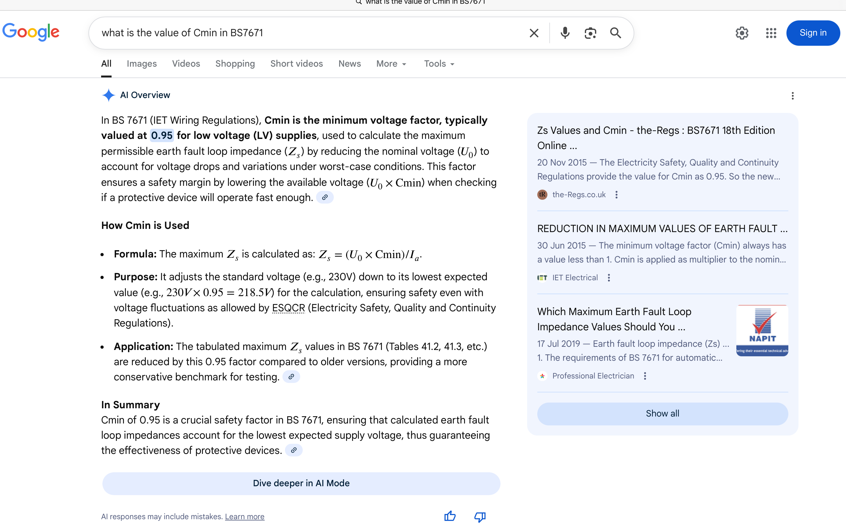
  • Just entered "Cmin." and look at the google answer.  Not quite what you would expect.

  • Not quite what you would expect.

    "typically valued at 0.95 to account for voltage variations." ... well, generally in the UK with supplies to ESQCR (at the moment), yes ... BUT not across CENELEC countries that adopt EN 50160, where Cmin is "typically 0.9"  ... 

    The source for this isn't BS 7671, but EN 60909-0.

  • If standards were open, one might ask Ai for an answer directly from the relevant one. In any event, as I see it, those hanging on to books and electronic copies of same for identifying specific technical information for use by coal-face electricians are flogging a dead horse! It really doesnt matter if the answer comes with a caution. 

  • The printed books need checking as well as the information gathered by AI, because there are counterfeit IET books that have errors and mistakes in them.

    engx.theiet.org/.../counterfeit-iet-books

  • If standards were open, one might ask Ai for an answer directly from the relevant one. In any event, as I see it, those hanging on to books and electronic copies of same for identifying specific technical information for use by coal-face electricians are flogging a dead horse! It really doesnt matter if the answer comes with a caution.

    I'm not sure I 100 % agree. 

    For example, with Cmin response, only the usage in relation to maximum measured earth fault loop impedance is cited, yet the usages for calculations adiabatic (or, where appropriate, Cmax), and maximum prospective fault current (Cmax) , are not ... however, they aren't cited directly in BS 7671 either.

    If BS EN [IEC] 60909 series and CLC/TR 50480 were available open-source, similarly the guidance on BS 7671, it might be ... otherwise, it's a sub-set of information on the topic.

    There's also the situation of AI algorithm picking up the right inference ... a lot of technical questions I've asked AI fall way short of the mark, and I've decided to park AI for the moment ... I think electrotechnical professionals should be advised to follow the practice the legal profession in the UK has been advised to in this regard: www.pinsentmasons.com/.../english-high-court-ai-lawyer-accuracy


  • I think electrotechnical professionals should be advised to follow the practice the legal profession in the UK

    I am with Graham on this one. One of the core skills of a lawyer is not only to be able to identify relevant case law, but to be able to understand and apply it. Mind you, it might be interesting to know the approach taken by law schools nowadays.

    AI seems to encourage idleness, but there is nothing new in that. My late father (who died in 1989) always said that if you rely upon somebody else's work, you cannot know whether it is correct or not.

    Back to the OP, I would go so far as to permit .pdf copies of BS 7671 in assessments, largely because they are easy to search, but no further.