Adding up current

In a ring final circuit
(Based on Paul Cooks commentary of the 17th edition)

Very simple curent split using both legs of the ring

Not sure about adding up the currents in each leg
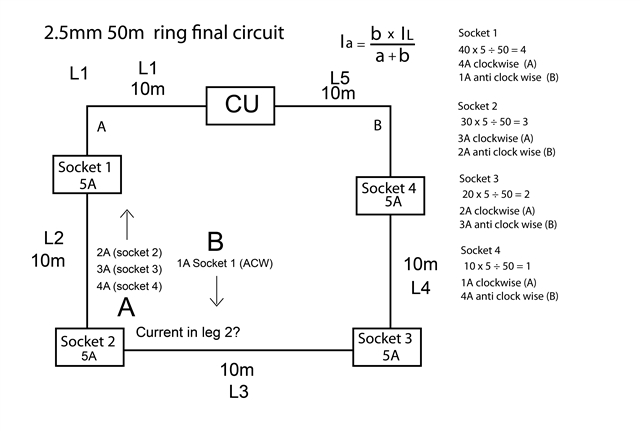
Take leg 2 Than will have the Ia of sockets 4,3 and 2
and the Ib of socket 1
How do these add up so you know the current in this leg?
Hope that makes sense
Thanks

  • AT first glance, your power loss calculation looks right to me (I've not checked your actual numbers though).

    Agreed. It would be easier to check the numbers if we knew the length of all of the legs!

  • yes, Actually, if it helps your visualisation, a current, or in the case of the clamp meter that surrounds it, the resultant magnetic field  caused, is all about the  electrons being passed along from atom to atom, but realise there are far more electrons in the wire all wizzing about like bees in a swarm or slightly drunken dancers at the disco, but on average going almost nowhere in particular.

    Each atom of copper brings 2 free electrons to the party, and they get passed around (in various metals the no. of free electrons per atom varies, and in an insulator it is generally 'none') but even with hundreds of amps flowing , the no of electrons that actually arrive and cause another to drop out the far end, (we've all been to discos like that as well ) forming the net current, is a remarkably small fraction of the total, and it is all about the combined total.

    So in a 3 phase circuit with 3 identical resistive loads wired in a star, there is no current flowing in the neutral, and it is safe to take that wire away, and indeed 3 phase plugs and socket without neutral pins are made for situations where we can be sure of good phase balance.   

    The difference is that the electrons that are just buzzing about in there on average neither gain nor lose energy, though they may briefly do either, or even leave and come back in again, so while there may be very brief temperature fluctuations over atomically short distances  ("thermal noise")  the wire neither heats nor cools in the long term from their activity. Even though the current is a small fraction of the total, the energy from a current with an overall sense of direction with arrivals at one end and departures at the other is steady net loss from the electrons, into vibrating the atomic lattice, which we see as heating of the metal.

    If however one source pushes some electrons in at one point, and another removes some from the same point, there is no need for any  electrons to 'fight the way across the dance floor'  to push any out the other end, and no net current flow, no voltage drop, and no loss of energy and no heating, they are not part of the current flow.

    Mike.

  • It's not possible for two currents to be flowing in different directions in the same conductor at the same instant.

    That's *net current* (after all contributions are added/subtracted as appropriate). [Just calrifying]

    One of the nice, but some times confusing, things when we all talk about this stuff is that there is the idea of "superposition" where each loop of voltage/current (must be a loop) can act independently (the voltage around the loop must be zero, and that at each junction point the currents (in and out) also add to zero. All that is a consequence of basic classical maths/arithmetic (3+2 = 2+3; 2*3 = 3*2; 3+3 = 2*3; etc). 

    In the ring final circuit  we have L-L loops, N-N loops, L-N loops, so fun all round. Here we 'suddenly' shift from perfect conductor ideas (which generate zero heat) to needing to be aware of the heat generated in these not quite perfect conductors as the *net current* in each cable is considered.

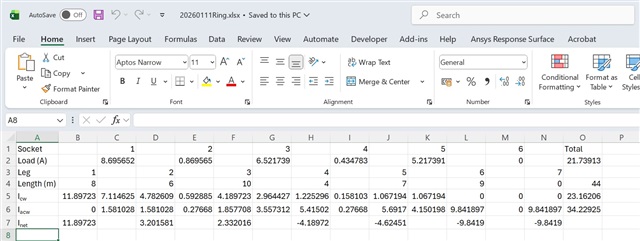
  • OK, I have deduced that the lengths of legs 2, 3, and 5 are 6 m, 10 m, and 7 m respectively, in which case the figures seem to be correct save that it is not clear what some of them mean. Calculations attached. I drew it up for 6 sockets, so the last leg and socket have values of zero.

    (Can we upload e.g. spreadsheets, or just pictures?)

  • Thank you for this, spot on with the lengths
    The legs were 1:8m  2:6m 3:10m  4:4m  5:7m  6:9m

  • Sorry to keep asking...

    Could I just try to confirm how current is added in a ring final leg.
    my online research keeps giving me different answers

    I kind of understand the idea that with maths you can have  clockwise or anticlock wise or + and - 
    and have algebraic answers or superposition...
    But  actual current in a piece of copper you can only have 1 value and 1 direction

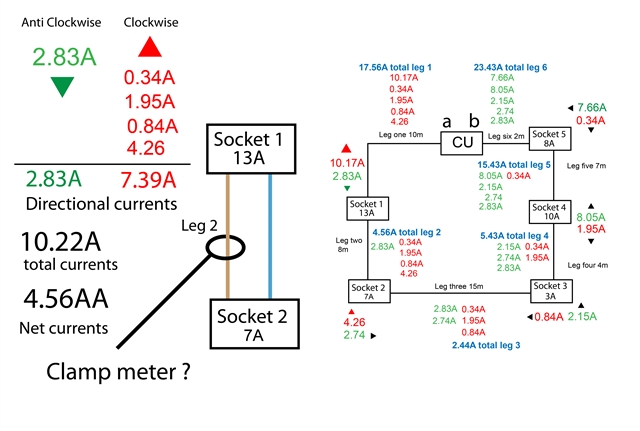
    In the attached picture. I have the total theoretical current traffic through a conductor
    The clockwise and anti clockwise currents
    And clock wise subtracted from anti clockwise.

    If I put a clamp around one live conductor at leg two
    is is possible from the numbers calculated to have a real world current value?

    frustratingly I read that you just add the values, and the the different opinion 
    that they cancel (Which seemed to be the guidance on here)

    appreciate your help...

    Thanks very much

  • It might be easier to understand in d.c. If you have three 1.5 V batteries and put them all in series, you have (+1.5 V) +(+1.5 V) + (+1.5 V) = +4.5 V. However if the middle one is the wrong way round, you get (+1.5 V) +(-1.5 V) + (+1.5 V) = +1.5 V.

    The currents need to be treated as vectors, i.e. they have direction as well as magnitude. The magnitude of cw and acw cannot simply be added because they are going in different directions.

    So, let cw be positive and acw negative. You have (+7.39 A) + (-2.83 A) = (7.39 - 2.83) A = 4.56 A. So your clamp meter would show 4.56 A, as indeed would an ordinary meter if you inserted it in the ring.

    By contrast, in leg 5, you have (+0.34 A) + (-15.77 A) =(0.34 - 15.77) A = -15.43 A. The minus sign indicates that the net current is going the opposite way, i.e. anticlockwise.

    Your clamp meter does not show the direction of flow, but CT clamps (as used in solar PV and EVCPs), which need to know whether current is coming or going, will do so: positive one way, and negative the other.

    HTH.

  • The clamp meter sees the total current flow - and when calculating that total realise that currents one way add to that total and currents the other way subtract as one is adding electrons at the time the other is removing them (and half a cycle later the reverse). Indeed if the currents to and fro were identical, there would be no current flow, no magnetic field, and it would be safe to walk off with the wire and the circuit would not be affected.
    In an AC system we have to define direction by being in phase with the voltage - the current flows from the live wire into a load in phase with the L-N voltage, while the current into a generator is out of phase with the voltage, or more sensibly expressed, the current coming out of a generator is in phase with the voltage.

    Mike.

    PS in the language of the mathematicians the it a simple vector sum - direction matters, not just magnitude.

  • Current in a ring leg is the sum of currents from both directions. For leg 2, add the currents coming from the sockets in that leg plus the return current from the opposite leg. Approximate split is usually 50:50 for domestic loads, but detailed calculation is needed for high-load or mixed-use circuits to comply with BS 7671 Appendix 15.