Upstream downstream RCD test

GN3 advises that the test should be conducted upstream neutral to downstream line. It would appear that there is a functional reason but I would like some clarification. Yesterday I used the method to test several Contactum RCBOs. As per GN3 method at x1, all operated between 14 and 18ms. Reversing the probes to upstream line and downstream neutral, all operated but the instrument reported greater than 300ms. 

  • If the RCBO is a single pole device with a solid neutral and you connect the probes between the upstream line and the downstream neutral the RCBO will not trip as the instrument is seeing a permanent voltage.

    JP

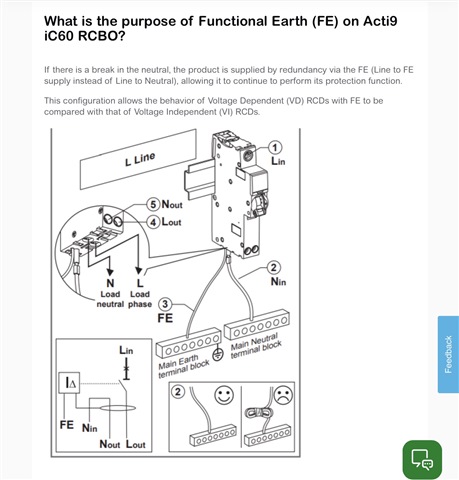
  • My thoughts revolve around the differences between voltage dependent and voltage independent RCDs, and RCDs with or without a functional earth lead.

    www.se.com/.../

  • If the RCBO is a single pole device with a solid neutral and you connect the probes between the upstream line and the downstream neutral the RCBO will not trip as the instrument is seeing a permanent voltage.

    As I see it (and I'm probably trying to clarify a clarification) the RCBO itself should physically trip OK, as the test current would have been out of balance just the same - just that the meter won't realise that it's tripped, because as you say the voltage remains regardless.

      - Andy.

  • My thoughts revolve around the differences between voltage dependent and voltage independent RCDs

    (not to be confused with voltage operated ELCBs...)

    With a FE connection, the RCD should still trip if the supply N is lost (and L and PE remain) but I don't think that helps us with a solid N devices, as even if the device has successfully opened, there's still 230V between load N and supply L.

       - Andy.

  • I am not giving you an answer, merely thinking out loud, with the earth test lead connected to the neutral downstream of a double pole RCD the earth fault path would be disconnected when the RCD trips, taking the earth reference away from both the RCD and the tester, not allowing the tester to complete the testing process.


    Voltage Independent Technology

    Residual current devices using Voltage Independent Technology can continue to operate in the event of a complete voltage loss or neutral break.

    • The toroid provides information on the leakage current and the power required to trip the device.
    • The electronic circuit and the relay are not connected to the electrical network. Power is provided only by the leakage current.
    • Even if there is an accidental break of the neutral conductor or a voltage drop, the entire electromechanical system will continue to operate, allowing the residual current device to trip.

    www.se.com/.../

  • Yes . . . a simplified explantion assuming a single-pole RCD . . . or indeed testing between the downstream line terminal of the RCD and earth, as is still the method shown in many instrument manufacturer's manuals.

    But if it is a single pole RCD, i.e. RCBO, and the neutral is solid, it does not matter whether you use the upstream or downstream neutral terminal.

    And if PME, surely it does not matter whether you use the neutral bar or earth bar.

  • it does not matter whether you use the upstream or downstream neutral terminal.

    well if you use downstream live and neutral it does not trip as it is then a normal load  - the neutral is solid, but the current in it is sensed !!
    Mike.

  • A single pole RCD device tested between the live input and neutral output should trip, but the tester would not know the RCD has tripped as it still has a live, neutral and earth connection, and there is no loss of voltage, hence no tripping time is recorded, despite the RCD having tripped.

    The up/down test allows a RCD to be tested without tripping another upfront RCD.

  • The GN3 recommendation to test upstream neutral to downstream line reflects the RCBO’s internal sensing and tripping mechanism. Testing in the reverse direction can still cause the device to operate, but the measured trip time will not represent normal performance, as the current path differs from the intended sensing circuit. The observed >300 ms is consistent with this effect and does not indicate a fault.

  • Testing in the reverse direction can still cause the device to operate, but the measured trip time will not represent normal performance, as the current path differs from the intended sensing circuit.

    This could be the case for RCDs (particularly voltage-dependent devices) for use in TN and TT systems - although in general is this not confusing the positive and negative half-cycle applied tests (0° and  180°) with the 'polarity of the live terminals of the RCD'.

    But What about RCDs in IT systems, or separated systems?

    Particularly in IT systems, there's no saying which line (or if three-phase, one line or neutral) will become earthed ... meaning on the second fault (which provides the shock risk) the device is working 'neutral to line' ... so the RCD has to be able to operate 'upstream neutral to downstream line' and vice-versa?