For a standard domestic Install, split board with 2x Type AC main switches.
No PV or Car Chargers should this be a C3 or C2?
Thanks in advance
For a standard domestic Install, split board with 2x Type AC main switches.
No PV or Car Chargers should this be a C3 or C2?
Thanks in advance
Nearly two weeks of discussion and nobody has mentioned high-frequency currents.
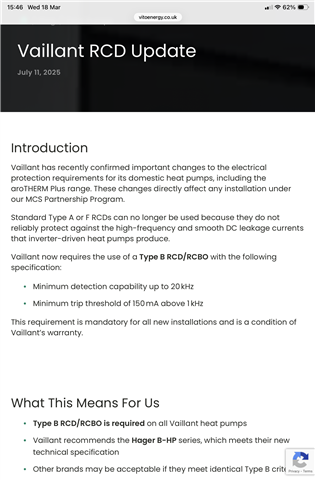

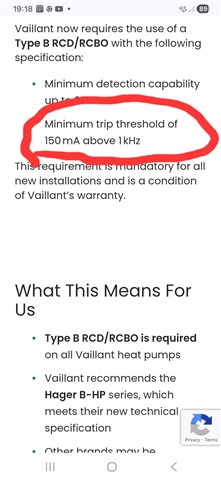
Be sure to read the complete article .. "ordinary" B-types aren't good enough for Vaillant (and perhaps other brands as well) - you need a special B-HP type (which are even less affordable than a B-type) - presuming you need 30mA RCD protection on that circuit in the first place that is.
nobody has mentioned high-frequency currents.
Sergio did mention B and F types 9 days ago ... but easily missed in the Forum's non-linear, not-quite-tree structure :-(
- Andy.

The other factor is that one should not, by increase of safety, remove the need for the expert practitioners such that safety is ultimately lost.
Thus we need extra activities for those very expert practitioners... I feel a new set of regulations coming on, just to keep the practitioners engaged  .
.
information on the internet that a type AC can/may get blinded
There's a lot of evidence free assertions, but minimal, hard to find, technical explanations.
We've had discussions in the forum about it. Along with the confusions between effective currents for AC and DC (rms vs sad [sum of absolute deviation]).
And no one openly admitting that their product was badly blinded..
I think that a free market decides the question,
In these areas of safety, the market is rarely able to decide. Placebos are a lot cheaper, and value is difficult to determine.
Second hand car sales has a similar value-price-consequence problem.

It would be more useful to see the manufacturer's installation instructions.
I do wonder why the manufacturers cannot make their products compatible with, e.g., type A RCDs. Surely, it cannot do much for sales: "Vaillant are a very good brand, sir, but you need new wiring." "How much?" "£1k extra, sir." "On yer bike!"

I'd like to know whether the more expensive brands are more reliable.
Brands set their testing percentage at point of manufacture. Some like Hager test about 5 to 15% of the RCBO they make, Some cheap imports made in China test less than 1%. Other brands like Navitascp do a far batter job and test every RCBO before shipping. On top of that they are a UK company.
Indeed .. (from memory the point was expanded on further down - assuming it's the same one I saw a while ago). (Continuing from an earlier discussion) given the human body isn't particularly less sensitive to currents at slightly higher frequencies, do these devices provide adequate additional protection? (I'm not doubting the comply with standards, but the standards were set on the assumption of 50Hz currents only).
- Andy.
Does that always matter, for example is the RCD is used for ADS due to circuit length, or in cases such as socket-outlet circuits where additional protection is necessary to meet the requirements for ADS in BS 7671?
That is my point: there seems to be this growing mindset that you can’t have a circuit without a RCD. It matters because better circuit design may negate the need for RCD protection altogether. It also matters in terms of the code given when existing RCD provision might not meet current requirements as per the case with the OP.
We're about to take you to the IET registration website. Don't worry though, you'll be sent straight back to the community after completing the registration.
Continue to the IET registration site