Bathroom appliance help please

Hi guys just after a bit of advice here please

Customer wants to build a full height cupboard and the bottom of the bath and put a washing machine and tumble dryer in it. It will have a door on the cupboard.

How would regs apply to this ? I can make it 3 x flex outlets and sfs outside the bathroom if need be rather than sockets.

The appliances would technically be within 600mm from the edge of the bath but inside a cupboard so couldn't remember if that then meant zones did not apply 

Thank you for any help here

Parents
  • However, even then it might be unwise, for reasons of  damp and perhaps machines rusting away.

    At one time, I would have supported this perspective, and certainly up to the early 1980s, many machines on the UK market didn't do well in a bathroom environment.

    However, in today's global market, things are a little different.

    Many countries in Europe think having dirty laundry in the kitchen is quite disgusting, and bathrooms are a common place to find washing machines and tumble dryers. Machines are therefore now made with that use case in mind, it being relatively common in the European market at a whole. 

    Also, I hope many bathrooms today are better-ventilated than those in the 1970s, or can be made so quite easily (if one has the correct certification to do that work, of course).

  • Moisture in kitchen v bathroom.

    We have a 10 inch fan in the kitchen. If it is not used, condensation appears pretty quickly. Don't forget that "gas" burns to produce CO2 and H2O. The dishwasher also expels moisture at the end of its cycle.

    There is a very weedy fan in my bathroom. When the central heating is on, there is no problem with condensation, but just lately, the mirrors have been steaming up.

    Our laundry appliances are in the scullery, where moisture is not a problem.

    I rather doubt that there is a significantly greater environmental risk when "kitchen appliances" are situated in a bathroom.

  • my tumble dryer lives in my shed

    Is it a dehumidifier/condensing/'heat pump' style beast, or the old roasted clothes style? Wink

  • Kitchen same though ... certainly in my 1930s house ... without the extractor, cooker hood, and trickle vents, both of those rooms would be sodden in winter.

    Mine is a Scottish 1960s property and we had that 'kitchen sodden in winter' when we first moved in 2 years ago. It's been a journey, as they say.

    Folks are too quick with prettifying their homes without appreciating all the hidden engineering 'comfort' aspects (safe?).

  • Is it a dehumidifier/condensing/'heat pump' style beast, or the old roasted clothes style?

    Yes, this is an issue, mine in the detached sectional concrete garage is the old type, which can cope with damp cold air coming into the machine in winter ... I don't think a condenser or heat pump dryer would work very well at all in the detached garage in winter.

    Given the fact there isn't room in the house, and we only use the tumble dryer in winter (and really then only for towels and bedding most of the time) I'm not sure a replacement tumble dryer would do at all !

    Answers on a post card !

  • I don't think the situation is that ALL type AC RCDs (or RCDs that pre-date BS EN 61008 series and BS EN 61009 series) are necessarily 'blinded' at all times by a switching converter. Certainly, according to the diagrams in Figure A53.1, it's only where the electrical fault occurs on the load side of the converter for many appliances.

    Aren't there two sorts of possible 'blinding' going on here.

    One being the possible back feed from the generating equipment through to the trip solenoid which wasn't disconnected by the fault disconnection.

    The other being the effective rectified DC components from switching supplies/converters/generators which could saturate the sense coil (current transformer) and fail to drive the trip solenoid at the trip level.

  • It's a condensing tumble drier, I use the collected water to water the weeds at the bottom of the garden  Joy

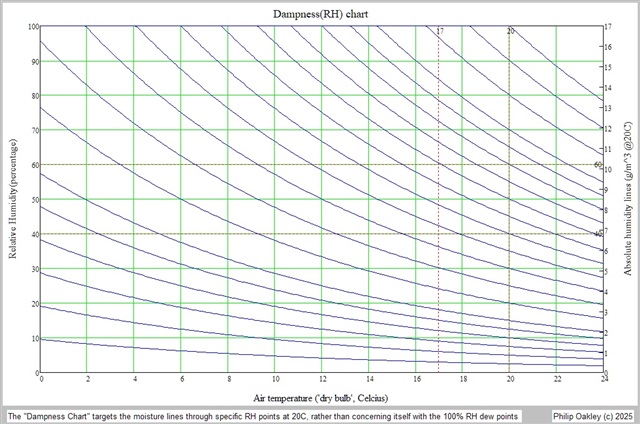
  • My "Dampness Chart" for all the relative humidity meter lovers (those cheap & easy RH /Temperature sensing for the damp house).

    100%RH is, obviously(?), the dew point for the lines of constant absolute water vapour.Dampness Chart

    PDF

    The chart is also helpful for explaining why/how underfloor ventilation dries a house.

  • I rather doubt that there is a significantly greater environmental risk when "kitchen appliances" are situated in a bathroom.

    The biggest risks are 'mindsets', where folks don't understand/appreciate why/how different approaches are taken, and will switch off fans immediately they exit the bathroom and close the doors (just like they switch off radiators when exiting a room and leaving it empty).

    The shift from warm jumpers (scarves & coats), to warm room, to whole house shirt sleeve environment causes lots of confusions and old habits die hard. Frustrating for all!

    I blame double glazing, especially the period when it was hopper windows and no vents!

  • Answers on a post card !

    As long as the cold damp air isn't mist & drizzle (actual water aerosol or droplets) it'll be even better than you expect.

    Cold air contains very little physical water per m3, so adding a little heat makes the warm air very dry which dries the clothes easily (like on a line on a spring day). 

    Adding a dehumidifier tent to the garage also works well, especially if you can fix a simple drain point/tube to beast.

    It feels really un-natural to have "cold damp air" being the best.. - see all the folks with rotten sub-flooring because they blocked their air vents - those 'Air Changes per Hour' (ACH) have to match up to the human generated humid air generation/extraction!

  • Magic!

    magic wand   Blue heart   potted plant

Reply Children
No Data