Why are different screw heads used in UK 3 pin plugs?

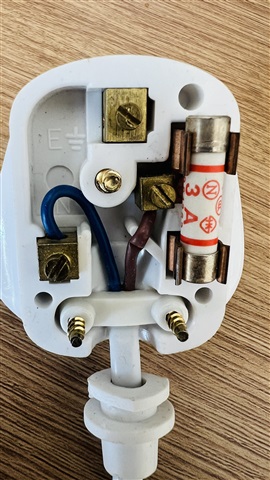
This morning I had to take my fan apart to fix it and while doing that I noticed the rubber bung on the three pin plug that gives you some resistance from pulling the wires out of the plug had come loose.

So, I went to unscrew the plug so I could pop the bung back in but then noticed that there are different types of screwheads used in the plug?

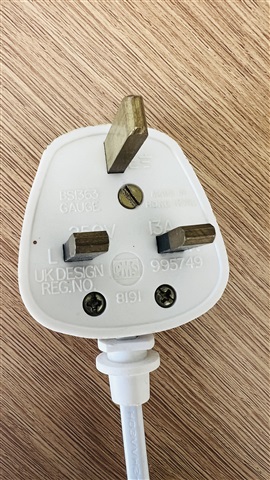
The main one to unscrew the back of the plug from the main body needs a flathead screwdriver but the one that you need to use to unscrew the bar across the cables is a Phillips head?

Why is that? Why are they different? Is that done deliberately?
  • Graham, how did you terminate the conductors? Shepherd's crook or ring?

    Ring, made by forming a crook with a bit of conductor left over to fold over the part nearest the conductor insulation. This prevents breaking strands as you tighten because the insulation moves nearer the terminal nut with a simple crook.

  • I too favoured a ring, but the conductor always had to be positioned 5 or 10 minutes early so that it arrived in the correct place when the nut was tight.

  • Hi Lisa, looking at your lower photo of the fuse side of the plug, note that the brown wire has been damaged by being "sandwiched" between the two case parts - ideally it would have been routed through the gap at contact level, going around rather than jumping over  the angled chicane. That mini-maze feature to the moulding is designed to ensure that wires cut to the same length don't pull-out in the wrong order leaving live connected but neutral pulled out, by using up the extra length saved  from the fuse compared to a direct to pin connection. 

    Ideally when someone trips on the lead, hard enough to tug through the cord grip (harder these days than on the early plugs) the live breaks first ! There is also something a bit odd about the grommet anti-kink tail and I think that is supposed to be pinched inside the body, and the wire generally pushed up further through the cord grip bar to allow this. 

    That said, as its a low current appliance and it is presumably running perfectly well it's not worth worrying about enough to open it up to change it specially, presumably although the insulation is displaced the core strands remain are intact and are not actually exposed,  but it is a thing worth looking at if it fails in the future. It may also mean the back is not fully seated.

    In any case something to  watch for, when fitting plugs in the future. 

    Best Regards Mike.

  • I would rather make off a gland on a 240mm2 SWA cable than wire a plug top. I don’t think my hands were made for the frustratingly fiddly nature of the thing!

  • Hi Mike

    Yes I spotted that when I took the back off the plug!

    Also the screw for the earthing cable contact was actually loose in the plug too so I popped that back in! Flushed  Given that neither myself or my partner had opened up that plug since it was purchased around 4 years ago it was obviously quite a shoddy manufacturing assembly! 

    Anyway... it's all a bit immaterial now as I managed to snap one of the fan blades whilst trying to straighten it out so the whole thing has gone in the bin Pensive

  • since it was purchased around 4 years ago

    New or, as they say nowadays, "pre-owned"?

    It has been 32 years since appliances had to be fitted with a plug https://www.legislation.gov.uk/uksi/1994/1768/regulation/12/made, but I would have expected a moulded plug 4 years ago.

  • Definitely 'new' Chris! Bought it from one of the big supermarkets.... and not the cheap ones either... 

  • Depends where on the planet the plug was put on, in terms of the labour cost of fitting it, and how big a fraction of that maker's market is in the UK to justify the investment in making leads with moulded plugs for just one destination's rather odd (if technically superior) square pin plug.

    Compared to the mainland Europe, we are a small market. (and the low  current (2.4A 4mm pins) Europlug with the slightly inward sprung pins fits a 13A socket anyway, with the aid of a biro to open the shutters. Sadly its not fused when doing that and not really very safe.)

    Mike

  • Well I suspect it's due to the torque capability of the screw head because the head design determines the maximum torque which can be applied before the screw driver jumps out of the head due to cam-out. Typically cross headed screws can handle more torque than flat headed screws.

    The plug pins have small terminal screws, screwing into a pre-cut thread and so need very little torque to tighten them, just enough to tighten onto the copper conductor, indeed you don't want to over-tighten them and risk damaging the conductor so a flat headed screw is fine. The plug cover screw is typically a machine screw into a pre-threaded insert, so again doesn't need much torque so flat head is fine.

    But the cord strain relief is, as mentioned, now normally a self-tapping screw cutting its own thread into a moulded plastic cable gripper, so it does need quite a lot more torque to cut that thread initially and then clamp the gripper down onto the cable sheath. With a flat head, you'd probably have the screw driver cam-out in the process, whereas a cross-headed screw can handle the extra torque.

  • More frustratingly, I would ask why the screws these days all seem to be made of Chinesium - a metal often softer than the plastic it's screwing into, and often indiscernibly harder than some cheeses......