


For High resistance earthed, LV systems, Can the neutral be used like this? Will there be any safety issues like increase voltage in the neutral?
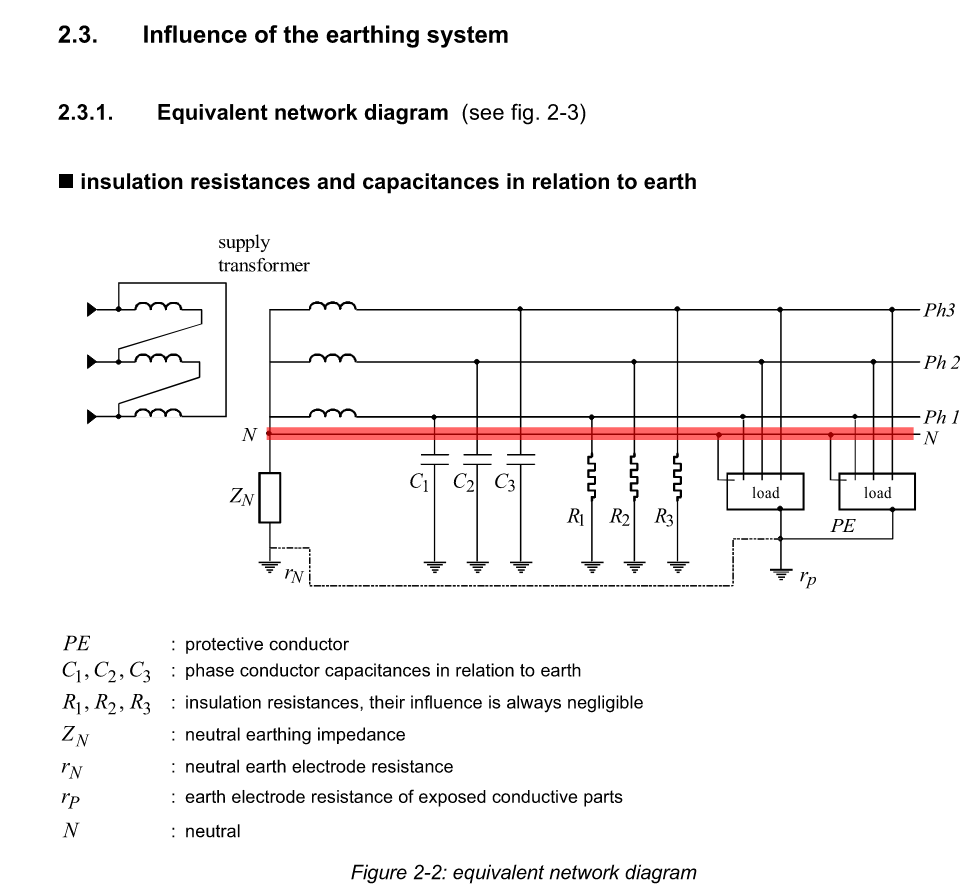
For High resistance earthed, LV systems, Can the neutral be used like this? Will there be any safety issues like increase voltage in the neutral?
What is the resistance of ZN?

What is the resistance of ZN?
"sufficiently high" according to BS 7671 (411.6.1) ... sufficient for what purpose seems less clear to me...
- Andy.

The earth fault current is limited to 1A, around 25ohms

The earth fault current is limited to 1A, around 25ohms
Ah, as I know only too well, the danger of doing sums in an open forum is that some smart!755 like me corrects you ;-)
Now, I reckon 230 V / 25 Ohm is closer to 'about' 10A To limit to 1A you'd need more like 230 ohms ;-)
(Much like the current limit for a hard fault on a single 4ft rod TT system typically an amp or three flows in in the electrodes ,and fuses never blow, just RCDs trip.)
I of course now am at risk of being corrected myself if I have misunderstood the intent of the answer.
Mike,

"sufficiently high" according to BS 7671 (411.6.1) ... sufficient for what purpose seems less clear to me...
The formula in 411.6.2 is the threshold criterion. This is explained in the 2nd paragraph of 411.6.1.
For systems that are fully IT, and you wish to control touch voltages, there is in effect a current limit - 10mA or less in the case of medical for example.
In a the more general case of a resistively earthed neutral but neither TN nor IT, this does not apply, and you need to look at both the ADS corner cases.
M.
For systems that are fully IT, and you wish to control touch voltages, there is in effect a current limit - 10mA or less in the case of medical for example.
Whoa a little 'apples and oranges' here ... for some very good reasons, the touch-voltage limits for Medical Locations and the Medical IT systems are half those addressed by the formula in 411.6.2 (see replacement formula Regulation 710.411.6.2 ... note that this Regulation also includes for DC touch-voltages).
The 'very good reasons' are the changes in anticipated contact with the body (perhaps the voltage might be directly applied to the human body, via medical electrical (ME) equipment or systems to BS EN 60601 series.
Also, BS 7671 does not limit touch-currents in IT systems, but sustained touch-voltages (this is specifically stated in 411.6.2). BS EN 60601 might look at touch-currents, but that's the product/system, not the installation.
For systems that are fully IT,
Apologies, I don't agree with this ... either the system is IT (it meets the criterion laid down in 411.6.2, or, if a medical IT system, the more onerous criterion of 710.411.6.2), or it is not !
Also, BS 7671 does not limit touch-currents in IT systems
This is fundamentally different to supplementary local protective bonding, which:
Also, BS 7671 does not limit touch-currents in IT systems
This is fundamentally different to supplementary local protective bonding, which:
We're about to take you to the IET registration website. Don't worry though, you'll be sent straight back to the community after completing the registration.
Continue to the IET registration site